


Two US troops were killed and three wounded by a mine detonated by remote control in Afghanistan's south-central province of Uruzgan, the US military said yesterday.
"We had five casualties, two killed in action and three injured in action," US military spokesman Scott Nelson told reporters, adding the troops were all US nationals.
They had been on a routine patrol Thursday in the Deh Rawood district in the south of the province when the mine was detonated as they passed by, he said.
A remote-controlled bomb also killed five people in the east of the violence-plagued country, an Afghan official said.
The five, who included a policeman, were killed in eastern Kunar province late Friday after the bomb exploded near a truck supplying food to US bases.
The truck had been stopped and set on fire by suspected loyalists of the ousted Taliban regime and the blast happened after a crowd had gathered, provincial governor Saeed Fazel Akbar Agha told reporters.
The explosion was on the main road in Dap area of Asmar district of Kunar province some 125km east of capital Kabul.
"The incident occurred after a truck supplying food to US bases in Kunar was stopped and set on fire by enemies of Afghanistan," the governor said.
"District police went to the site and villagers were there as well when the remote control bomb went off."
Meanwhile, vote counting in Afghanistan's landmark election resumed yesterday after a break for a religious holiday, with early results showing interim leader Hamid Karzai ahead in the vote for this country's first democratically elected president.
The count was put on hold for a day on Friday as Muslims marked the start of the fasting month of Ramadan.
Election spokeswoman Silvana Puizina said counting had resumed at 9am in the capital, Kabul, and in other counting centers across the country.
"We should see a full day's counting. It seems to be moving along quite nicely," she said.
Earlier, however, a preacher at Kabul's main mosque warned that Afghans won't stand for arrogance in whomever wins.
"If the president becomes too arrogant, we will cut him down. Isn't that right?" Mullah Obeid-ul Rahman said to hundreds of worshippers, drawing cries of "God is great!"
Karzai, who has led this predominantly Muslim country since the US-led forces ousted the Taliban regime in late 2001, is widely expected to win the Oct. 9 vote.
The UN-backed election, which cost about US$200 million to stage, has generated huge interest among Afghans, who are aching for peace after conflicts spanning the Soviet occupation of the 1980s, a murderous civil war in the early 1990s and then the Taliban's tyrannical rule.
Many see Karzai as a bridge to the country's international backers and a leader untainted by the fighting. But they are impatient for him to deliver on pledges to rebuild their impoverished country.
Of 35,986 valid votes tallied in six northern and central provinces during the first day of counting on Thursday, Karzai won 20,213, or 56.2 percent of the total, according to the official election Web site. If he keeps that up, he'll secure the simple majority needed to avoid a run-off vote with his closest rival.
Former Education Minister Yunus Qanooni, expected to be Karzai's closest challenger, was running at 17.2 percent, ahead of ethnic Uzbek warlord Abdul Rashid Dostum with 15 percent. No other candidate mustered more than 2.5 percent.
The tally represented only a tiny fraction of the estimated 8 million votes cast. Counting hasn't started yet in the Pashtun-dominated south, where Karzai is expected to make his strongest showing.
Final results are due at the end of October, although it should be clear who has won after about a week.
Counting had been delayed for five days while a panel of foreign experts probed allegations of electoral fraud, including multiple voting, ballot-box stuffing and voter intimidation. And on Friday, the 1,000 Afghan counting staff were off work to celebrate the start of Ramadan. Counting was to resume yesterday.
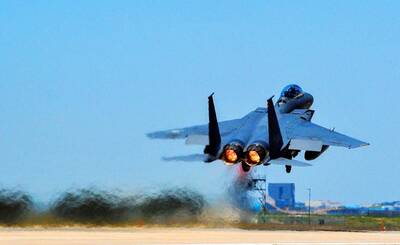
South Korea’s air force yesterday apologized for a 2021 midair collision involving two fighter jets, a day after auditors said the pilots were taking selfies and filming during the flight and held them responsible for the accident. “We sincerely apologize to the public for the concern caused by the accident that occurred in 2021,” an air force spokesman told a news conference, adding that one of the pilots involved had been suspended from flying duties, received severe disciplinary action and has since left the military. The apology followed a report released on Wednesday by the South Korean Board of Audit and Inspection,

Indonesian police have arrested 13 people after shocking images of alleged abuse against small children at a daycare center went viral, sparking outrage across the nation, officials said on Monday. Police on Friday last week raided Little Aresha, a daycare center in Yogyakarta on Java island, following a report from a former employee. CCTV footage circulating on social media showed children, most younger than two, lying on the floor wearing only diapers, their hands and feet bound with rags. The police have confirmed that the footage is authentic. Police said they also found 20 children crammed into a room just 3m by 3m. “So

About 240 Indians claiming descent from a Biblical tribe landed at Tel Aviv airport on Thursday as part of a government operation to relocate them to Israel. The newcomers passed under a balloon arch in blue and white, the colors of the Israeli flag, as dozens of well-wishers welcomed them with a traditional Jewish song. They were the first “bnei Menashe” (“sons of Manasseh”) to arrive in Israel since the government in November last year announced funding for the immigration of about 6,000 members of the community from the states of Manipur and Mizoram in northeast India. The community claims to descend from

‘TROUBLING’: The firing of Phelan, who was an adviser to a nonprofit that supported the defense of Taiwan, was another example of ‘dysfunction’ under Trump, a US senator said US Secretary of the Navy John Phelan has been fired, a US official and a person familiar with the matter said on Wednesday, in another wartime shakeup at the Pentagon coming just weeks after US Secretary of Defense Pete Hegseth ousted the Army’s top general. The Pentagon announced his departure in a brief statement, saying he was leaving the administration “effective immediately,” but it did not provide a reason or say whether it was his decision to go. The sources, who spoke on condition of anonymity, said Phelan was dismissed in part because he was moving too slowly to implement reforms to


 RSS
RSS