


The US government has admitted its network of border radiation detectors designed to prevent the smuggling of a "dirty bomb" could be fooled, in a conclusion that lends credence to charges voiced by Senator John Kerry during the presidential campaign.
The Department of Homeland Security said, in a report by its inspector general, that the performance of its detection equipment installed at ports and border crossings "is reduced by certain factors."
"The analysis described the distances beyond which the detection equipment would no longer detect the radiation source," Inspector General Clark Kent Ervin said in a thoroughly sanitized report, an unclassified version of which was released Thursday.
Specific findings about the system's flaws will remain secret to avoid tipping off potential terrorists, officials said.
The investigation was launched at the request of two high-level congressional Democrats, John Dingell of Michigan and Jim Turner of Texas, alarmed by recent media reports indicating that despite all efforts by the administration of US President George W. Bush to shore up border security, the nation's borders remain porous -- even to smuggled nuclear devices.
The outcry first erupted two years ago, when ABC News managed to successfully bring into the country nearly 7kg of depleted uranium in a suitcase.
The uranium, purchased in the former Soviet Union and stashed in a cylinder shielded with lead, was first brought by train to Austria, then shipped to Istanbul, Turkey, where it was loaded onto a US-bound cargo ship and successfully made it to its destination.
According to the report, the US Customs Service failed to detect the radioactive material despite the fact that the crate, in which it was traveling, was classified as a "high-risk" shipment.
The department did not explain the reasons for the failure, but pointed out that the uranium was placed in the middle of a large container filled with huge vases and Turkish horse carts.
The sting operation was repeated in August last year, when ABC News placed a similar uranium-filled cylinder into a teak trunk and sent it to the US from Jakarta, Indonesia, in a container full of furniture.
As it the first case, the uranium arrived undetected.
In a subdued tone, the report accepted the department's responsibility, saying "the protocols and procedures that ... officials followed, at the time of the two smuggling incidents, were not adequate to detect the depleted uranium."
The inspector general assured that technological and procedural improvements have since been made.
But Turner, the ranking member of the House homeland security committee, remained skeptical.
"It is hard to see how the government can reassure anyone based on the inspector general's report," he told the television network. "The sad state of affairs is that three years after 9/11 it still seems possible to get nuclear material into this country."
With homeland security topping this year's election agenda, Kerry, the Democratic presidential nominee, has repeatedly complained that nearly seven million cargo containers arrive in US ports each year, but only five percent of them are physically inspected.
"We will reduce the spread of nuclear and biological and chemical weapons and better guard our ports," the Massachusetts senator said in one of his stump speeches.

‘IN A DIFFERENT PLACE’: The envoy first visited Shanghai, where he attended a Chinese basketball playoff match, and is to meet top officials in Beijing tomorrow US Secretary of State Antony Blinken yesterday arrived in China on his second visit in a year as the US ramps up pressure on its rival over its support for Russia while also seeking to manage tensions with Beijing. The US diplomat tomorrow is to meet China’s top brass in Beijing, where he is also expected to plead for restraint as Taiwan inaugurates president-elect William Lai (賴清德), and to raise US concerns on Chinese trade practices. However, Blinken is also seeking to stabilize ties, with tensions between the world’s two largest economies easing since his previous visit in June last year. At the
Nearly half of China’s major cities are suffering “moderate to severe” levels of subsidence, putting millions of people at risk of flooding, especially as sea levels rise, according to a study of nationwide satellite data released yesterday. The authors of the paper, published by the journal Science, found that 45 percent of China’s urban land was sinking faster than 3mm per year, with 16 percent at more than 10mm per year, driven not only by declining water tables, but also the sheer weight of the built environment. With China’s urban population already in excess of 900 million people, “even a small portion

UNSETTLING IMAGES: The scene took place in front of TV crews covering the Trump trial, with a CNN anchor calling it an ‘emotional and unbelievably disturbing moment’ A man who doused himself in an accelerant and set himself on fire outside the courthouse where former US president Donald Trump is on trial has died, police said yesterday. The New York City Police Department (NYPD) said the man was declared dead by staff at an area hospital. The man was in Collect Pond Park at about 1:30pm on Friday when he took out pamphlets espousing conspiracy theories, tossed them around, then doused himself in an accelerant and set himself on fire, officials and witnesses said. A large number of police officers were nearby when it happened. Some officers and bystanders rushed
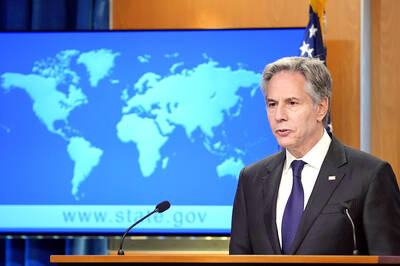
Beijing is continuing to commit genocide and crimes against humanity against Uyghurs and other Muslim minorities in its western Xinjiang province, U.S. Secretary of State Antony Blinken said in a report published on Monday, ahead of his planned visit to China this week. The State Department’s annual human rights report, which documents abuses recorded all over the world during the previous calendar year, repeated language from previous years on the treatment of Muslims in Xinjiang, but the publication raises the issue ahead of delicate talks, including on the war in Ukraine and global trade, between the top U.S. diplomat and Chinese


 RSS
RSS