


In beach shorts and black armbands, mourners met yesterday under blue Bali skies for an emotional ceremony to remember 202 people killed two years ago when bombs tore through the heart of Indonesia's resort island.
Clutching each other for support, survivors and friends and families of victims offered prayers, sang songs and observed 202 seconds of silence for those who died in the Oct. 12, 2002 attack by Islamic militants.
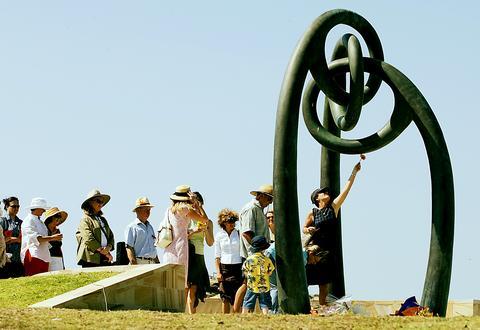
PHOTO: AP
"We are here to remember all of those who died or were injured here on this site on that awful day," Australia's ambassador to Indonesia David Ritchie said in a speech at a newly-completed monument bearing the names of the victims.
"The events of that day have become part of our own lives, they represent a loss of innocence, a tragedy for all of those who value peace, beauty and what is right."
Some 88 Australians were killed along with people from 21 other countries by the bombs planted by the al-Qaeda-linked Jemaah Islamiyah regional terrorist group in a deliberate attempt to target Western tourists.
As the ceremony got underway, widows and children of the Indonesian victims were joined by 120 Australian family members, friends of the dead and foreign officials laying wreaths in front of the bomb sites.
The monument to the dead, featuring a Balinese tree-like sculpture, a small fountain and the 22 flags of the victims' homelands, stands between the Sari Club and Paddy's Bar where the two bombs exploded.
Many survivors, still struggling to overcome the injuries and memories of the attack on Bali's Kuta tourist strip attended the ceremony, joining in a tearful rendition of Australia's unofficial national anthem Waltzing Matilda.
"It is good after two years, when I have had time to heal, to come back to something like this," said Andrew Csabi of Australia's Gold Coast, who lost a leg in the bombing.
"Next year I will have improved even more. Every day is a new challenge, but I'm getting better."
Australian survivor Mitch Ryan was with other members of his Southport Sharks football team mourning the loss of teammate Billy Hardy.
"It doesn't get any easier, it is still a real emotional time, but I have got great friends and family and everyone looks after each other," said Ryan, who was also injured in the blasts.
Another Australian Natalie Juniardi, who lost her Indonesian husband -- surf shop owner Juniardi -- said the event brought back difficult memories.
"On ceremonies and events like this, it is hard. It is hard every day, but life goes on with my two children," she said.
In Canberra, newly re-elected Prime Minister John Howard attended a church service to commemorate the bombing victims, while several hundred tourists turned out to witness yesterday's ceremony in Bali.
Although visitors are returning to the island, Bali is still struggling to pick up after the bombs, and subsequent attacks in Indonesia, hit its vital tourism industry.
The Bali attack, the worst in terms of human casualty since the Sept. 11, 2001 strikes, have been followed by a deadly blast at Jakarta's Marriott hotel in August last year and on the city's Australian embassy last month.
Security was tight for Tuesday's ceremony, with streets blocked off around the bomb site, a helicopter buzzing over head and six snipers positioned on rooftops around the bomb site.
Bali's police chief Inspector General I Made Mangku Pastika, who led operations to capture more than 30 people involved in the attack, said 1,000 officers had been deployed to guard the ceremony.
"Everybody thinks that, so we must prepare," he told reporters.
Pastika said the attacks were seen by Islamic militants as strike against the US.
"In their minds all white men are Americans, that is the problem," he said.

South Korea’s air force yesterday apologized for a 2021 midair collision involving two fighter jets, a day after auditors said the pilots were taking selfies and filming during the flight and held them responsible for the accident. “We sincerely apologize to the public for the concern caused by the accident that occurred in 2021,” an air force spokesman told a news conference, adding that one of the pilots involved had been suspended from flying duties, received severe disciplinary action and has since left the military. The apology followed a report released on Wednesday by the South Korean Board of Audit and Inspection,

Indonesian police have arrested 13 people after shocking images of alleged abuse against small children at a daycare center went viral, sparking outrage across the nation, officials said on Monday. Police on Friday last week raided Little Aresha, a daycare center in Yogyakarta on Java island, following a report from a former employee. CCTV footage circulating on social media showed children, most younger than two, lying on the floor wearing only diapers, their hands and feet bound with rags. The police have confirmed that the footage is authentic. Police said they also found 20 children crammed into a room just 3m by 3m. “So

About 240 Indians claiming descent from a Biblical tribe landed at Tel Aviv airport on Thursday as part of a government operation to relocate them to Israel. The newcomers passed under a balloon arch in blue and white, the colors of the Israeli flag, as dozens of well-wishers welcomed them with a traditional Jewish song. They were the first “bnei Menashe” (“sons of Manasseh”) to arrive in Israel since the government in November last year announced funding for the immigration of about 6,000 members of the community from the states of Manipur and Mizoram in northeast India. The community claims to descend from

‘TROUBLING’: The firing of Phelan, who was an adviser to a nonprofit that supported the defense of Taiwan, was another example of ‘dysfunction’ under Trump, a US senator said US Secretary of the Navy John Phelan has been fired, a US official and a person familiar with the matter said on Wednesday, in another wartime shakeup at the Pentagon coming just weeks after US Secretary of Defense Pete Hegseth ousted the Army’s top general. The Pentagon announced his departure in a brief statement, saying he was leaving the administration “effective immediately,” but it did not provide a reason or say whether it was his decision to go. The sources, who spoke on condition of anonymity, said Phelan was dismissed in part because he was moving too slowly to implement reforms to


 RSS
RSS