


The actions of the Central Intel-ligence Agency in keeping inmates at Abu Ghraib prison in Iraq off official rosters appeared to have been intended to speed their transfer to sites outside Iraq, where they would not be protected by the Geneva Conventions, the former commander of the joint interrogation center at the prison has told Army investigators.
The allegation by Lieutenant Colonel Steven Jordan in testimony in February was included in hundreds of pages of secret documents released on Friday by the Center for Public Integrity. Jordan said the approach had been authorized under an unwritten agreement between the CIA and Colonel Thomas Pappas, the top US military intelligence officer at the prison. The center said it had obtained the documents from a journalist, Osha Gray Davidson.
Two Army generals told Con-gress last month that at the CIA's request, Army jailers had failed to register dozens of detainees at Abu Ghraib in order to hide them from Red Cross inspectors. But Jordan said that the CIA's purpose had been to avoid anything that might have slowed moving them.
"They would not put them in the regular detainee process where you get fingerprinted, cause once a detainee did that, you're kinda in there three to six to eight months," Jordan said in his testimony at Camp Doha, Kuwait, on Feb. 21.
He went on to use an abbreviation for "other government agency," a term used in military circles to refer to the CIA: "The OGA folks wanted to be able to pull somebody in 24, 48, 72 hours if they had to get 'em to Gitmo, do what have you."
In the past, US officials have insisted that no prisoners from Iraq were ever transferred to the American detention center in Guantanamo Bay, Cuba, which is known as Gitmo. They have acknowledged two cases in which prisoners captured were transferred out of Iraq and then returned, but they have declined to comment on whether there might have been others.
The US has said all prisoners captured in Iraq were covered under the Geneva Conventions. Yet prisoners held by the US in Guantanamo and some other lockups, including those in Afghanistan and secret locations have not been granted the same protection.
A CIA spokesman and Jordan's lawyer declined comment on Jordan's remarks. Jordan, an Army reservist, is among the military intelligence officers identified by Army investigators as sharing in responsibility for abuses at Abu Ghraib.
An Army report by General Paul Kern and others criticized Pappas in particular for failing to challenge the CIA practice of keeping detainees off the books.
The documents made public by the Center for Public Integrity on Friday also included a classified memorandum written by an Army general in September 2003 recommending that guards at Abu Ghraib prison in Iraq be put under the authority of a senior military intelligence officer.
The document provides the clearest indication to date that the military police at Abu Ghraib were made subordinate to the new Joint Interrogation and Debriefing Center under Jordan. Both military police and military intelligence personnel have been accused of wrongdoing in connection with abuses at Abu Ghraib, which allegedly began shortly the new interrogation center was established.

‘IN A DIFFERENT PLACE’: The envoy first visited Shanghai, where he attended a Chinese basketball playoff match, and is to meet top officials in Beijing tomorrow US Secretary of State Antony Blinken yesterday arrived in China on his second visit in a year as the US ramps up pressure on its rival over its support for Russia while also seeking to manage tensions with Beijing. The US diplomat tomorrow is to meet China’s top brass in Beijing, where he is also expected to plead for restraint as Taiwan inaugurates president-elect William Lai (賴清德), and to raise US concerns on Chinese trade practices. However, Blinken is also seeking to stabilize ties, with tensions between the world’s two largest economies easing since his previous visit in June last year. At the

UNSETTLING IMAGES: The scene took place in front of TV crews covering the Trump trial, with a CNN anchor calling it an ‘emotional and unbelievably disturbing moment’ A man who doused himself in an accelerant and set himself on fire outside the courthouse where former US president Donald Trump is on trial has died, police said yesterday. The New York City Police Department (NYPD) said the man was declared dead by staff at an area hospital. The man was in Collect Pond Park at about 1:30pm on Friday when he took out pamphlets espousing conspiracy theories, tossed them around, then doused himself in an accelerant and set himself on fire, officials and witnesses said. A large number of police officers were nearby when it happened. Some officers and bystanders rushed

Beijing is continuing to commit genocide and crimes against humanity against Uyghurs and other Muslim minorities in its western Xinjiang province, U.S. Secretary of State Antony Blinken said in a report published on Monday, ahead of his planned visit to China this week. The State Department’s annual human rights report, which documents abuses recorded all over the world during the previous calendar year, repeated language from previous years on the treatment of Muslims in Xinjiang, but the publication raises the issue ahead of delicate talks, including on the war in Ukraine and global trade, between the top U.S. diplomat and Chinese
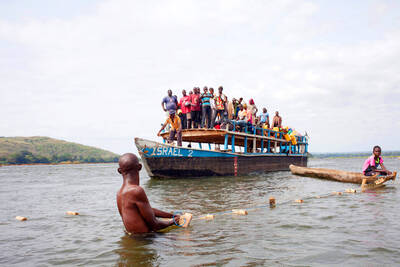
RIVER TRAGEDY: Local fishers and residents helped rescue people after the vessel capsized, while motorbike taxis evacuated some of the injured At least 58 people going to a funeral died after their overloaded river boat capsized in the Central African Republic’s (CAR) capital, Bangui, the head of civil protection said on Saturday. “We were able to extract 58 lifeless bodies,” Thomas Djimasse told Radio Guira. “We don’t know the total number of people who are underwater. According to witnesses and videos on social media, the wooden boat was carrying more than 300 people — some standing and others perched on wooden structures — when it sank on the Mpoko River on Friday. The vessel was heading to the funeral of a village chief in


 RSS
RSS