


The White House staunchly defended its Iraq policy on Tuesday as new questions emerged about US President George W. Bush's prewar decisions and postwar planning. An impending weapons report undercut the administration's main rationale for the war, and the former head of the US occupation said the US had too few troops in Iraq after the invasion.
Four weeks before the election, Democratic presidential candidate Senator John Kerry pounced on an acknowledgment by former Iraq administrator Paul Bremer on Monday that the US had "paid a big price" for insufficient troop levels.
Bremer, who shot into the national headlines with his remarks, softened his comments during a speech on Tuesday in Michigan.
"We certainly had enough [troops] going into Iraq, because we won the war in a very short three weeks," he told an audience of more than 400 people at Michigan State University.
"The point that I have been making, and that has gotten a little bit distorted in the press recently, is that, as I look back now, I believe it would have been better to stop the looting that was found right after the war.
"One way to have stopped the looting would have been to have more troops on the ground. That's a retrospective wisdom of mine, looking backwards," he added. "I think there are enough troops there now for the job we are doing."
Kerry said there was a "long list of mistakes" that the Bush administration had made in Iraq.
"I'm glad that Paul Bremer has finally admitted at least two of them," Kerry said, referring to postwar troop levels and a failure to contain chaos.
A 1,000-page report by the chief US weapons inspector in Iraq, Charles Duefler, concludes that former Iraqi president Saddam Hussein had less capacity to develop nuclear, chemical and biological weapons when the invasion occurred last year than it did in 1998, when UN weapons inspectors left, the Washington Post reported on its Web site on Tuesday night.
But the report, which was to be released yesterday, also includes comments Saddam made to debriefers after his capture supporting the administration's assertions, the Post said, quoting an unidentified senior US official. It cited a claim by Saddam that his past possession of weapons of mass destruction "was one of the reasons he had survived so long."
A US official said he could not confirm the report on Tuesday night.
At a campaign stop in Tipton, Iowa, Kerry said the question for voters was whether Bush was "constitutionally incapable of acknowledging the truth" or was "just so stubborn."
In a rare day spent in Washington, Bush remained out of sight and silent, letting his surrogates answer Kerry's charges. His speechwriters polished an address that administration aides said would be a sweeping indictment of Kerry's policies on Iraq, the war on terrorism and the economy.
"It's a comprehensive look at two very different records, one of accomplishment, and one of being on the wrong side of history over and over again," Bush campaign communications director Nicolle Devenish said of the speech.
The address in the swing state of Pennsylvania was originally to focus on healthcare, but the White House reversed course and made it about Iraq, seeking to blunt a new report on the absence of weapons of mass destruction there before the war.
Bremer, in a speech last month at DePauw University in Indiana, said he had raised with the Bush administration the issue of there being too few troops and "should have been even more insistent" when his advice was rejected.
White House spokesman Scott McClellan refused to say if Bremer had pleaded with Bush for more troops, saying, "We never get into reading out all the conversations they had."
Bush consulted military commanders -- not his hand-picked Iraq administrator -- for guidance on troop levels, McClellan said, adding, "The lessons from the past, including Vietnam, are that we shouldn't try to micromanage military decisions from Washington."
In unusual public acknowledgment of internal dissent, Bush campaign spokesman Brian Jones said Bremer and the military brass had clashed on troop levels.
"Ambassador Bremer differed with the commanders in the field," Jones said. "That is his right, but the president has always said that he will listen to his commanders on the ground and give them the support they need for victory."
Military commanders believed the force level was adequate, Pentagon spokesman Larry Di Rita said.
"Before, during and subsequent to Mr. Bremer's tenure, the military commanders and the Chairman of the Joint Chiefs of Staff believed that the level of US forces in Iraq was the appropriate level, and that was their recommendation to the secretary of defense," Di Rita said.
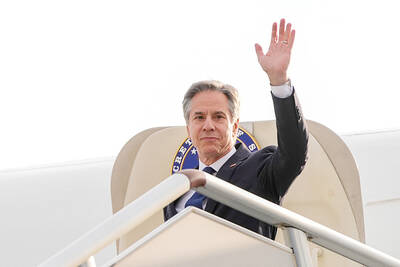
‘IN A DIFFERENT PLACE’: The envoy first visited Shanghai, where he attended a Chinese basketball playoff match, and is to meet top officials in Beijing tomorrow US Secretary of State Antony Blinken yesterday arrived in China on his second visit in a year as the US ramps up pressure on its rival over its support for Russia while also seeking to manage tensions with Beijing. The US diplomat tomorrow is to meet China’s top brass in Beijing, where he is also expected to plead for restraint as Taiwan inaugurates president-elect William Lai (賴清德), and to raise US concerns on Chinese trade practices. However, Blinken is also seeking to stabilize ties, with tensions between the world’s two largest economies easing since his previous visit in June last year. At the

UNSETTLING IMAGES: The scene took place in front of TV crews covering the Trump trial, with a CNN anchor calling it an ‘emotional and unbelievably disturbing moment’ A man who doused himself in an accelerant and set himself on fire outside the courthouse where former US president Donald Trump is on trial has died, police said yesterday. The New York City Police Department (NYPD) said the man was declared dead by staff at an area hospital. The man was in Collect Pond Park at about 1:30pm on Friday when he took out pamphlets espousing conspiracy theories, tossed them around, then doused himself in an accelerant and set himself on fire, officials and witnesses said. A large number of police officers were nearby when it happened. Some officers and bystanders rushed

Beijing is continuing to commit genocide and crimes against humanity against Uyghurs and other Muslim minorities in its western Xinjiang province, U.S. Secretary of State Antony Blinken said in a report published on Monday, ahead of his planned visit to China this week. The State Department’s annual human rights report, which documents abuses recorded all over the world during the previous calendar year, repeated language from previous years on the treatment of Muslims in Xinjiang, but the publication raises the issue ahead of delicate talks, including on the war in Ukraine and global trade, between the top U.S. diplomat and Chinese
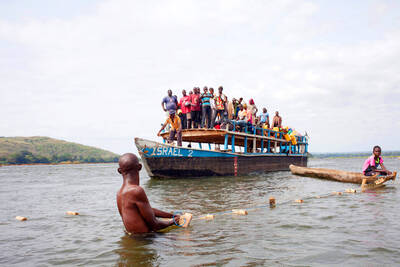
RIVER TRAGEDY: Local fishers and residents helped rescue people after the vessel capsized, while motorbike taxis evacuated some of the injured At least 58 people going to a funeral died after their overloaded river boat capsized in the Central African Republic’s (CAR) capital, Bangui, the head of civil protection said on Saturday. “We were able to extract 58 lifeless bodies,” Thomas Djimasse told Radio Guira. “We don’t know the total number of people who are underwater. According to witnesses and videos on social media, the wooden boat was carrying more than 300 people — some standing and others perched on wooden structures — when it sank on the Mpoko River on Friday. The vessel was heading to the funeral of a village chief in


 RSS
RSS