


Democratic Senator John Edwards and US Vice President Dick Cheney stretched the findings of US intelligence to their own ends in tangling over former Iraqi president Saddam Hussein's alleged ties to al-Qaeda.
Edwards said the connection between Saddam and the terrorist network was minimal or nonexistent; Cheney asserted Saddam's Iraq ``had an established relationship with al-Qaeda.''
Both statements Tuesday night mask what intelligence sources have said. The contacts were limited and sketchy, mostly Iraqi intelligence agents and al-Qaeda operatives, and did not amount to state sponsorship of al-Qaeda or any link to the Sept. 11 attacks, US intelligence officials have said.
But the recent Senate Intelligence Committee report on flawed Iraqi intelligence did conclude that the CIA had reasonably assessed there were likely several contacts between the Iraqis and al-Qaeda throughout the 1990s, although they did not add up to a formal relationship.
The exchange was typical of a night in which each accused the other of mangling facts and traded accusations at a faster pace than in the presidential debate last week.
"More attacks, more problematic facts," said Kathleen Hall Jamieson, director of the Annenberg Public Policy Center at the University of Pennsylvania, comparing this debate with the last. She said Edwards and Cheney had more of a chance to challenge each other on distorted claims than President George W. Bush and Democrat John Kerry did, but "still a lot of factual inaccuracies were left standing."
In perhaps the most awkward blooper of the evening, Cheney told Edwards to his face that they had never met before the debate, despite evidence they had.
Edwards' campaign later provided a transcript of a February 2001 prayer breakfast at which Cheney began his remarks by acknowledging the North Carolina senator. The campaign said the two also met when Edwards accompanied the other North Carolina senator, Elizabeth Dole, to her swearing-in ceremony.
Cheney was trying to make the point that Edwards was an absentee senator. "The first time I ever met you was when you walked on the stage tonight."
At one point, Edwards attacked Cheney for the administration's decision to give billions of dollars in new contracts to the vice president's former company, Halliburton. But congressional auditors recently reviewed those contracts and concluded US officials met legal guidelines in awarding the business without competition -- in part because Halliburton was the only company capable of doing some of the work.
He also asserted, "They sent 40,000 American troops into Iraq without the body armor they needed," a comment that might suggest they had no body armor at all, when in fact they did.
General Peter Pace, vice chairman of the Joint Chiefs, said 40,000 troops did not have the brand new, improved armor but, "every soldier and Marine on the ground ... had body armor."
Cheney accused Kerry of voting for taxes 98 times. That's down from the 350 times wrongly claimed by Republicans, but it's still a stretch. Those 98 votes include times when Kerry voted for lower taxes -- but not as low as Republicans wanted. And times when many procedural votes were cast on a single tax increase or package.
Whatever the relationship between al-Qaeda and Iraq over the years, another question touched on by the debaters was whether Saddam's Iraq had anything to do with the Sept. 11 attacks specifically. There is no evidence of that.
The vice president stated flatly that he has never suggested a connection between Iraq and Sept. 11.
But he did say in 2003 that if efforts to establish democracy in Iraq succeeded, "we will have struck a major blow right at the heart of the base, if you will, the geographic base of the terrorists who have had us under assault now for many years, but most especially on 9/11."
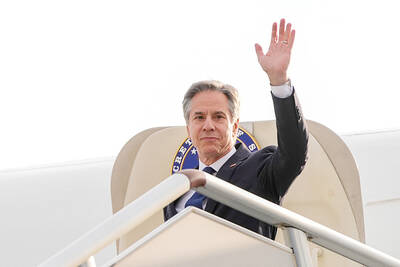
‘IN A DIFFERENT PLACE’: The envoy first visited Shanghai, where he attended a Chinese basketball playoff match, and is to meet top officials in Beijing tomorrow US Secretary of State Antony Blinken yesterday arrived in China on his second visit in a year as the US ramps up pressure on its rival over its support for Russia while also seeking to manage tensions with Beijing. The US diplomat tomorrow is to meet China’s top brass in Beijing, where he is also expected to plead for restraint as Taiwan inaugurates president-elect William Lai (賴清德), and to raise US concerns on Chinese trade practices. However, Blinken is also seeking to stabilize ties, with tensions between the world’s two largest economies easing since his previous visit in June last year. At the
Nearly half of China’s major cities are suffering “moderate to severe” levels of subsidence, putting millions of people at risk of flooding, especially as sea levels rise, according to a study of nationwide satellite data released yesterday. The authors of the paper, published by the journal Science, found that 45 percent of China’s urban land was sinking faster than 3mm per year, with 16 percent at more than 10mm per year, driven not only by declining water tables, but also the sheer weight of the built environment. With China’s urban population already in excess of 900 million people, “even a small portion

UNSETTLING IMAGES: The scene took place in front of TV crews covering the Trump trial, with a CNN anchor calling it an ‘emotional and unbelievably disturbing moment’ A man who doused himself in an accelerant and set himself on fire outside the courthouse where former US president Donald Trump is on trial has died, police said yesterday. The New York City Police Department (NYPD) said the man was declared dead by staff at an area hospital. The man was in Collect Pond Park at about 1:30pm on Friday when he took out pamphlets espousing conspiracy theories, tossed them around, then doused himself in an accelerant and set himself on fire, officials and witnesses said. A large number of police officers were nearby when it happened. Some officers and bystanders rushed

Beijing is continuing to commit genocide and crimes against humanity against Uyghurs and other Muslim minorities in its western Xinjiang province, U.S. Secretary of State Antony Blinken said in a report published on Monday, ahead of his planned visit to China this week. The State Department’s annual human rights report, which documents abuses recorded all over the world during the previous calendar year, repeated language from previous years on the treatment of Muslims in Xinjiang, but the publication raises the issue ahead of delicate talks, including on the war in Ukraine and global trade, between the top U.S. diplomat and Chinese


 RSS
RSS