


US Senator John Kerry used suspect accounting in sizing up the cost of the Iraq war and President George W. Bush got his opponent's position wrong on withdrawing troops as the two men rushed to knock each other down as many pegs as possible in their first debate.
Sometimes, one candidate had a chance to take on the wayward claim of the other, as when Bush suggested he went to war in Iraq because "the enemy attacked us" and Kerry pointed out Saddam Hussein did no such thing.
Often, wrongful assertions or oversimplifications went unanswered, as when Kerry attacked Bush for spending too little on protecting the country from terrorism and declared, "That's why they had to close down the subway in New York when the Republican convention was there."
The subway didn't close; some exits near the convention did.
"The format made it difficult for the candidates to rebut some distortions by their opponents," said Kathleen Hall Jamieson, director of the Annenberg Public Policy Center at the University of Pennsylvania. "Viewers should not assume that just because a fact was not rebutted it is true."
Bush, twice during Thursday's debate, suggested al-Qaeda is a vastly diminished terrorist force at the top, saying at one point that "75 percent of known al-Qaeda leaders have been brought to justice," and at another, Osama bin Laden is "isolated -- 75 percent of his people have been brought to justice."
But al-Qaeda is still considered a mortal danger in part because it refills its ranks and leadership. The president was actually referring to deaths or arrests of operatives who powered al-Qaeda when it mounted the Sept. 11, 2001, attacks, not those behind the organization today.
Earlier this year, the CIA estimated two-thirds of those leaders were gone. Bush upped the proportion to three-quarters in his Republican Party national convention speech, based on intelligence findings that were not publicly detailed.
Bush also misrepresented Kerry on withdrawing troops from Iraq: "My opponent at one time said, well, get me elected, I'll have them out of there in six months."
In fact, Kerry's position has been that he would hope to begin a withdrawal in six months, not complete it. His aim would be to finish the withdrawal in four years if conditions allowed.
Kerry stretched in accusing Bush of spending too little on homeland security and too much in giving tax cuts to the rich.
"This president thought it was more important to give the wealthiest people in America a tax cut rather than invest in homeland security," the senator said. "And long before President Bush and I get a tax cut -- and that's who gets it -- long before we do, I'm going to invest in homeland security."
Bush's tax cuts were across the board, not just for rich people like Kerry and himself. And much of the money Kerry wants to save by raising taxes on the rich is already spoken for; he'd use it for healthcare and middle-income tax relief.
Kerry, as he often does, said America has spent US$200 billion on the Iraq war.
An analysis by Annenberg's FactCheck.org found the true cost to be under US$120 billion so far, and that Kerry reaches his figure by counting money scheduled to be spent next year, money that hasn't been requested yet and money for Afghanistan operations and US cities.
Bush blasted Kerry for calling the Iraq invasion the wrong war at the wrong time and said foreign leaders would never follow a president who talked that way. But major US allies thought the war was wrong before it started.
Kerry may have taken the weight of probability a step too far by accusing Bush, in essence, of letting bin Laden get away.
"Unfortunately, he escaped in the mountains of Tora Bora," the Democrat said. "We had him surrounded. But we didn't use American forces, the best trained in the world, to go kill him. The president relied on Afghan warlords, and he outsourced that job, too."
There has been no definitive conclusion bin Laden was in the caves of Tora Bora in December 2001 when US and Afghan troops surrounded the complex.
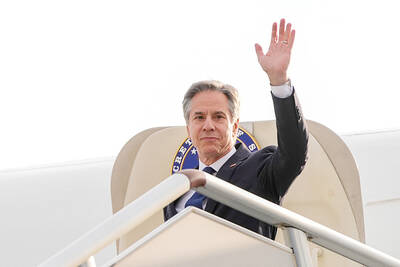
‘IN A DIFFERENT PLACE’: The envoy first visited Shanghai, where he attended a Chinese basketball playoff match, and is to meet top officials in Beijing tomorrow US Secretary of State Antony Blinken yesterday arrived in China on his second visit in a year as the US ramps up pressure on its rival over its support for Russia while also seeking to manage tensions with Beijing. The US diplomat tomorrow is to meet China’s top brass in Beijing, where he is also expected to plead for restraint as Taiwan inaugurates president-elect William Lai (賴清德), and to raise US concerns on Chinese trade practices. However, Blinken is also seeking to stabilize ties, with tensions between the world’s two largest economies easing since his previous visit in June last year. At the
Nearly half of China’s major cities are suffering “moderate to severe” levels of subsidence, putting millions of people at risk of flooding, especially as sea levels rise, according to a study of nationwide satellite data released yesterday. The authors of the paper, published by the journal Science, found that 45 percent of China’s urban land was sinking faster than 3mm per year, with 16 percent at more than 10mm per year, driven not only by declining water tables, but also the sheer weight of the built environment. With China’s urban population already in excess of 900 million people, “even a small portion

UNSETTLING IMAGES: The scene took place in front of TV crews covering the Trump trial, with a CNN anchor calling it an ‘emotional and unbelievably disturbing moment’ A man who doused himself in an accelerant and set himself on fire outside the courthouse where former US president Donald Trump is on trial has died, police said yesterday. The New York City Police Department (NYPD) said the man was declared dead by staff at an area hospital. The man was in Collect Pond Park at about 1:30pm on Friday when he took out pamphlets espousing conspiracy theories, tossed them around, then doused himself in an accelerant and set himself on fire, officials and witnesses said. A large number of police officers were nearby when it happened. Some officers and bystanders rushed
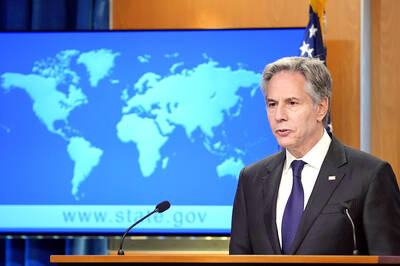
Beijing is continuing to commit genocide and crimes against humanity against Uyghurs and other Muslim minorities in its western Xinjiang province, U.S. Secretary of State Antony Blinken said in a report published on Monday, ahead of his planned visit to China this week. The State Department’s annual human rights report, which documents abuses recorded all over the world during the previous calendar year, repeated language from previous years on the treatment of Muslims in Xinjiang, but the publication raises the issue ahead of delicate talks, including on the war in Ukraine and global trade, between the top U.S. diplomat and Chinese


 RSS
RSS