


While Bruce Springsteen, Dave Matthews and other rock stars sing on a "Vote for Change" concert tour, another disgruntled group -- this one of scientists -- will crisscross the well-worn landscape of battleground states over the next month, giving lectures that will argue that the Bush administration has ignored and misused science.
The group, Scientists and Engineers for Change, another addition to the flood of so-called 527 advocacy groups that have filled this year's election discourse, announced its existence and plans on Monday in a telephone news conference. At least 25 scientists will give talks in 10 contested states.
Among the headlining lecturers are 10 Nobel Prize winners, including Douglas Osheroff, a professor of physics at Stanford; Peter Agre, a professor of biological chemistry at Johns Hopkins and Harold Varmus, former director of the National Institutes of Health.
Compared with more prominent 527s, like MoveOn PAC and Swift Boat Veterans for Truth, the scientists' group will operate on a modest budget of US$100,000, which will mainly pay for travel expenses.
The group has no direct ties to the campaign of Senator John Kerry but nine members were among 48 Nobel laureates who signed a June 21 letter endorsing Kerry. Several of the scientists have also signed a statement from the Union of Concerned Scientists that accuses the Bush administration of manipulating scientific findings to support its policies. The union opposes the administration on numerous issues.
At the conference, Vinton Cerf, one of the architects of the Internet in the 1960s and 1970s and chairman of the Internet Corp for Assigned Names and Numbers, said, "Science counts, and it has not counted sufficiently in this administration."
Cerf said that he was a registered Republican, but that he joined the group "in the hope that we bring debate, science and technology, into the political debate so that the electorate understands the importance that it has in our society."
Cerf said the US was "at risk of losing the edge" in technology because the Bush administration was cutting basic research budgets at the Department of Defense, the National Science Foundation and the National Institute of Standards and Technology.

‘IN A DIFFERENT PLACE’: The envoy first visited Shanghai, where he attended a Chinese basketball playoff match, and is to meet top officials in Beijing tomorrow US Secretary of State Antony Blinken yesterday arrived in China on his second visit in a year as the US ramps up pressure on its rival over its support for Russia while also seeking to manage tensions with Beijing. The US diplomat tomorrow is to meet China’s top brass in Beijing, where he is also expected to plead for restraint as Taiwan inaugurates president-elect William Lai (賴清德), and to raise US concerns on Chinese trade practices. However, Blinken is also seeking to stabilize ties, with tensions between the world’s two largest economies easing since his previous visit in June last year. At the
Nearly half of China’s major cities are suffering “moderate to severe” levels of subsidence, putting millions of people at risk of flooding, especially as sea levels rise, according to a study of nationwide satellite data released yesterday. The authors of the paper, published by the journal Science, found that 45 percent of China’s urban land was sinking faster than 3mm per year, with 16 percent at more than 10mm per year, driven not only by declining water tables, but also the sheer weight of the built environment. With China’s urban population already in excess of 900 million people, “even a small portion

UNSETTLING IMAGES: The scene took place in front of TV crews covering the Trump trial, with a CNN anchor calling it an ‘emotional and unbelievably disturbing moment’ A man who doused himself in an accelerant and set himself on fire outside the courthouse where former US president Donald Trump is on trial has died, police said yesterday. The New York City Police Department (NYPD) said the man was declared dead by staff at an area hospital. The man was in Collect Pond Park at about 1:30pm on Friday when he took out pamphlets espousing conspiracy theories, tossed them around, then doused himself in an accelerant and set himself on fire, officials and witnesses said. A large number of police officers were nearby when it happened. Some officers and bystanders rushed
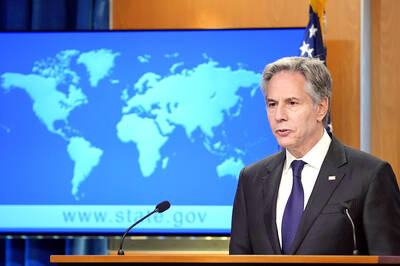
Beijing is continuing to commit genocide and crimes against humanity against Uyghurs and other Muslim minorities in its western Xinjiang province, U.S. Secretary of State Antony Blinken said in a report published on Monday, ahead of his planned visit to China this week. The State Department’s annual human rights report, which documents abuses recorded all over the world during the previous calendar year, repeated language from previous years on the treatment of Muslims in Xinjiang, but the publication raises the issue ahead of delicate talks, including on the war in Ukraine and global trade, between the top U.S. diplomat and Chinese


 RSS
RSS