


In a remarkable appearance, the commander of US forces in Baghdad stood before a roomful of Arab and Western reporters on Wednesday, trying to explain the confusing events that led to the deaths of Iraqi civilians at the hands of his men.
Americans do not often do such things, but the deaths of 13 Iraqis, including a young girl and a television cameraman, whose last moments have been replayed across televisions in the Middle East, prompted the commander, Major General Peter Chiarelli, to try to explain how such a lamentable thing had come to pass.
The answer, the said, lay in the grim necessities of the fight, a duel between Iraqi insurgents who had crippled a Bradley armored vehicle and two US helicopters. Mixed in with the insurgents were a number of civilians. The helicopters loosed their rockets only after they had taken fire themselves, Chiarelli said, from somewhere in the crowd.
"We wanted to explain, particularly to the Iraqi people, that we do everything we can to eliminate collateral damage," Chiarelli said, in a conference room inside the US headquarters known as Camp Victory. Then he turned to the subject of the Iraqi civilians who had been killed Sunday.
Yet although Chiarelli said he was saddened by the deaths of innocent Iraqis, he firmly defended the actions of his men.
"The actions of our soldiers and pilots were well within their rights," he said.
The appearance of Chiarelli and his deputy, Colonel Jim McConville, stemmed in part from the televised death of Mazen Tomeizi, a Palestinian producer for Al Arabiya Television. Tomeizi was killed while standing in front of the burning Bradley.
He died on the air.
Film broadcast on Al-Arabiya showed a crowd of mostly young men and boys around the Bradley, but showed no evidence that anyone was either armed or fighting. The film shows an explosion, and Tomeizi going down. Blood splatters on the camera lens.
Yet if Chiarelli was trying to mollify Iraqi opinion with his appearance, the skepticism expressed by the Arabic-speaking journalists suggested he still had some way to go.
"Why don't you use small weapons, rather than missiles?" asked an Arabic-speaking reporter. "We know an innocent Iraqi was killed. Why not just disperse the crowd?"
"As you say, the pilot was so sweet," another Arab-speaking journalist said, referring to a member of the American helicopter crew. "But you didn't mention anything about the journalist who was there."
The most bitter words came, not surprisingly, from a reporter at Al-Arabiya, who told the Americans that they had blasted the Bradley and killed those around it even though, as the tape showed, no one near it was firing a gun.
"The tape does not show any shots coming from the tank," said the reporter, Hadeer al-Rubaie. "We have the tape. We have proof."
"Your soldiers do not have any discipline," Rubaie said. "Why don't you go out of the cities, and face the terrorists somewhere else?"
Chiarelli and McConville addressed those questions in some detail, if not to the satisfaction of everyone present. By so doing, they spelled out the challenges faced by US soldiers in Iraq as they try to carry on in densely populated areas where civilians and insurgents are often impossible to tell apart.
The helicopter strikes against the insurgents on Sunday were the most restrained means available, the officers said. The Americans had wanted to use ground troops to retrieve the Bradley, but six of their soldiers had already been wounded.
The helicopters could have fired their rockets from three or four miles away, McConville said, which would have been much safer for the pilots. They moved in close, putting themselves in greater danger, to try to avoid Iraqi civilians.
When the helicopters passed over the battle site, McConville said, the pilots took fire from the "vicinity" of the Bradley and fired four rockets. One hit the Bradley.
Still, for all of the discussion about hostile fire, the US officers suggested that there might have been a second motive for shooting the Bradley: to ensure that no one was able to steal the vehicle's communications equipment.
American officers attending the news conference suggested that the helicopter pilots might have fired at the Bradley not because of hostile fire, but because they feared that the young men who had clambered on top of it might have been trying to strip it of its equipment.
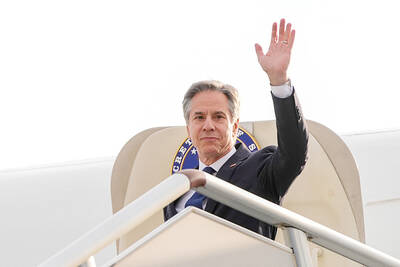
‘IN A DIFFERENT PLACE’: The envoy first visited Shanghai, where he attended a Chinese basketball playoff match, and is to meet top officials in Beijing tomorrow US Secretary of State Antony Blinken yesterday arrived in China on his second visit in a year as the US ramps up pressure on its rival over its support for Russia while also seeking to manage tensions with Beijing. The US diplomat tomorrow is to meet China’s top brass in Beijing, where he is also expected to plead for restraint as Taiwan inaugurates president-elect William Lai (賴清德), and to raise US concerns on Chinese trade practices. However, Blinken is also seeking to stabilize ties, with tensions between the world’s two largest economies easing since his previous visit in June last year. At the
Nearly half of China’s major cities are suffering “moderate to severe” levels of subsidence, putting millions of people at risk of flooding, especially as sea levels rise, according to a study of nationwide satellite data released yesterday. The authors of the paper, published by the journal Science, found that 45 percent of China’s urban land was sinking faster than 3mm per year, with 16 percent at more than 10mm per year, driven not only by declining water tables, but also the sheer weight of the built environment. With China’s urban population already in excess of 900 million people, “even a small portion

UNSETTLING IMAGES: The scene took place in front of TV crews covering the Trump trial, with a CNN anchor calling it an ‘emotional and unbelievably disturbing moment’ A man who doused himself in an accelerant and set himself on fire outside the courthouse where former US president Donald Trump is on trial has died, police said yesterday. The New York City Police Department (NYPD) said the man was declared dead by staff at an area hospital. The man was in Collect Pond Park at about 1:30pm on Friday when he took out pamphlets espousing conspiracy theories, tossed them around, then doused himself in an accelerant and set himself on fire, officials and witnesses said. A large number of police officers were nearby when it happened. Some officers and bystanders rushed

Beijing is continuing to commit genocide and crimes against humanity against Uyghurs and other Muslim minorities in its western Xinjiang province, U.S. Secretary of State Antony Blinken said in a report published on Monday, ahead of his planned visit to China this week. The State Department’s annual human rights report, which documents abuses recorded all over the world during the previous calendar year, repeated language from previous years on the treatment of Muslims in Xinjiang, but the publication raises the issue ahead of delicate talks, including on the war in Ukraine and global trade, between the top U.S. diplomat and Chinese


 RSS
RSS