


South Korea yesterday admitted that its scientists extracted a small amount of plutonium, a key ingredient for making nuclear bombs, in secret research in the early 1980s.
The admission comes just one week after the country made startling revelations that it had conducted unauthorized experiments to enrich uranium, also used to build nuclear weapons.
A government official said a recent visit by inspectors from the International Atomic Energy Agency (IAEA) to a South Korean government-run nuclear research center was linked to the previously undisclosed research on plutonium.
"We have been in consultation with the IAEA over the inspection of our nuclear research activity [based on plutonium] in the early 1980s," said the government official.
South Korea admitted last week that the same research center conducted unauthorized tests to enrich uranium four years ago.
The plutonium research was conducted at a now-defunct "TRIGA-type" research reactor at the Korea Atomic Energy Research Institute, at the time located in a northern Seoul suburb, the official said.
"A small number of scientists were engaged in the experiment to analyze the chemical properties of plutonium, but there have been no records on their research or on how much plutonium was extracted," the Ministry of Science and Technology said in a statement.
"An investigation showed that a miniscule amount of plutonium was extracted in April and May 1982," the statement added.
The statement said that Seoul filed a report to the IAEA in September 1983, concerning nuclear material that had gone missing. It added that equipment used for the test was later scrapped but is still in the possession of the research institute.
South Korean officials said the experiment did not violate Seoul's commitments under the nuclear Non-Proliferation Treaty, which seeks to prevent the use of nuclear technology for military purposes.
Seoul last week admitted that its scientists four years ago had carried out an unauthorized experiment at the state-run research center in Daejon, south of Seoul, to enrich uranium. It denied the research was linked to a weapons program.
An IAEA team investigated South Korea's nuclear activities last week and its findings will be discussed at a four-day board meeting of the nuclear watchdog next week.
The clandestine activity embarrassed both the US and its ally South Korea at a time when they are trying through six-party talks to pressure communist North Korea to end its nuclear weapons drive.
South Korean officials insist that the country has no interest in acquiring atomic bombs. Seoul abandoned any such ambitions in the 1970s, they say, after Washington persuaded then-military dictator Park Chung-hee to give up his nuclear weapons program.
However North Korea, res-ponding to the uranium enrichment revelations, said on Wednesday that the South's nuclear activities could trigger an arms race in the region.
"We view South Korea's uranium enrichment program as part of armament race in the Northeast Asian region," Han Song-ryol, deputy chief of North Korea's mission to the UN, told the Yonhap News Agency.
"It will be difficult to prevent the spread of armament race in the region due to the South's nuclear experiment," Han said.
The latest revelation comes amid efforts to convene a fourth round of six-nation talks before the end of the month. The talks are aimed at persuading Pyongyang to give up its nuclear ambitions.
Three rounds, involving China, the two Koreas, Japan, Russia and the US, have taken place in Bei-jing since Washington in October 2002 accused Pyongyang of running a secret uranium enrichment program.
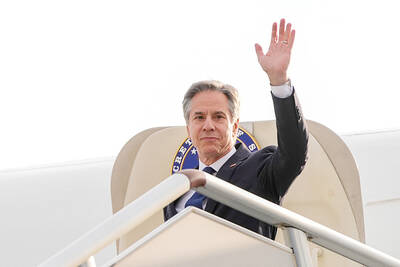
‘IN A DIFFERENT PLACE’: The envoy first visited Shanghai, where he attended a Chinese basketball playoff match, and is to meet top officials in Beijing tomorrow US Secretary of State Antony Blinken yesterday arrived in China on his second visit in a year as the US ramps up pressure on its rival over its support for Russia while also seeking to manage tensions with Beijing. The US diplomat tomorrow is to meet China’s top brass in Beijing, where he is also expected to plead for restraint as Taiwan inaugurates president-elect William Lai (賴清德), and to raise US concerns on Chinese trade practices. However, Blinken is also seeking to stabilize ties, with tensions between the world’s two largest economies easing since his previous visit in June last year. At the

UNSETTLING IMAGES: The scene took place in front of TV crews covering the Trump trial, with a CNN anchor calling it an ‘emotional and unbelievably disturbing moment’ A man who doused himself in an accelerant and set himself on fire outside the courthouse where former US president Donald Trump is on trial has died, police said yesterday. The New York City Police Department (NYPD) said the man was declared dead by staff at an area hospital. The man was in Collect Pond Park at about 1:30pm on Friday when he took out pamphlets espousing conspiracy theories, tossed them around, then doused himself in an accelerant and set himself on fire, officials and witnesses said. A large number of police officers were nearby when it happened. Some officers and bystanders rushed
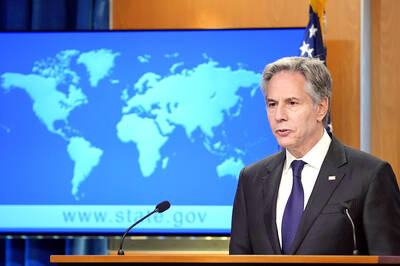
Beijing is continuing to commit genocide and crimes against humanity against Uyghurs and other Muslim minorities in its western Xinjiang province, U.S. Secretary of State Antony Blinken said in a report published on Monday, ahead of his planned visit to China this week. The State Department’s annual human rights report, which documents abuses recorded all over the world during the previous calendar year, repeated language from previous years on the treatment of Muslims in Xinjiang, but the publication raises the issue ahead of delicate talks, including on the war in Ukraine and global trade, between the top U.S. diplomat and Chinese
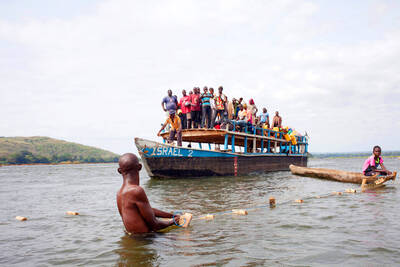
RIVER TRAGEDY: Local fishers and residents helped rescue people after the vessel capsized, while motorbike taxis evacuated some of the injured At least 58 people going to a funeral died after their overloaded river boat capsized in the Central African Republic’s (CAR) capital, Bangui, the head of civil protection said on Saturday. “We were able to extract 58 lifeless bodies,” Thomas Djimasse told Radio Guira. “We don’t know the total number of people who are underwater. According to witnesses and videos on social media, the wooden boat was carrying more than 300 people — some standing and others perched on wooden structures — when it sank on the Mpoko River on Friday. The vessel was heading to the funeral of a village chief in


 RSS
RSS