


Venezuela's chronically corrupt and inefficient justice system has come under renewed criticism since Linda Loaiza stopped eating over a week ago.
Staging a hunger strike on the steps of Venezuela's Supreme Tribunal, Loaiza quietly protests delays in court proceedings that could allow a suspect accused of raping and brutally torturing her to be released without a trial.
Flowers, burning candles, handwritten prayers and images of the Virgin Mary brought by sympathizers surround her mattress outside the country's highest court.
"Hunger for justice is stronger than hunger" for food, said Loaiza, a fragile 21-year-old from a poor family.
Loaiza's protest highlights the failure of Venezuela's courts to efficiently administer justice: her case against Luis Carrera Almoin has been deferred 29 times and passed through the hands of 59 judges since it was filed in 2001.
Under Venezuela's penal code, suspects cannot remain in custody if they have not gone to trial within three years of the moment criminal charges were filed against them.
If Carrera Almoin -- who is accused of attempted homicide, rape and kidnapping -- does not go to trial this month, he would be eligible for release.
"If there is anything that shows that the administration of justice in Venezuela continues to be as rotten as ever ... it's the case of this unfortunate young woman," stated an editorial in the Tal Cual daily.
Roughly half the inmates in Venezuela's 32 overcrowded prisons are awaiting trials. Some wait for weeks or months, others linger behind bars for years without seeing a judge. Dozens die yearly during bloody riots in which inmates demand prompt trials.
Government critics argue sluggishness within the court system demonstrates the failure of a far-reaching judicial reform pushed through by President Hugo Chavez in 1999, when hundreds of judges were fired by an assembly stacked with the president's allies. Many were replaced by "provisional" judges eager to keep their jobs.
Chavez and his allies in Venezuela's legislature, which is dominated by the ruling party, approved legislation in May permitting a new reform. Pro-Chavez lawmakers argue the law was necessary because the first reform fell short of its goal: total transformation of the judiciary.
The law increases the number of justices on the Supreme Tribunal to 32 from 20 and allows the unicameral National Assembly in some cases to elect or sack justices by a simple majority vote, rather than a two-thirds vote as in the past. The ruling party used the law in June to remove a justice considered by Chavez supporters to be sided with the opposition.
New York-based Human Rights Watch has criticized the law for violating the independence of Venezuela's judicial branch and urged the Organization of American States to intervene if the removal of the justice is not rescinded.
Opposition leaders claim the process is aimed at stacking the court with government-friendly justices rather than improving a deficient system.
While political rivals debate ways to speed up a system that moves at a snail's pace, Loaiza awaits justice as saline solution slowly drips into her veins.
"I know that, with help from God, I will be able to get through this," she said.

‘IN A DIFFERENT PLACE’: The envoy first visited Shanghai, where he attended a Chinese basketball playoff match, and is to meet top officials in Beijing tomorrow US Secretary of State Antony Blinken yesterday arrived in China on his second visit in a year as the US ramps up pressure on its rival over its support for Russia while also seeking to manage tensions with Beijing. The US diplomat tomorrow is to meet China’s top brass in Beijing, where he is also expected to plead for restraint as Taiwan inaugurates president-elect William Lai (賴清德), and to raise US concerns on Chinese trade practices. However, Blinken is also seeking to stabilize ties, with tensions between the world’s two largest economies easing since his previous visit in June last year. At the
Nearly half of China’s major cities are suffering “moderate to severe” levels of subsidence, putting millions of people at risk of flooding, especially as sea levels rise, according to a study of nationwide satellite data released yesterday. The authors of the paper, published by the journal Science, found that 45 percent of China’s urban land was sinking faster than 3mm per year, with 16 percent at more than 10mm per year, driven not only by declining water tables, but also the sheer weight of the built environment. With China’s urban population already in excess of 900 million people, “even a small portion

UNSETTLING IMAGES: The scene took place in front of TV crews covering the Trump trial, with a CNN anchor calling it an ‘emotional and unbelievably disturbing moment’ A man who doused himself in an accelerant and set himself on fire outside the courthouse where former US president Donald Trump is on trial has died, police said yesterday. The New York City Police Department (NYPD) said the man was declared dead by staff at an area hospital. The man was in Collect Pond Park at about 1:30pm on Friday when he took out pamphlets espousing conspiracy theories, tossed them around, then doused himself in an accelerant and set himself on fire, officials and witnesses said. A large number of police officers were nearby when it happened. Some officers and bystanders rushed
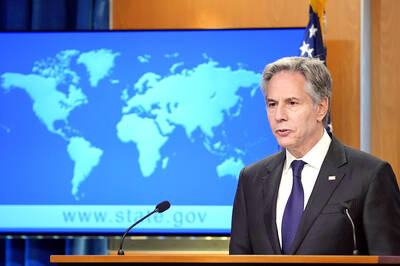
Beijing is continuing to commit genocide and crimes against humanity against Uyghurs and other Muslim minorities in its western Xinjiang province, U.S. Secretary of State Antony Blinken said in a report published on Monday, ahead of his planned visit to China this week. The State Department’s annual human rights report, which documents abuses recorded all over the world during the previous calendar year, repeated language from previous years on the treatment of Muslims in Xinjiang, but the publication raises the issue ahead of delicate talks, including on the war in Ukraine and global trade, between the top U.S. diplomat and Chinese


 RSS
RSS