


The most obvious tip-off that the four men had lethal intent was the 15kg of explosives police found in their possession. Eventually they were convicted of plotting to assassinate a head of state.
To some, it looked like a clear case of international terrorism. To others, the four were freedom fighters trying to liberate their homeland.
The scene of the attempt was Panama in November 2000. The perpetrators were four Cuban exiles. Their target, prosecutors said, was Cuban President Fidel Castro, who was due in Panama to attend a summit conference.
Debate over the case has resurfaced with the decision of Panamanian President Mireya Moscoso last week to pardon the four.
Among some Cuban-Americans in Miami there was jubilation. The Cuban government was furious. The US State Department declined to criticize Moscoso's action.
"This was a decision made by the government of Panama," state department deputy spokesman Adam Ereli said. "We never lobbied the Panamanian government to pardon anyone involved in this case, and I'd leave it to the government of Panama to discuss the action."
Representative William Delahunt, a Massachusetts Democrat, said he was stunned to learn of the pardon, adding that the state department loses credibility in refusing to voice outrage over the release of people he says are ``assassins, ... terrorists.''
Moscoso announced the pardon six days before the end of her term as president. President-elect Martin Torrijos was taking the oath of office yesterday in the presence of US Secretary of State Colin Powell and other foreign dignitaries.
The state department response may have been influenced by election-year politics, particularly the administration's interest in keeping the Cuban-American vote in President George W. Bush's column this November, much as it was in 2000.
Cuba has long complained about what it sees as a US double standard on terrorism. It insists the US harbors countless criminals from the pre-Castro military regime. It also alleges the US has done nothing to stop Florida-based anti-Castro groups from launching armed attacks on the island.
In response, the US maintains that Cuba supports groups on the US list of foreign terrorist organizations and provides a haven for numerous fugitives from US justice. Cuba is one of seven countries on the US list of state sponsors of terrorism.
Moscoso said she decided on the pardon for humanitarian reasons, claiming she was fearful her successor would extradite the men to Cuba, where they would await a firing squad.
The circumstances of the pardon suggest close cooperation between the Panamanian government and wealthy Cuban-Americans in South Florida, one of whom chartered two small planes that picked up three of the exiles shortly after their release.
The fourth was Luis Posada Cariles, whom Castro has described as "the worst terrorist in the hemisphere." He is believed to be in Honduras.
Posada left Cuba after the 1959 revolution and has spent much of his life seeking Castro's ouster. He trained for the CIA-organized Bay of Pigs invasion in 1961, though his group did not reach shore.
He is wanted by Venezuelan authorities for the 1976 bombing of a Cuban civilian jetliner that had taken off from Caracas. All 73 aboard were killed.
Posada and his colleagues say they were in Panama to help a Cuban official defect. They say they were framed by Cuban agents.
Many in South Florida see the four as heroes. Shortly after the convictions last April, more than 400 people turned up at a US$100-a-plate fund-raiser in Miami to help cover the costs of an appeal. Their sentences ranged from seven to eight years.
With the pardon, no appeal was needed, and there were hugs and handshakes last Thursday as a welcoming crowd greeted the three exiles at Opa-locka Airport in Miami.
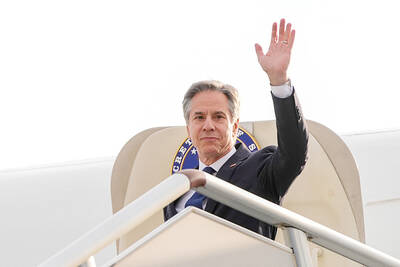
‘IN A DIFFERENT PLACE’: The envoy first visited Shanghai, where he attended a Chinese basketball playoff match, and is to meet top officials in Beijing tomorrow US Secretary of State Antony Blinken yesterday arrived in China on his second visit in a year as the US ramps up pressure on its rival over its support for Russia while also seeking to manage tensions with Beijing. The US diplomat tomorrow is to meet China’s top brass in Beijing, where he is also expected to plead for restraint as Taiwan inaugurates president-elect William Lai (賴清德), and to raise US concerns on Chinese trade practices. However, Blinken is also seeking to stabilize ties, with tensions between the world’s two largest economies easing since his previous visit in June last year. At the

UNSETTLING IMAGES: The scene took place in front of TV crews covering the Trump trial, with a CNN anchor calling it an ‘emotional and unbelievably disturbing moment’ A man who doused himself in an accelerant and set himself on fire outside the courthouse where former US president Donald Trump is on trial has died, police said yesterday. The New York City Police Department (NYPD) said the man was declared dead by staff at an area hospital. The man was in Collect Pond Park at about 1:30pm on Friday when he took out pamphlets espousing conspiracy theories, tossed them around, then doused himself in an accelerant and set himself on fire, officials and witnesses said. A large number of police officers were nearby when it happened. Some officers and bystanders rushed
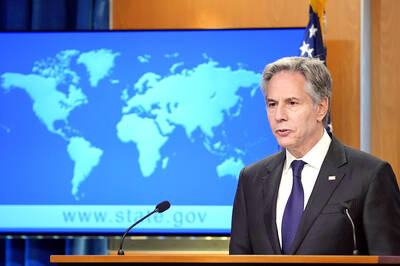
Beijing is continuing to commit genocide and crimes against humanity against Uyghurs and other Muslim minorities in its western Xinjiang province, U.S. Secretary of State Antony Blinken said in a report published on Monday, ahead of his planned visit to China this week. The State Department’s annual human rights report, which documents abuses recorded all over the world during the previous calendar year, repeated language from previous years on the treatment of Muslims in Xinjiang, but the publication raises the issue ahead of delicate talks, including on the war in Ukraine and global trade, between the top U.S. diplomat and Chinese
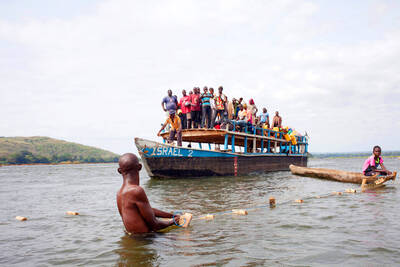
RIVER TRAGEDY: Local fishers and residents helped rescue people after the vessel capsized, while motorbike taxis evacuated some of the injured At least 58 people going to a funeral died after their overloaded river boat capsized in the Central African Republic’s (CAR) capital, Bangui, the head of civil protection said on Saturday. “We were able to extract 58 lifeless bodies,” Thomas Djimasse told Radio Guira. “We don’t know the total number of people who are underwater. According to witnesses and videos on social media, the wooden boat was carrying more than 300 people — some standing and others perched on wooden structures — when it sank on the Mpoko River on Friday. The vessel was heading to the funeral of a village chief in


 RSS
RSS