


Clad in blue nylon safety harnesses, students scramble up the Tibet Guide School's climbing rock, moving quickly and smoothly from one handhold to the next on the six-story-high concrete slab.
"Hoi!" shouts one as he nears the top of the ochre-and-slate-colored structure in the front yard of the facility. Others, in T-shirts, fleece jackets, jeans and shorts, are grinning from below, kicking at the gravel with their climbing shoes.
The school is an unusual development effort, training Tibetan children from poor families to work as guides on the fabled Mount Everest and other Himalayan peaks that draw thousands of climbers from around the world every year.
Tibet is one of China's poorest areas, but has some of the globe's most challenging summits and spectacular scenery -- assets that communist authorities are trying to harness in order to develop the region.
"The children of peasants and herdsmen can train here and get a job later," said Zhang Minxing, general secretary of the China Tibet Mountaineering Association, which founded the school in 1999. He said it is the first of its kind in the country. Graduates get jobs at the school's Himalaya Expedition Co Ltd., which serves climbers who hope to conquer the 8,848-meter summit of Everest via its northern slope in Tibet.
In addition to the 40 students who have already graduated, 30 more are enrolled -- a total that includes eight women, Zhang said. Most are in their late teens.
"I've been climbing since I was a child," said Awang, a deeply tanned 23-year-old graduate from the small village of Nilang, near Tibet's border with Nepal, who has scaled Everest three times. "It's great that this school can help our people."
The aim is to even out the economic disparity that critics say has allowed China's dominant Han ethnic group to secure the best jobs, while ethnic Tibetans have been left behind. "This will help improve the incomes of the local people," Zhang said.
Even so, he said the school -- which has received 7 million yuan (US$875,000) from Beijing -- plans to expand to let enthusiasts from outside Tibet study climbing once its facilities are big enough.
The students live in the compound of pastel-colored, three-story concrete buildings just minutes from the center of Lhasa but with a backdrop of mountain peaks.
The two-year curriculum mixes outdoor training such as ice-climbing techniques with classroom lessons on mountaineering theory and language skills in English and Mandarin.
Hundreds of mountaineers pour into Nepal and Tibet every year in an attempt to reach the top of Everest.
"It's the highest peak in the world," Zhang said. "Everyone wants to climb it as their highest achievement."
In addition to the Himalayas, Tibet has two more major mountain ranges, with five peaks over 8,000m and more than 200 over 7,000m.
That translates to brisk business for Himalaya Expedition, which charges clients from all over the world about US$1,800 for each guided ascent to Everest.
Last year, guides from the Tibet Guide School helped a team of Chinese mountaineers reach the Everest summit during the 50th anniversary of the first successful ascent in 1953 by Sir Edmund Hillary of New Zealand and Nepal's Tenzing Norgay.
The school also has organized trips up Everest and other peaks to pick up trash left by mountaineers. A room at the school exhibits trophies from those jaunts -- a pile of empty oxygen tanks, ripped tents and worn-out climbing shoes.
In 2002 alone, about a ton of refuse was brought down, Zhang says.

‘IN A DIFFERENT PLACE’: The envoy first visited Shanghai, where he attended a Chinese basketball playoff match, and is to meet top officials in Beijing tomorrow US Secretary of State Antony Blinken yesterday arrived in China on his second visit in a year as the US ramps up pressure on its rival over its support for Russia while also seeking to manage tensions with Beijing. The US diplomat tomorrow is to meet China’s top brass in Beijing, where he is also expected to plead for restraint as Taiwan inaugurates president-elect William Lai (賴清德), and to raise US concerns on Chinese trade practices. However, Blinken is also seeking to stabilize ties, with tensions between the world’s two largest economies easing since his previous visit in June last year. At the

UNSETTLING IMAGES: The scene took place in front of TV crews covering the Trump trial, with a CNN anchor calling it an ‘emotional and unbelievably disturbing moment’ A man who doused himself in an accelerant and set himself on fire outside the courthouse where former US president Donald Trump is on trial has died, police said yesterday. The New York City Police Department (NYPD) said the man was declared dead by staff at an area hospital. The man was in Collect Pond Park at about 1:30pm on Friday when he took out pamphlets espousing conspiracy theories, tossed them around, then doused himself in an accelerant and set himself on fire, officials and witnesses said. A large number of police officers were nearby when it happened. Some officers and bystanders rushed

Beijing is continuing to commit genocide and crimes against humanity against Uyghurs and other Muslim minorities in its western Xinjiang province, U.S. Secretary of State Antony Blinken said in a report published on Monday, ahead of his planned visit to China this week. The State Department’s annual human rights report, which documents abuses recorded all over the world during the previous calendar year, repeated language from previous years on the treatment of Muslims in Xinjiang, but the publication raises the issue ahead of delicate talks, including on the war in Ukraine and global trade, between the top U.S. diplomat and Chinese
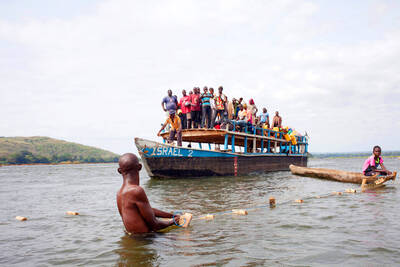
RIVER TRAGEDY: Local fishers and residents helped rescue people after the vessel capsized, while motorbike taxis evacuated some of the injured At least 58 people going to a funeral died after their overloaded river boat capsized in the Central African Republic’s (CAR) capital, Bangui, the head of civil protection said on Saturday. “We were able to extract 58 lifeless bodies,” Thomas Djimasse told Radio Guira. “We don’t know the total number of people who are underwater. According to witnesses and videos on social media, the wooden boat was carrying more than 300 people — some standing and others perched on wooden structures — when it sank on the Mpoko River on Friday. The vessel was heading to the funeral of a village chief in


 RSS
RSS