


The pending visit of a radical animal rights activist from the US has provoked the British government to warn he could be prevented from entering.
Jerry Vlasak immediately said he would contest any attempt by Home Secretary David Blunkett to prevent him speaking at an animal rights conference next month.
And he threatened to take legal action against the Observer Sunday newspaper which reported that he had advocated violence against animal researchers.
Vlasak, a surgeon who acknowledges he has himself carried out experiments on animals, has come to the view that animal experimentation has little or no value in research into medical treatment for humans.
Animal rights activists in Britain have targeted companies involved in animal research, picketing their facilities, attacking their staff and putting pressure on their financial backers.
Brian Cass, managing director of Huntingdon Life Sciences, one of Europe's leading animal testing laboratories, was seriously injured when he was attacked by a masked gang wielding pickax handles outside his home near Cambridge in February 2001.
This month he backed new legislation to make protests outside private homes illegal.
"We really do feel that it's necessary to make it illegal for anybody to hold a protest of any sort directly at somebody's home," he said.
And the chief executive of Britain's biggest drug company, Glaxo SmithKline, Jean-Pierre Garnier, said his employees were found that anti-vivisection militants were costing the UK ?1 billion a year in security costs and lost investment.
Cambridge University this year abandoned plans for a new primate research facility, and last month construction group Montpellier pulled out of a ?18 million project near Oxford.
Even their concrete supplier was targeted, with the brakes of trucks being sabotaged and equipment destroyed.
Tipu Aziz, a neurosurgeon at Oxford University, said it would be a national disaster if the laboratory was not built because of demonstrations. "If it doesn't get built it will be proof that an extremist handful of people can disrupt everything," he said.
The Home Office responded by announcing police would have additional powers to curb protests outside private homes, drawing anger not only from animal rights activists, but also from civil libertarians.
The protesters have developed highly effective strategies to put pressure on the companies conducting animal experiments. They picket their premises, target individual staff members, put pressure on shareholders and conduct well-organized campaigns against banks providing them with finance.
As the construction company and its cement supplier found out in recent months, even a fairly remote connection with animal experiments can lead to action.
Activists have even sent letters to the neighbors of scientists, accusing them of being pedophiles.
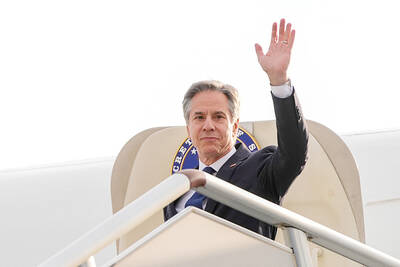
‘IN A DIFFERENT PLACE’: The envoy first visited Shanghai, where he attended a Chinese basketball playoff match, and is to meet top officials in Beijing tomorrow US Secretary of State Antony Blinken yesterday arrived in China on his second visit in a year as the US ramps up pressure on its rival over its support for Russia while also seeking to manage tensions with Beijing. The US diplomat tomorrow is to meet China’s top brass in Beijing, where he is also expected to plead for restraint as Taiwan inaugurates president-elect William Lai (賴清德), and to raise US concerns on Chinese trade practices. However, Blinken is also seeking to stabilize ties, with tensions between the world’s two largest economies easing since his previous visit in June last year. At the
Nearly half of China’s major cities are suffering “moderate to severe” levels of subsidence, putting millions of people at risk of flooding, especially as sea levels rise, according to a study of nationwide satellite data released yesterday. The authors of the paper, published by the journal Science, found that 45 percent of China’s urban land was sinking faster than 3mm per year, with 16 percent at more than 10mm per year, driven not only by declining water tables, but also the sheer weight of the built environment. With China’s urban population already in excess of 900 million people, “even a small portion

UNSETTLING IMAGES: The scene took place in front of TV crews covering the Trump trial, with a CNN anchor calling it an ‘emotional and unbelievably disturbing moment’ A man who doused himself in an accelerant and set himself on fire outside the courthouse where former US president Donald Trump is on trial has died, police said yesterday. The New York City Police Department (NYPD) said the man was declared dead by staff at an area hospital. The man was in Collect Pond Park at about 1:30pm on Friday when he took out pamphlets espousing conspiracy theories, tossed them around, then doused himself in an accelerant and set himself on fire, officials and witnesses said. A large number of police officers were nearby when it happened. Some officers and bystanders rushed

Beijing is continuing to commit genocide and crimes against humanity against Uyghurs and other Muslim minorities in its western Xinjiang province, U.S. Secretary of State Antony Blinken said in a report published on Monday, ahead of his planned visit to China this week. The State Department’s annual human rights report, which documents abuses recorded all over the world during the previous calendar year, repeated language from previous years on the treatment of Muslims in Xinjiang, but the publication raises the issue ahead of delicate talks, including on the war in Ukraine and global trade, between the top U.S. diplomat and Chinese


 RSS
RSS