


Suspected Maoist rebels yesterday gunned down a pedestrian in the Nepalese capital, causing new jitters in a city weathering a guerrilla blockade for the past six days.
Prem Bahadur Thokare, a small-time contractor, was hit by two bullets as he walked past the tightly guarded home of an army officer in the capital's outlying Kapan Sawaraswoti Nagar area, police said.
Dozens of panicked residents gathered around Thokare's bloodied body as it lay on the pavement, searching for a way to take him to hospital.
"Everyone started looking for money to provide a cash deposit to the hospital so he could get treatment, but while we were preparing to take him he succumbed to his injuries," neighbor Sunder Wagle said.
It was the latest targeted killing in the city of 1.5 million people, a strategy observers said was meant to trigger fear alongside the blockade which has been largely symbolic.
"The Maoists' main objective is to create panic. The closure of the roads has not been fully successful, so they are trying additional methods," academic and political analyst Prakash Joshi said.
The government yesterday said that a committee had been formed under Deputy Prime Minister Bharat Mohan Adhikhari to monitor supplies of produce and ensure security for transporters.
The Maoists, who are fighting to overthrow the Himalayan state's monarchy, say the blockade should pressure the two-month-old government into agreeing to immediate peace talks. The blockade is being enforced mainly through psychological fear of reprisals rather than physical roadblocks.
Hundreds of trucks continue to venture daily into the Kathmandu Valley, where armed police and soldiers frisk incoming passengers and check the identity of all going out.
While local markets remain well stocked with produce, prices have shot up, leading to fears that a prolonged blockade could be devastating.
Transport operators said the hidden victims of the blockade have been those who depend on a normal flow of traffic.
"People who sell tea and fruits on the side of the highway are starving. This kind of blockade would not serve the interests of anybody," said Hira Udas, chairman of the Federation of Nepalese Transport Entrepreneurs.
The Maoists announced a fresh blockade from Saturday to stop traffic entering from the border with Tibet.
Joshi saw the blockade of the northern border as a pressure tactic aimed at the poor, who are the primary support base of the rebels in the largely agrarian kingdom.
Nepal each year imports some US$72 million in Chinese goods, largely manufactured wares not made locally, which customers of modest means can buy at a fraction of the cost of comparable products from neighboring India.
The rebels late on Saturday raided the remote town of Khalanga, headquarters of the mountainous Jumla district, 445km northwest of Kathmandu, bombing and setting fire to seven office buildings including a court.
Five rebels and one soldier were killed, police said. Residents said the insurgents carried away 20 to 25 wounded colleagues.
Troops scoured the mountains yesterday for six policemen, four civil servants and four civilians abducted in the raid.
"A hectic search has been launched by the army, both by land and air, to locate the abducted people," a police officer said.
Founded by teacher Prachanda, known as the Fierce One, the Maoists' violent anti-government campaign has claimed over 10,000 lives since 1996.
They draw their inspiration from Chinese revolutionary Mao Zedong's (毛澤東) fight against landowners and their tactics from Peru's Shining Path guerrillas.
They control vast swathes of Nepal's countryside, running parallel district administrations in many areas.

VAGUE: The criteria of the amnesty remain unclear, but it would cover political violence from 1999 to today, and those convicted of murder or drug trafficking would not qualify Venezuelan Acting President Delcy Rodriguez on Friday announced an amnesty bill that could lead to the release of hundreds of prisoners, including opposition leaders, journalists and human rights activists detained for political reasons. The measure had long been sought by the US-backed opposition. It is the latest concession Rodriguez has made since taking the reins of the country on Jan. 3 after the brazen seizure of then-Venezuelan president Nicolas Maduro. Rodriguez told a gathering of justices, magistrates, ministers, military brass and other government leaders that the ruling party-controlled Venezuelan National Assembly would take up the bill with urgency. Rodriguez also announced the shutdown
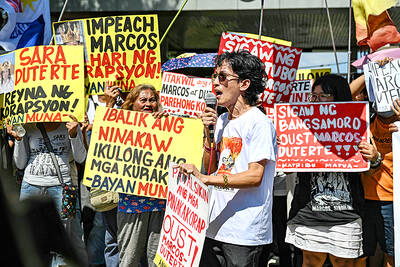
Civil society leaders and members of a left-wing coalition yesterday filed impeachment complaints against Philippine Vice President Sara Duterte, restarting a process sidelined by the Supreme Court last year. Both cases accuse Duterte of misusing public funds during her term as education secretary, while one revives allegations that she threatened to assassinate former ally Philippine President Ferdinand Marcos Jr. The filings come on the same day that a committee in the House of Representatives was to begin hearings into impeachment complaints against Marcos, accused of corruption tied to a spiraling scandal over bogus flood control projects. Under the constitution, an impeachment by the
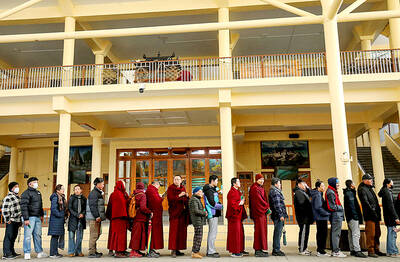
Exiled Tibetans began a unique global election yesterday for a government representing a homeland many have never seen, as part of a democratic exercise voters say carries great weight. From red-robed Buddhist monks in the snowy Himalayas, to political exiles in megacities across South Asia, to refugees in Australia, Europe and North America, voting takes place in 27 countries — but not China. “Elections ... show that the struggle for Tibet’s freedom and independence continues from generation to generation,” said candidate Gyaltsen Chokye, 33, who is based in the Indian hill-town of Dharamsala, headquarters of the government-in-exile, the Central Tibetan Administration (CTA). It

A Virginia man having an affair with the family’s Brazilian au pair on Monday was found guilty of murdering his wife and another man that prosecutors say was lured to the house as a fall guy. Brendan Banfield, a former Internal Revenue Service law enforcement officer, told police he came across Joseph Ryan attacking his wife, Christine Banfield, with a knife on the morning of Feb. 24, 2023. He shot Ryan and then Juliana Magalhaes, the au pair, shot him, too, but officials argued in court that the story was too good to be true, telling jurors that Brendan Banfield set


 RSS
RSS