


The new Roman Catholic Archbishop of Harare publicly criticized the Zimbabwean government's poor human rights record Saturday, drawing a scathing attack from President Robert Mugabe.
Archbishop Robert Ndlovu told a crowd of some 6,000 people, including Mugabe, who turned out for his inauguration that free expression, association and assembly were rights the church supported.
Zimbabwe has been wracked by political violence and economic turmoil in recent years as Mugabe's government has seized thousands of white-owned farms for redistribution to blacks. Seeking to crack down on dissent, the government has arrested opposition leaders, trade unionists and independent journalists.
"The role of a bishop and of the church in general is to stand up for human dignity, and from human dignity flow human rights," said Ndlovu, who was formerly the Bishop of Hwange, a city in northwestern Zimbabwe where up to 20,000 suspected opposition supporters were killed by Mugabe's security forces in the 1980s.
After Ndlovu finished speaking, Mugabe made an impromptu speech, attacking unnamed religious leaders who "joined hands with erstwhile colonial masters to peddle lies about the state of affairs and demonize Zimbabwe."
Mugabe often accuses critics of being league with Zimbabwe's former colonizer, Britain, and other Western nations.
Before leaving, Mugabe commended the Catholic church for giving him his early education as a mission teacher and took communion with his wife.
Ndlovu's appointment last month drew sharp criticism from Zimbabwe's state-controlled media, which said that one of several known pro-Mugabe clerics from Mugabe's majority Shona tribe should have been made Harare archbishop. Ndlovu is from the minority Ndebele tribe.
Friday, Mugabe's government published plans for new restrictive legislation banning foreign human rights group and making all private relief work subject to stringent state controls.

It began as a satirical online project. Now millions of young people in India are flocking to it as an outlet for their frustration. A parody political party called the Cockroach Janta Party, with the insect as its symbol, has exploded across India’s social media by turning absurdist humor into protest. Memes and short videos mocking corruption, joblessness and political dysfunction have flooded social media sites, where millions of users are embracing the cockroach — known for its ability to survive harsh conditions — as a tongue-in-cheek symbol of endurance. The online movement’s rise has been unusually rapid. The Cockroach Janta Party (CJP)

SPEAKING OUT: After Siranudh Scott’s allegations surfaced, celebrities and public figures took to social media to share their own experiences of sexual misconduct and abuse A high-profile alleged sexual abuse case within a wealthy Thai beer brewing family has prompted a wave of painful accounts from survivors of unconnected abuse in the conservative nation. Siranudh Scott, a member of the billionaire Thai family that founded the ubiquitous Singha beer brand, posted an emotional video this month accusing his elder brother Sunit of repeatedly abusing him when he was a teenager. Sunit, who is in his 30s, later denied the allegations in a video posted online, but Singha parent Boonrawd dismissed him from his executive role with the company on Tuesday last week. “I felt I needed to speak

A Hong Kong astronaut is to join a Chinese space mission for the first time as part of a three-person crew launching today, as Beijing edges closer to its goal of landing people on the moon. The Tiangong space station — crewed by teams of three astronauts that are typically rotated every six months — is the crown jewel of China’s space program, boosted by billions in state investment in a bid to catch up with the US and Russia. The Shenzhou-23 mission is to blast off at 11:08pm from the Jiuquan Satellite Launch Center in northwestern China, carrying three astronauts to
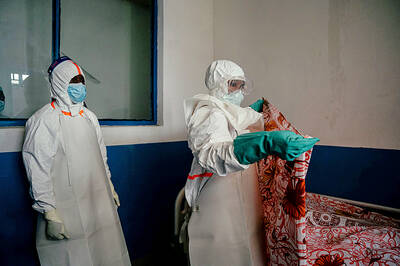
UPGRADED ALERT: The risk inside DR Congo is now considered ‘very high,’ while neighboring countries face a ‘high’ threat as the outbreak continues, the WHO said Ebola is spreading faster than responders can track it in eastern Congo, where health workers managed to follow up with barely one in five identified contacts in a single day. Authorities in the Democratic Republic of the Congo (DR Congo) reported 83 confirmed infections, 746 suspected cases and 1,603 identified contacts as of Thursday, but health workers were able to follow up on only 342 contacts that day — about 21 percent of the total under monitoring — data released by the DR Congo Ministry of Public Health on Friday showed. The figures suggest the response is falling behind the outbreak itself,


 RSS
RSS