


Dust storms emanating from the Sahara have increased tenfold in 50 years, contributing to climate change as well as threatening human health and destroying coral reefs thousands of kilometers away.
And one major cause is the replacement of the camel by four-wheel drive vehicles as the desert vehicle of choice.
Andrew Goudie, geography professor at Oxford University, blames the process of Toyotarization -- a coinage reflecting the near-ubiquitous desert use of Toyota Land Cruisers -- for destroying a thin crust of lichen and stones that has protected vast areas of the Sahara from the wind for centuries.
Four-wheel drive use, along with overgrazing and deforestation, were the major causes of the world's growing dust storm problem, the scale of which was much bigger than previously realized, Goudie, master of St Cross College, told the International Geographical Congress in Glasgow, Scotland, on Thursday.
"I am quite serious, you should look at deserts from the air, scarred all over by wheel tracks, people driving indiscriminately over the surface breaking it up. Toyotarization is a major cause of dust storms. If I had my way I would ban them from driving off-road."
The problem has become so serious that an estimated 2 billion to 3 billion tonnes of dust is carried away on the wind each year. Storms in the Sahara transport dust high into the atmosphere and deposit it as far away as Greenland and the US.
The UK was seeing increasing levels of "blood rain" in spring that came direct from the Sahara, Goudie said. From an aircraft over the Alps in summer it was possible to see the telltale color of red dust on the mountains.
Although the storms are mainly particles of quartz, smaller than grains of sand, they also contain salt and quantities of pesticide and herbicide which can cause serious health problems. Microbe-laden dust from storms is also credited with carrying cattle diseases such as foot and mouth.
The world's largest single dust source is the Bodele depression in Chad, between an ever-shrinking Lake Chad (now a twentieth of its size in the 1960s) and the Sahara.
The depression releases 1.2 billion tonnes of dust a year, 10 times more than when measurements began in 1947, according to Goudie's research.
Taking the whole Sahara, and the Sahel to the south, dust volumes had increased four- to sixfold since the 1960s. Countries worst affected were Niger, Chad, northern Nigeria, Burkina Faso and Mauritania, the research found.
But the effects went far beyond. In the Caribbean, scientists had directly linked the death of coral reefs to smothering by dust which had travelled almost 5,000km.
African dust had also found its way to Greenland, Goudie said. While white ice reflected sunlight and remains frozen, the dark dust on top absorbed the sun's heat, causing the ice to melt and accelerating the raising of sea levels.
In China, extensive efforts had been made to plant trees to hold back the dust, and increases in rainfall had also helped, the study found. However, large dust storms were still emanating from the vast deserts in the north, which included the Lopnor nuclear test site -- raising fears that storms could interfere with the 2008 Olympics in Beijing and might contain radioactive particles.

‘IN A DIFFERENT PLACE’: The envoy first visited Shanghai, where he attended a Chinese basketball playoff match, and is to meet top officials in Beijing tomorrow US Secretary of State Antony Blinken yesterday arrived in China on his second visit in a year as the US ramps up pressure on its rival over its support for Russia while also seeking to manage tensions with Beijing. The US diplomat tomorrow is to meet China’s top brass in Beijing, where he is also expected to plead for restraint as Taiwan inaugurates president-elect William Lai (賴清德), and to raise US concerns on Chinese trade practices. However, Blinken is also seeking to stabilize ties, with tensions between the world’s two largest economies easing since his previous visit in June last year. At the

UNSETTLING IMAGES: The scene took place in front of TV crews covering the Trump trial, with a CNN anchor calling it an ‘emotional and unbelievably disturbing moment’ A man who doused himself in an accelerant and set himself on fire outside the courthouse where former US president Donald Trump is on trial has died, police said yesterday. The New York City Police Department (NYPD) said the man was declared dead by staff at an area hospital. The man was in Collect Pond Park at about 1:30pm on Friday when he took out pamphlets espousing conspiracy theories, tossed them around, then doused himself in an accelerant and set himself on fire, officials and witnesses said. A large number of police officers were nearby when it happened. Some officers and bystanders rushed
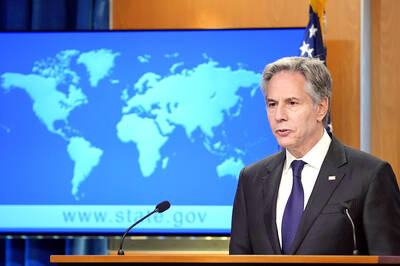
Beijing is continuing to commit genocide and crimes against humanity against Uyghurs and other Muslim minorities in its western Xinjiang province, U.S. Secretary of State Antony Blinken said in a report published on Monday, ahead of his planned visit to China this week. The State Department’s annual human rights report, which documents abuses recorded all over the world during the previous calendar year, repeated language from previous years on the treatment of Muslims in Xinjiang, but the publication raises the issue ahead of delicate talks, including on the war in Ukraine and global trade, between the top U.S. diplomat and Chinese
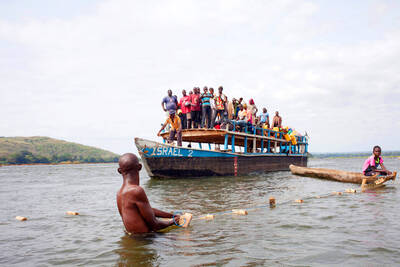
RIVER TRAGEDY: Local fishers and residents helped rescue people after the vessel capsized, while motorbike taxis evacuated some of the injured At least 58 people going to a funeral died after their overloaded river boat capsized in the Central African Republic’s (CAR) capital, Bangui, the head of civil protection said on Saturday. “We were able to extract 58 lifeless bodies,” Thomas Djimasse told Radio Guira. “We don’t know the total number of people who are underwater. According to witnesses and videos on social media, the wooden boat was carrying more than 300 people — some standing and others perched on wooden structures — when it sank on the Mpoko River on Friday. The vessel was heading to the funeral of a village chief in


 RSS
RSS