


US President George W. Bush said Monday that the Pentagon would withdraw 60,000 to 70,000 troops over the next decade from Europe and Asia in the biggest realignment of the US military since the end of the Cold War.
In a speech to a convention of the Veterans of Foreign Wars in the political combat zone of Ohio, the president said the redeployment would create a more flexible military that would be better positioned to fight terrorism. While the event on Monday event was billed as the formal unveiling of the plan, most of the details had been reported in early June, after the proposal was circulated among European and Asian allies.
Some troops will be brought home, Bush said, while others will be rotated through locations closer to the terrorist threat -- principally the Middle East and Central Asia, as well as Southeast Asia. The administration already is striking deals for greater access rights and temporary basing privileges in nations closer to locations believed to be terrorist headquarters and havens.
"For decades America's armed forces abroad have essentially remained where the wars of the last century ended, in Europe and in Asia," Bush told an enthusiastic crowd of veterans and their families. "America's current force posture was designed, for example, to protect us and our allies from Soviet aggression. The threat no longer exists."
The redeployment will affect an additional 100,000 military support and families, but it will not affect the troops now in Iraq and Afghanistan, deployments that have stretched the Army.
Bush's announcement, in a swing state that the White House has identified as essential to the president's chances for re-election, came with heavy political overtones. It is part of an effort leading into the Republican National Convention to promote Bush's record on national security, which polls show is his greatest advantage against his Democratic competitor, Senator John Kerry.
Kerry, a Vietnam combat veteran, is slated to address the same convention today. Bush, who spent the Vietnam War in a noncombat role in the Texas Air National Guard, attacked Kerry several times in his remarks as weak on defense.
"It's important we send the right signals when we speak here in America," Bush said. "The other day my opponent said if he's elected, the number of troops in Iraq will be significantly reduced within six months. I think it sends the wrong signal."
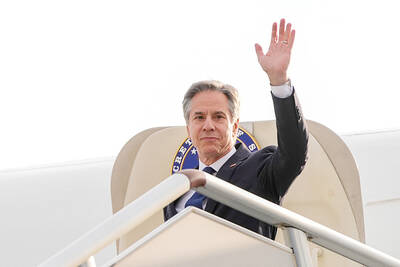
‘IN A DIFFERENT PLACE’: The envoy first visited Shanghai, where he attended a Chinese basketball playoff match, and is to meet top officials in Beijing tomorrow US Secretary of State Antony Blinken yesterday arrived in China on his second visit in a year as the US ramps up pressure on its rival over its support for Russia while also seeking to manage tensions with Beijing. The US diplomat tomorrow is to meet China’s top brass in Beijing, where he is also expected to plead for restraint as Taiwan inaugurates president-elect William Lai (賴清德), and to raise US concerns on Chinese trade practices. However, Blinken is also seeking to stabilize ties, with tensions between the world’s two largest economies easing since his previous visit in June last year. At the
Nearly half of China’s major cities are suffering “moderate to severe” levels of subsidence, putting millions of people at risk of flooding, especially as sea levels rise, according to a study of nationwide satellite data released yesterday. The authors of the paper, published by the journal Science, found that 45 percent of China’s urban land was sinking faster than 3mm per year, with 16 percent at more than 10mm per year, driven not only by declining water tables, but also the sheer weight of the built environment. With China’s urban population already in excess of 900 million people, “even a small portion

UNSETTLING IMAGES: The scene took place in front of TV crews covering the Trump trial, with a CNN anchor calling it an ‘emotional and unbelievably disturbing moment’ A man who doused himself in an accelerant and set himself on fire outside the courthouse where former US president Donald Trump is on trial has died, police said yesterday. The New York City Police Department (NYPD) said the man was declared dead by staff at an area hospital. The man was in Collect Pond Park at about 1:30pm on Friday when he took out pamphlets espousing conspiracy theories, tossed them around, then doused himself in an accelerant and set himself on fire, officials and witnesses said. A large number of police officers were nearby when it happened. Some officers and bystanders rushed

Beijing is continuing to commit genocide and crimes against humanity against Uyghurs and other Muslim minorities in its western Xinjiang province, U.S. Secretary of State Antony Blinken said in a report published on Monday, ahead of his planned visit to China this week. The State Department’s annual human rights report, which documents abuses recorded all over the world during the previous calendar year, repeated language from previous years on the treatment of Muslims in Xinjiang, but the publication raises the issue ahead of delicate talks, including on the war in Ukraine and global trade, between the top U.S. diplomat and Chinese


 RSS
RSS