


Iraqi authorities abruptly put off a national conference of political, religious and civic leaders considered a crucial step on the road to democracy amid disarray over choice of delegates and boycott threats by key factions.
The announcement on Thursday came a day after a car bombing killed 70 people, the worst single attack since US officials transferred power to an interim Iraqi government.
The national conference, which had been scheduled to start today, appeared to be far behind schedule even before the two-week delay was announced. No venue had been disclosed and there were no outward signs in Baghdad of preparations for the 1,000-person gathering.
Conference organizers insisted they were ready to start, but agreed to the postponement at the request of UN officials, who wanted time to encourage wider participation and prepare for the meeting.
UN Secretary-General Kofi Annan welcomed the decision to postpone the conference, stressing the need to take the time to prepare properly and encourage wider participation.
"The secretary-general believes that a well-prepared national conference can provide a much-needed opportunity for Iraqi political forces and civil society," spokeswoman Marie Okabe said.
Officials hope the conference, which is to elect an interim national assembly, will give Iraqis faith in their government and isolate the insurgents who have carried out a 15-month campaign of bombings, assassinations and kidnappings.
One insurgent group linked to Jordanian militant Abu Musab al-Zarqawi said on Thursday that it had kidnapped a Somali truck driver and would behead him if his Kuwaiti company did not stop working in Iraq.
Another group threatened to behead one of seven foreign truck drivers it was holding in 24 hours if its string of demands, which included a pullout by their company, were not met.
Another militant Islamic group posted an Internet warning that threatened any Muslim or Arab nation that contributed troops to a Saudi-proposed Muslim force for Iraq -- a proposal supported by US officials and Iraqi Prime Minister Ayad Allawi.
"Our swords will be drawn in the face of anyone who cooperates with the Jews and the Christians," the group said in a statement posted on Thursday.
"We will strike with an iron fist all the traitors from the Arab governments who cooperate with the Zionists, secretly or openly," it said.
A US soldier was killed on Thursday in clashes north of Baghdad, and a Polish soldier died in a roadside bombing.
The former's death raises the number of US personnel killed in Iraq since the war began to at least 909.

PHISHING: The con might appear convincing, as the scam e-mails can coincide with genuine messages from Apple saying you have run out of storage For a while you have been getting messages from Apple saying “your iCloud storage is full.” They say you have exceeded your storage plan, so documents are no longer being backed up, and photos you take are not being uploaded. You have been resisting Apple’s efforts to get you to pay a minimum of £0.99 (US$1.33) a month for more storage, but it seems that you cannot keep putting off the inevitable: You have received an e-mail which says your iCloud account has been blocked, and your photos and videos would be deleted very soon. To keep them you need

For two decades, researchers observed members of the Ngogo chimpanzee group of Kibale National Park in Uganda spend their days eating fruits and leaves, resting, traveling and grooming in their tropical rainforest abode, but this stable community then fractured and descended into years of deadly violence. The researchers are now describing the first clearly documented example of a group of wild chimpanzees splitting into two separate factions, with one launching a series of coordinated attacks against the other. Adult males and infants were targeted, with 28 deaths. “Biting, pounding the victim with their hands, dragging them, kicking them — mostly adult males,
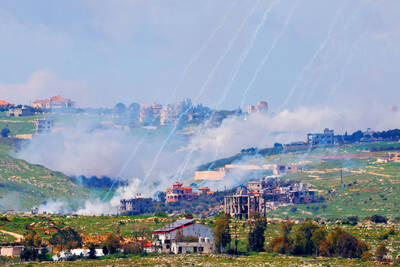
The Israeli military has demolished entire villages as part of its invasion of south Lebanon, rigging homes with explosives and razing them to the ground in massive remote detonations. The Guardian reviewed three videos posted by the Israeli military and on social media, which showed Israel carrying out mass detonations in the villages of Taybeh, Naqoura and Deir Seryan along the Israel-Lebanon border. Lebanese media has reported more mass detonations in other border villages, but satellite imagery was not readily available to verify these claims. The demolitions came after Israeli Minister of Defense Israel Katz called for the destruction of

SUPERFAN: The Japanese PM played keyboard in a Deep Purple tribute band in middle school and then switched to drums at university, she told the British rock band Legendary British rock band Deep Purple yesterday made Japanese Prime Minister Sanae Takaichi’s day with a brief visit to their high-profile superfan as they returned to the nation they first toured more than half a century ago. Takaichi’s reputation as an amateur drummer, and a fan of hard rock and heavy metal has been well documented, and she has referred to Deep Purple as one of her favorite bands along with the likes of Black Sabbath and Iron Maiden. “You are my god,” a giddy Takaichi said in English to Deep Purple drummer Ian Paice, presenting him with a set of made-in-Japan


 RSS
RSS