

Canada warned on Tuesday it would ratchet up pressure on Iran over the killing of a jailed Iranian-Canadian photographer, and called on Tehran to respect international human rights norms.
But Foreign Minister Pierre Pettigrew's promise of action fell far short of measures demanded by the press, his opposition counterpart and the family of Zahra Kazemi, who died while in Iranian custody last year.
The issue exploded into a new diplomatic row after a security agent was acquitted in Iran on Saturday of the photographer's murder.
"We are going to work with our partners across the world, in the European Union and in the United Nations to increase the pressure on Iran," Pettigrew told reporters in Montreal.
"Iran must accept its responsibilities in line with its own laws, but also in line with the UN Declaration of Human Rights," Pettigrew said in his first public comments on the issue since Mohammad Reza Aghdam Ahmadi, 42, was acquitted.
Kazemi, 54, a freelance photographer with dual nationality, died in July last year from a brain hemorrhage from a blow to her skull after her arrest for taking photos outside Tehran's notorious Evin prison. The judiciary initially claimed Kazemi died of a stroke, but a government report later revealed she had been struck by a blunt object. Her mother says Kazemi's body showed evidence of torture in several places, including broken bones.
Kazemi's family has demanded justice, and charged the Canadian government with doing little to call Tehran to account.
"I'm questioning myself on the honest intention of the Canadian government," Kazemi's son, Stephan Hachemi, said on Tuesday. "It's a shame."
The chief Conservative Party spokesman for foreign affairs, Stockwell Day, accused Pettigrew of "failing to take immediate and decisive action."
Three UN human rights experts earlier on Tuesday said they were profoundly concerned at the acquittal verdict. The UN special rapporteurs on the right to freedom of opinion and expression, on the independence of judges and lawyers, and on torture expressed "their profound concern regarding the unanswered questions which have resulted from the acquittal of an Iranian intelligence officer on 24 July after a two-day trial."
The experts, Ambeyi Ligabo, Leandro Despouy and Theo van Boven respectively, said in a statement that Iranian "authorities are favoring a climate of impunity for law enforcement officials and setting the ground for the recurrence of similar human rights violations in the future."
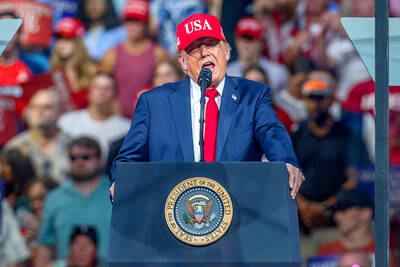
US President Donald Trump on Wednesday threatened to take action against the EU if it moves forward with European Commission President Ursula von der Leyen’s proposal to make Canada the bloc’s first associate member. “If they do that, if I think it’s at all a hostile act; I will put very serious tariffs or stop trading with Europe on many things,” Trump told reporters en route to an event in North Carolina, calling the proposal “laughable.” “If it’s a good intention, that’s fine. If it’s a bad intention, we’ll put very heavy tariffs on Europe,” he said. Von der Leyen made the proposal

SECRET FOOTAGE: A 17-year-old girl told British broadcaster Channel 4 that she had been approached by a man who covertly recorded her and their interaction Calls are growing louder in Europe for action against “pervert” smart glasses after secretly filmed footage of girls and women appeared online — with a petition in Britain demanding a ban on their sale. Anyone wearing smart glasses can take photos, film videos, listen to music, make phone calls, translate text or interact with an artificial intelligence (AI) assistant, with sales now hitting millions. The devices grabbed attention this summer after a marketing tie-up between Kylie Jenner, beauty mogul and member of the Kardashian dynasty, and tech giant Meta. Since smartphones are now embedded in daily life, “big tech” is
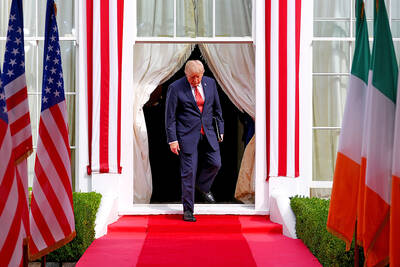
FROSTY RECEPTION: ‘I conveyed the strong view of the Irish people that the normalization of war and genocide can never be accepted,’ the Irish president said US President Donald Trump on Saturday said that he would “love to see” a united Ireland, wading into a politically sensitive subject as he embarked on a two-day Irish visit that blurs the lines between his presidency and personal business interests. After meeting Irish Prime Minister Micheal Martin in Dublin, Trump said reunification of the Republic of Ireland and Northern Ireland — split for more than a century — would be “a fantastic thing.” “It’s going to happen eventually. It may as well happen now,” he told reporters, adding that “the UK will have something to say about it, obviously.”
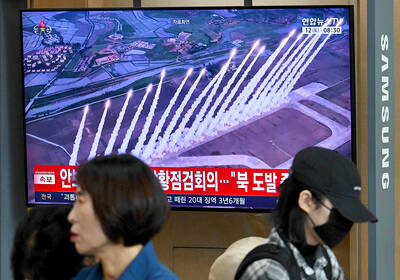
North Korea yesterday fired multiple ballistic missiles, Seoul said, a day after South Korea concluded five days of joint maritime drills with the US and Japan that were focused on the North. Pyongyang last month slammed plans for the so-called Freedom Edge joint exercises in international waters off South Korea as a “threat” to North Korea and other countries of the region. Yesterday, Seoul’s military detected “multiple short-range ballistic missiles launched from the Wonsan area toward the East Sea [the Sea of Japan],” the South Korean Joint Chiefs of Staff said in a statement. The missiles were detected at about


 RSS
RSS