


Iran's hardline judiciary yesterday barred diplomats and foreign media from the trial of an intelligence agent accused of killing a Canadian journalist in custody last year.
The move followed dramatic proceedings on Saturday when the mother of 54-year-old photographer Zahra Kazemi told the court her daughter had been tortured to death in prison.
The case has strained Iran's relations with Canada, which announced the withdrawal of its ambassador last week, and exposed deep rifts between the reformist government and judiciary.
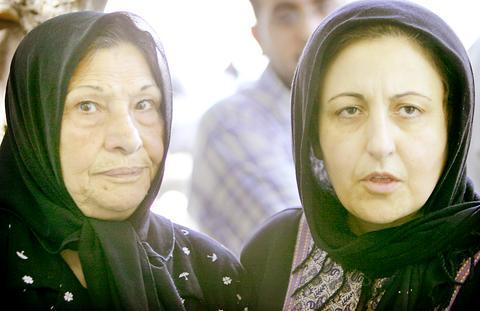
PHOTO: REUTERS
Court officials told diplomats from Canada, the Netherlands, Britain and France -- who had attended the court on Saturday when the trial resumed after a nine-month delay -- that they needed written permission from Iran's Foreign Ministry to enter.
Journalists who work for foreign media organizations, who were also permitted to watch Saturday's session, were told there was no room in the courtroom yesterday. Journalists working for local media were allowed to enter.
The diplomats warned the move could have a serious impact on international perceptions of Iran's human rights record, already shaken by revelations emerging from the trial.
"This will have a bad impact on the human rights issue," said one of the diplomats, who declined to be named. "The next time it comes to discussing Iran's human rights situation we will have nothing positive to say."
Iran's Foreign Ministry spokesman, who was unaware of the court's move to bar diplomats and journalists, said the trial was transparent and that Tehran would not accept any international pressure over the case.
"We have to be accountable to Iranian citizens about this case, not to a foreign country," Hamid Reza Asefi told a weekly news conference. "The court is open which shows that we have no concerns about the case."
Kazemi, a Canadian of Iranian descent, was arrested outside a Tehran jail last July for taking photographs.
Her tearful mother told the court on Saturday she had seen evidence that her daughter was tortured to death.
"There were burns on my daughter's chest, her fingers and nose and toes were broken ... she was tortured to death," Ezzat Kazemi told the court.
Iran's judiciary initially said Kazemi had died of a stroke. But a government inquiry showed she received a blow to the skull while in prison that cracked her skull causing a brain hemorrhage. She died in hospital 10 days after lapsing into a coma.
Intelligence agent Mohammad Reza Aqdam has denied the prosecution's charge of "semi-intentional murder."
Nobel Peace Prize laureate Shirin Ebadi, who is representing Kazemi's family, has accused the judiciary of ignoring evidence which pointed to other suspects working for the judiciary itself.

‘IN A DIFFERENT PLACE’: The envoy first visited Shanghai, where he attended a Chinese basketball playoff match, and is to meet top officials in Beijing tomorrow US Secretary of State Antony Blinken yesterday arrived in China on his second visit in a year as the US ramps up pressure on its rival over its support for Russia while also seeking to manage tensions with Beijing. The US diplomat tomorrow is to meet China’s top brass in Beijing, where he is also expected to plead for restraint as Taiwan inaugurates president-elect William Lai (賴清德), and to raise US concerns on Chinese trade practices. However, Blinken is also seeking to stabilize ties, with tensions between the world’s two largest economies easing since his previous visit in June last year. At the

UNSETTLING IMAGES: The scene took place in front of TV crews covering the Trump trial, with a CNN anchor calling it an ‘emotional and unbelievably disturbing moment’ A man who doused himself in an accelerant and set himself on fire outside the courthouse where former US president Donald Trump is on trial has died, police said yesterday. The New York City Police Department (NYPD) said the man was declared dead by staff at an area hospital. The man was in Collect Pond Park at about 1:30pm on Friday when he took out pamphlets espousing conspiracy theories, tossed them around, then doused himself in an accelerant and set himself on fire, officials and witnesses said. A large number of police officers were nearby when it happened. Some officers and bystanders rushed

Beijing is continuing to commit genocide and crimes against humanity against Uyghurs and other Muslim minorities in its western Xinjiang province, U.S. Secretary of State Antony Blinken said in a report published on Monday, ahead of his planned visit to China this week. The State Department’s annual human rights report, which documents abuses recorded all over the world during the previous calendar year, repeated language from previous years on the treatment of Muslims in Xinjiang, but the publication raises the issue ahead of delicate talks, including on the war in Ukraine and global trade, between the top U.S. diplomat and Chinese
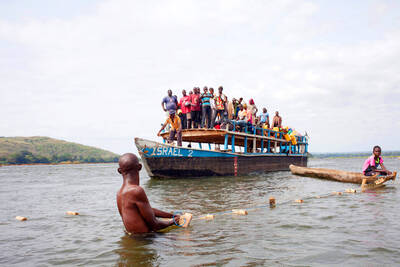
RIVER TRAGEDY: Local fishers and residents helped rescue people after the vessel capsized, while motorbike taxis evacuated some of the injured At least 58 people going to a funeral died after their overloaded river boat capsized in the Central African Republic’s (CAR) capital, Bangui, the head of civil protection said on Saturday. “We were able to extract 58 lifeless bodies,” Thomas Djimasse told Radio Guira. “We don’t know the total number of people who are underwater. According to witnesses and videos on social media, the wooden boat was carrying more than 300 people — some standing and others perched on wooden structures — when it sank on the Mpoko River on Friday. The vessel was heading to the funeral of a village chief in


 RSS
RSS