


Libya agreed to open a corridor for food aid and other UN humanitarian supplies to help about 1.2 million people displaced by the Darfur conflict in western Sudan.
An agreement was signed Thursday between the Libyan government and UN World Food Program (WFP) in the capital, Tripoli, to guarantee the safe passage of food aid from the US and other donors through Libya to Sudan and Chad.
"This is a Libyan initiative to extend help to the Africans and to help achieve peace and security in Africa," Mohammed Sayala, Libya's deputy foreign minister, told a news conference after the signing ceremony.
John Powell, the WFP deputy executive director, said the first shipment of 450 tonnes of wheat flour from Switzerland is expected to arrive in the Libyan port of Benghazi early next month.
Powell expressed hope that relief aid would reach 1 million displaced Sudanese people next month and 1.5 million additional people in November.
Another 200,000 displaced Sudanese people are living in temporary camps along the border in neighboring Chad.
Meanwhile, in the Sudanese capital of Khartoum, two top World Health Organization (WHO) officials said that increased funds and supplies were needed to save hundreds of thousands of internally displaced people in Darfur from diseases such as cholera, dysentery and malaria.
"People are dying now because they are living in totally unsatisfactory conditions, but too many more could die in the coming weeks unless we prevent the lack of sanitation, malnutrition, shortage of clean water and the coming rains from combining into a recipe for death," WHO Director-general Lee Jong-wook said.
Lee and Hussein Gezairy, the WHO's regional director for the eastern Mediterranean region, visited camps and hospitals in southern and western Darfur.
In a press release, Lee and Gezairy said that progress has been achieved in providing relief, particularly healthcare, in the last few weeks, but that health risks could be reduced further with an intensified relief program.
The Darfur crisis has killed more than 30,000 and driven over 1 million people from their homes in what the UN has called the world's worst humanitarian crisis.
Foreign governments plus international aid and rights groups accuse the Khartoum government of backing Arab militiamen, known as the Janjaweed, who have carried out looting, destruction and evictions based on ethnicity.
The government has denied the charge.
A ceasefire was signed April 8, but both sides accuse the other of violations.
Sudanese officials and black African rebels fighting the 17-month war were to begin African Union-sponsored talks in Ethiopia on Thursday in a bid to end the conflict.

Crowds in Bangladesh are flocking to snap photographs with an unlikely social media star — an albino buffalo with flowing blond hair nicknamed “Donald Trump” that is due to be sacrificed within days. Owner Zia Uddin Mridha, 38, said his brother named the 700kg bull over its flowing helmet of hair resembling the signature look of the US president. “My younger brother picked this name because of the buffalo’s extraordinary hair,” he said at his farm in Narayanganj, just outside the capital, Dhaka. Mridha said that a constant stream of curious visitors — social media fans, onlookers and children — have come throughout

The Bolivian government on Friday struck a deal with protesting miners, but was still grappling with blockades and demonstrations by other workers across La Paz. Other groups are still blocking access roads into the city, which is also the seat of the government. Police on Thursday prevented the miners from entering the main square by using tear gas, while the demonstrators hurled stones and explosives with slingshots. Protests against the policies of Bolivian President Rodrigo Paz have convulsed the Andean nation since early this month, and roadblocks were choking routes into La Paz throughout Friday, the national road authority said. Miners demanded that Paz
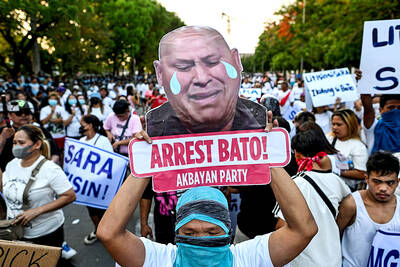
The Philippines said it has asked the country’s Supreme Court to allow it to arrest former Philippine president Rodrigo Duterte’s chief drug war enforcer to stand trial in an international tribunal. The International Criminal Court (ICC) last week unsealed an arrest warrant against Philippine Senator Ronald dela Rosa, accusing him along with Duterte and other “coperpetrators” of the “crime against humanity of murder.” Dela Rosa briefly sought refuge in the Philippine Senate last week while asking the Philippine Supreme Court to stop an ongoing attempt by government agents to arrest him. “By his own conduct, he has placed himself outside the protection of

The researchers in Ireland looked at their computer screen, marveling at a medieval book tracked down in a Roman library. They flipped through its digitized pages and found their sought-after treasure: the oldest surviving English poem. “We were extremely surprised. We were speechless. We couldn’t believe our eyes when we first saw that,” said Elisabetta Magnanti, a visiting research fellow at Trinity College Dublin’s school of English. The poem was also within the main body of Latin text, she said, calling it “extraordinary.” Composed in Old English by a Northumbrian agricultural worker in the 7th century, Caedmon’s Hymn appears within some copies of


 RSS
RSS