


When Saddam Hussein entered court last week to face charges of crimes against humanity, his first concern, after shedding his chains and settling into the dock, seemed to lie with a small group of people who were there to witness his day of reckoning.
For the first minute or more, something to his right, toward the rear of the room, distracted him, so much so that the judge seemed to have only half his attention. Was it the presence of foreign reporters? Or the two senior officials of the new Iraqi government who were sitting at the front of the cramped stall serving as a visitors' gallery?
Only later, from a burly Iraqi prison guard who clasped Saddam's right arm on his way in and out of the court, did Dr. Mouwafak al-Rubaie, Iraq's new national security adviser, discover that Saddam was trying to get a fix on him, one of the two officials who sat watching Saddam from the lower tier of the stall.
"He asked the guard as he left, `The man with the beard, was that Mouwafak al-Rubaie?'" Rubaie recalled on Sunday. "And the guard told him `Yes,' and he said, `I thought so."'
Here, at last, was the turning of the tables: The hunter turned hunted, the accuser accused.
Hundreds of thousands of people in Iraq felt the scourge of Saddam's brutality. A few of them now sit in the seats of power that once belonged to Saddam and the other 11 now under formal investigation on charges that, in most cases, amount to mass murder.
The prime minister in the new interim government that assumed office after the United States restored Iraq's formal sovereignty last week, Iyad Allawi, is a British-trained neurosurgeon who survived an ax attack in London that British authorities attributed to Saddam's agents. Adel Abdul Mahdi, the finance minister, has said he was tortured by Saddam's secret police, as has Hamid al-Bayati, the deputy foreign minister.
Al-Rubaie, a neurologist now on extended leave from a medical post in London, has said that he was seized from an operating theatre while still an intern in Baghdad in 1979, taken to a dungeon, tied up, and hung and rotated from a ceiling for hours.
There are others with similar stories in virtually every government department, including some of the men working as lawyers and judges for the Iraqi Special Tribunal, which is to try cases arising from the repression under Saddam. But only one of these men, al-Rubaie, had the satisfaction - his word, after the court hearings for the 12 men on Thursday - of being present in the courtroom, barely 10 paces from Saddam, to see their persecutor brought to account.
"I'm on top of the world, not because I want revenge, but because it's so important that we are applying justice," al-Rubaie, 54, said as he left the court on Thursday evening, after the last of the 12 accused had been driven off in chains to an American helicopter on the first leg of their journey back to a secret detention center outside Baghdad.
"By bringing these men into a court, we've begun a huge psychological healing process," al-Rubaie said. "This is a new Iraq."
On Sunday, back in his office in the Green Zone, al-Rubaie reflected on the experience of sitting, empowered now, across from some of the men who once persecuted him.
After three stints in Saddam's jails, he fled for England, helped to found an Iraqi exile group, and gained British citizenship. More than 20 years later, he still suffers from the back pains and kidney ailments that he traces to being hung from the ceiling, beaten and given electric shocks.
At that time, he says now, he wondered if anybody of real authority in Saddam's terror machinery knew about his case. Families of many who disappeared into the jails, and from there to mass graves, now speak of a terrifying casualness about the arrests, for the most trivial of perceived slights against Saddam.
Being recognized by the former dictator in the court, without ever having met him, al-Rubaie said, was an indication that he was not one of the army of unknown. He acknowledged, too, that, at moments, he experienced a personal edge to his feelings.
One, he said, came when he listened to Barzan Ibrahim Hasan, Saddam's 53-year-old half-brother, who was deputy head of the feared secret police at the time of al-Rubaie's arrests in the late 1970s.
"I thought, `Mouwafak al-Rubaie, when you were in your cell, and being tortured, this man was upstairs,' and I thought how unfair it was, in a way, that he should be treated with such respect by the court," he said. "You know, at the time these men seemed like giants, like monsters, but it turns out that they were basically just thugs. I sat there in court thinking, how could it be that men like this reduced a nation with a 5,000-year history of civilization to this? How did we allow it to happen?"
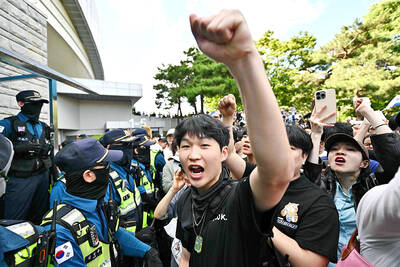
‘ABSURD MISTAKE’: The election commission said that there had been a failure to anticipate turnout after 14 polling stations ran short of ballot papers South Korean riot police yesterday cleared protesters from a Seoul polling station after a 35-hour blockade sparked by a shortage of ballot papers during local elections earlier this week. Wednesday’s election was the first nationwide vote since South Korean President Lee Jae-myung took office following the ouster of Yoon Suk-yeol over his short-lived martial law declaration. Lee’s ruling Democratic Party swept most races, but failed to flip the crucial Seoul mayoral seat. The South Korean National Election Commission apologized, blaming a failure to anticipate turnout after 14 polling stations in Seoul ran short of ballot papers. Some polling stations stayed open until 10pm to

IMAGE ‘DAMAGED’? Ted Tseng, who emigrated to the US from Taiwan, was concerned the espionage case would deepen animosity against Asian Americans In 2024, voters in the Southern California city of Arcadia elected the first all-Asian city council in the city’s history. Now, one of those politicians has pleaded guilty to being an illegal agent of the Chinese government. Former Arcadia mayor Eileen Wang’s (王愛琳) plea, entered in federal court on Friday last year, continues a saga that some residents of the area worry could bring unfair scrutiny on the broader Chinese and Asian American community. Arcadia has gone under rapid demographic change in the past two decades as immigrants from Taiwan, China and Hong Kong flocked to the San Gabriel Valley
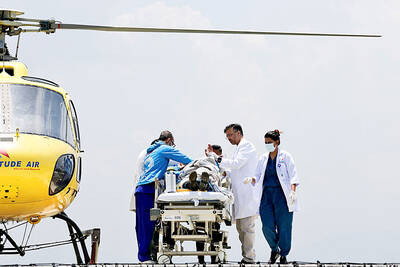
A Sherpa guide was found crawling to base camp on Mount Everest a week after he went missing and was reunited with his family, who had given up hope he would return. Dawa Sherpa was last seen on Friday last week descending the mountain, but he did not reach base camp even though his client did. The pair were among the last climbers on the mountain as the climbing season came to an end and the route was dismantled. Dawa was located by a cleaning crew on Thursday morning as he was crawling down the snowy slopes around the Khumbu Icefall, just above
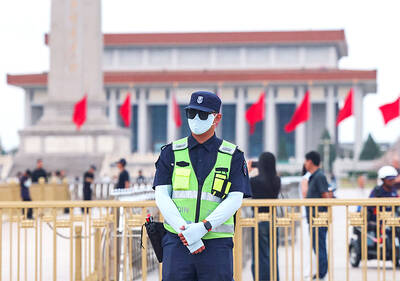
Chinese authorities are snuffing out any remembrance of the deadly 1989 military crackdown on student-led pro-democracy protests in Tiananmen Square, which happened 37 years ago yesterday, in a further tightening of a years-long campaign to erase what happened from public memory. Police told relatives of the victims they would not be allowed to visit a cemetery in Beijing on the anniversary of the crackdown, a person with knowledge of the matter said. Relatives of the victims visited the cemetery on the anniversary for more than 30 years to read memorial statements with police keeping watch, Amnesty International said. Hundreds of people,


 RSS
RSS