


Everybody should have a right to protect themselves from baseless and debasing sexual innuendo, particularly the kind that ridicules and humiliates. According to a US federal judge, however, that right does not extend to dolls -- even Barbie.
In a ruling that ended five years of legal wrangling, Judge Ronald Lew of the Central District Court of California ordered the toymaker Mattel to pay US$1.8m in legal costs after he threw out a copyright infringement suit filed by the company against a photographer who posed Barbie dolls naked in suggestive positions in or around household appliances.
"I thought the pictures needed something that really said `crass consumerism' and to me, that's Barbie," said Tom Forsythe, an artist and photographer. "The doll is issued in every possible role you can imagine and comes with every possible accessory for each and every role."
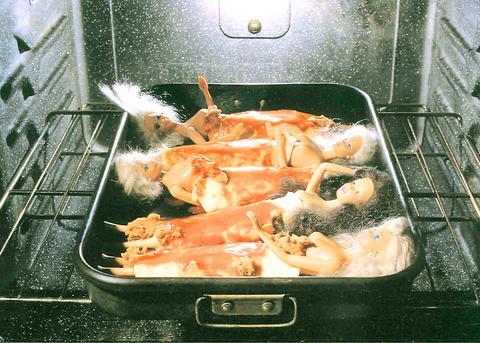
PHOTO: NY TIMES NEWS SERVICE
Forsythe exhibited his series of 78 pictures in Utah and Kansas City under the theme "Barbie's power as a beauty myth" and sold several thousand photos.
When Mattel found out, they sued him for copyright and trademark infringement in 1999.
It is not the first time Mattel has moved in to protect Barbie's honor. In the same year they started pursuing Forsythe, they also slapped Seal Press with a suit over a book called Adios Barbie. Seal agreed to remove the doll's name from the title and images of its clothing and accessories from the cover.
Last year Mattel unsuccessfully sought to stop the MCA record label from releasing a song called Barbie Girl, which they argued was defamatory because of its sexual innuendo.
In a written order, Lew effectively accused Mattel, of trying to bully Forsythe into backing down -- and ruled that photographers could play with dolls.
"[The] Plaintiff had access to sophisticated counsel who could have determined that such a suit was objectively unreasonable and frivolous," Lew wrote.
"Instead it appears [the] plaintiff forced [the] defendant into costly litigation to discourage him from using Barbie's image in his artwork. This is just the sort of situation in which this court should award attorneys fees to deter this type of litigation, which contravenes the intent of the Copyright Act," Lew wrote.
Forsythe had struggled to find a legal team to defend him, until the American Civil Liberties Union, a civil rights group, stepped in.
"I couldn't have asked for a better result," Forsythe said. "This should set a new standard for the ability to critique brands that are pervasive in our culture."
Mattel still holds the right to appeal the award, but would have to appeal to the 9th Circuit Court that already instructed the district court to consider awarding attorney's fees.
Johnathan Zittrain, a professor at Harvard Law School who specializes in Internet and copyright law, said that the case may set a precedent.
"It's enough to give corporations with brands they want to protect and expand pause to consider whether to simply reflexively unleash the hounds the minute they see somebody doing something that relates to their brand of which they don't approve," he said. "It may send a signal that a `take no prisoner' strategy against the little guy has new risks for the plaintiff."
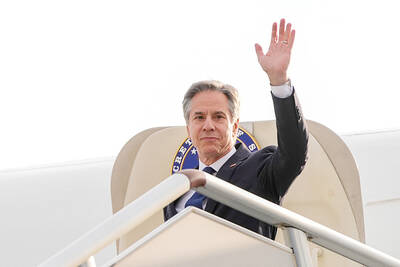
‘IN A DIFFERENT PLACE’: The envoy first visited Shanghai, where he attended a Chinese basketball playoff match, and is to meet top officials in Beijing tomorrow US Secretary of State Antony Blinken yesterday arrived in China on his second visit in a year as the US ramps up pressure on its rival over its support for Russia while also seeking to manage tensions with Beijing. The US diplomat tomorrow is to meet China’s top brass in Beijing, where he is also expected to plead for restraint as Taiwan inaugurates president-elect William Lai (賴清德), and to raise US concerns on Chinese trade practices. However, Blinken is also seeking to stabilize ties, with tensions between the world’s two largest economies easing since his previous visit in June last year. At the
Nearly half of China’s major cities are suffering “moderate to severe” levels of subsidence, putting millions of people at risk of flooding, especially as sea levels rise, according to a study of nationwide satellite data released yesterday. The authors of the paper, published by the journal Science, found that 45 percent of China’s urban land was sinking faster than 3mm per year, with 16 percent at more than 10mm per year, driven not only by declining water tables, but also the sheer weight of the built environment. With China’s urban population already in excess of 900 million people, “even a small portion

UNSETTLING IMAGES: The scene took place in front of TV crews covering the Trump trial, with a CNN anchor calling it an ‘emotional and unbelievably disturbing moment’ A man who doused himself in an accelerant and set himself on fire outside the courthouse where former US president Donald Trump is on trial has died, police said yesterday. The New York City Police Department (NYPD) said the man was declared dead by staff at an area hospital. The man was in Collect Pond Park at about 1:30pm on Friday when he took out pamphlets espousing conspiracy theories, tossed them around, then doused himself in an accelerant and set himself on fire, officials and witnesses said. A large number of police officers were nearby when it happened. Some officers and bystanders rushed
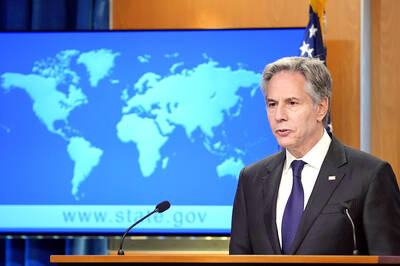
Beijing is continuing to commit genocide and crimes against humanity against Uyghurs and other Muslim minorities in its western Xinjiang province, U.S. Secretary of State Antony Blinken said in a report published on Monday, ahead of his planned visit to China this week. The State Department’s annual human rights report, which documents abuses recorded all over the world during the previous calendar year, repeated language from previous years on the treatment of Muslims in Xinjiang, but the publication raises the issue ahead of delicate talks, including on the war in Ukraine and global trade, between the top U.S. diplomat and Chinese


 RSS
RSS