


UN peacekeepers have established a command post in Haiti, preparing to take over from a US-led force later this month despite uncertainty over troop numbers, funding and how to help thousands of flood victims.
In a symbolic ceremony Tuesday, Brazilian General Augusto Heleno Ribeiro Pereira took control of the 8,000-strong UN force at Haiti's police academy. Although only a fraction of troops have arrived, most are expected to come by the end of this month, when US troops leave and UN troops start performing the duties of the 3,600-member multinational task force.
Their initial mission will be to provide security, which includes disarming rebels, who helped oust former Haitian president Jean-Bertrand Aristide on Feb. 29, and pro-Aristide militants. Both sides have said they will disarm if the other side does the same, but the US-led troops have collected fewer than 200 weapons and many have been in symbolic handovers.
"Disarmament is very important, but what is also important is the disarmament of the spirit and the desire to rebuild," said the general, as about 80 troops -- including Brazilians, Chileans, Canadians and Nepalese -- replaced their camouflage caps with blue UN berets.
Less than a dozen of the 1,900 US troops will stay on with the UN force. Others in the in the 3,600-strong force will have staggered departure dates. France will leave later this month, Canada will stay on until September and Chile will participate until the UN mandate expires.
"The UN has a big job ahead of it, but they're coming in with double the force and will be here for twice as much time," US Ambassador James Foley said.
"The operation will deal with security, but it will also help the government spread its authority, which is not the case now. Rebels are still in control of a pretty significant chunk of real estate," Foley said.
The symbolic handover comes as the country of 8 million copes with deadly floods that killed more than 1,700 in Haiti and the Dominican Republic. It was unclear whether the newly arrived troops would be involved in emergency operations to flooded areas.
The UN says there will be 6,700 troops and 1,622 civilian police from more than two dozen countries, led by 1,200 Brazilian troops.
Whether the force will reach full strength is unclear. Brazil, Chile and Argentina have pledged up to 2,500 troops. Other countries, including strife-torn nations such as Nepal and Rwanda, have promised 750 troops each.
Interim Haitian Prime Minister Gerard Latortue said he would try to persuade the US to extend their stay, saying only US troops have a "dissuasive effect" on the population.
Several members of Aristide's government and inner circle have been arrested on drug-trafficking charges, including former senator Fourel Celestin, who surrendered on Tuesday at the US embassy in Port-au-Prince. He was quickly flown to Miami, where he will likely be arraigned, according to a US official who spoke on condition of anonymity.
Barring more help from US troops, Latortue said he hoped the UN force would stay until Feb. 7, 2006, when an elected president is to be installed.
He also asked the international community to tackle the root of Haiti's instability, which he said was grinding poverty.
"What we need here is a UN mission that will not limit itself to maintaining the peace," Latortue said after the ceremony.
"They will have to get involved in the development process," he said.
After a decade of failed missions, many in the traumatized nation wonder whether the peacekeepers can succeed.
This UN mission will again try to keep a tentative peace and again train an ill-equipped and understaffed police force.
UN Secretary-general Kofi Annan has asked member nations to make a long-term commitment to transform Haiti -- which has suffered more than 30 coups in 200 years -- into "a functioning democracy." But only a fraction of the US$35 million he requested has arrived and the mission's mandate remains six months.

VAGUE: The criteria of the amnesty remain unclear, but it would cover political violence from 1999 to today, and those convicted of murder or drug trafficking would not qualify Venezuelan Acting President Delcy Rodriguez on Friday announced an amnesty bill that could lead to the release of hundreds of prisoners, including opposition leaders, journalists and human rights activists detained for political reasons. The measure had long been sought by the US-backed opposition. It is the latest concession Rodriguez has made since taking the reins of the country on Jan. 3 after the brazen seizure of then-Venezuelan president Nicolas Maduro. Rodriguez told a gathering of justices, magistrates, ministers, military brass and other government leaders that the ruling party-controlled Venezuelan National Assembly would take up the bill with urgency. Rodriguez also announced the shutdown
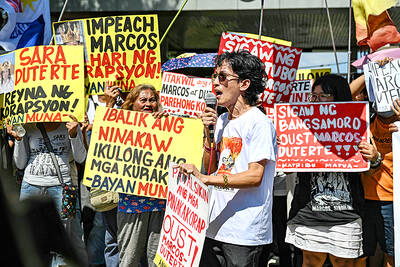
Civil society leaders and members of a left-wing coalition yesterday filed impeachment complaints against Philippine Vice President Sara Duterte, restarting a process sidelined by the Supreme Court last year. Both cases accuse Duterte of misusing public funds during her term as education secretary, while one revives allegations that she threatened to assassinate former ally Philippine President Ferdinand Marcos Jr. The filings come on the same day that a committee in the House of Representatives was to begin hearings into impeachment complaints against Marcos, accused of corruption tied to a spiraling scandal over bogus flood control projects. Under the constitution, an impeachment by the
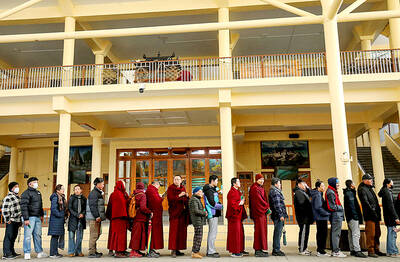
Exiled Tibetans began a unique global election yesterday for a government representing a homeland many have never seen, as part of a democratic exercise voters say carries great weight. From red-robed Buddhist monks in the snowy Himalayas, to political exiles in megacities across South Asia, to refugees in Australia, Europe and North America, voting takes place in 27 countries — but not China. “Elections ... show that the struggle for Tibet’s freedom and independence continues from generation to generation,” said candidate Gyaltsen Chokye, 33, who is based in the Indian hill-town of Dharamsala, headquarters of the government-in-exile, the Central Tibetan Administration (CTA). It

A Virginia man having an affair with the family’s Brazilian au pair on Monday was found guilty of murdering his wife and another man that prosecutors say was lured to the house as a fall guy. Brendan Banfield, a former Internal Revenue Service law enforcement officer, told police he came across Joseph Ryan attacking his wife, Christine Banfield, with a knife on the morning of Feb. 24, 2023. He shot Ryan and then Juliana Magalhaes, the au pair, shot him, too, but officials argued in court that the story was too good to be true, telling jurors that Brendan Banfield set


 RSS
RSS