


Suspected Islamist militants shot dead at least four Westerners, two Saudi guards and an Egyptian boy and seized many hostages in triple attacks yesterday targeting oil facilities in eastern Saudi Arabia, residents and diplomatic sources said.
Men, women and children were taken hostage at the Oasis housing compound in the oil city of Al-Khobar, one diplomat said.
"At least five of them are Lebanese," he said, calling the kidnappers "terrorists."
Shooting continued between security forces and the gunmen who were holed up in the compound with their hostages, he added, asking not to be named.
A week after a German was gunned down in the capital Riyadh, at least four Westerners died under a hail of bullets in the Al-Arrakah area of Al-Khobar, 5km from the Oasis, residents said.
Four suspected Islamist radicals also attacked an adjacent building of Arab Petroleum Investment during the morning, killing two guards, a senior official with the Saudi-based company, an arm of the Organization of Arab Petroleum Exporting Countries, said.
"At least four terrorists attacked the company building this morning and clashed with security guards," the official said, asking not to be named. An Egyptian boy caught in the crossfire also died, he said.
The official would not comment on reports from residents that at least four Westerners had been killed and many wounded at the adjacent compound on the Gulf coast in an area popular with foreign oil workers.
Police guards fired back at the attackers, local people said.
Before the hostage taking at the Oasis, a nearby "Petroleum Centre" where oil firms, including Anglo-Dutch giant Shell, have offices, also came under attack, the official said.
He added that he thought that the same gunmen were involved in all the attacks.
The bloodshed seemed likely to provoke a new surge in oil prices that had already closed higher Friday amid fears of unwelcome developments over the weekend.
It followed a statement purported to be from the al-Qaeda chief in Saudi Arabia and posted on an Islamist Web site Thursday that urged the group's followers to wage an urban guerrilla war of assassinations, kidnappings and bombings.
The statement's authenticity could not be ascertained by the media.
It referred to a Saudi announcement "in recent days" of a list of 26 most-wanted terror suspects, which was in fact issued in December following a series of suicide bombings that targeted residential compounds in Riyadh in May and November of last year.
Two major attacks have happened in Saudi Arabia since the list was released: the bombing of a security forces building in Riyadh on April 21 and a shooting rampage at a petrochemical plant in the Red Sea port of Yanbu on May 1, which claimed the lives of six Westerners.
Germans were warned last Sunday to take extra care after Hermann Dingel, a caterer with Saudi Airlines, was gunned down outside a bank in Riyadh's Al-Hamra district last Saturday evening.
Few extra details have emerged of the murder but the German embassy suspected a terror attack.
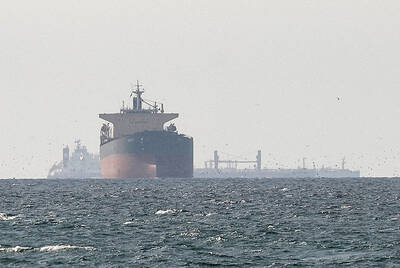
A ship that appears to be taking on the identity of a scrapped gas carrier exited the Strait of Hormuz on Friday, showing how strategies to get through the waterway are evolving as the Middle East war progresses. The vessel identifying as liquefied natural gas (LNG) carrier Jamal left the Strait on Friday morning, ship-tracking data show. However, the same tanker was also recorded as having beached at an Indian demolition yard in October last year, where it is being broken up, according to market participants and port agent’s reports. The ship claiming to be Jamal is likely a zombie vessel that

German Chancellor Friedrich Merz’s conservative Christian Democratic Union (CDU) yesterday faced a regional election battle in Rhineland-Palatinate, now held by the center-left Social Democratic Party (SPD). Merz’s CDU has enjoyed a narrow poll lead over the SPD — their coalition partners at the national level — who have ruled the mid-sized state for 35 years. Polling third is the far-right Alternative for Germany (AfD), which spells a greater threat to the two centrist parties in several state elections in September in the country’s ex-communist east. The picturesque state of Rhineland-Palatinate, bordering France, Belgium and Luxembourg and with a population of about 4 million,
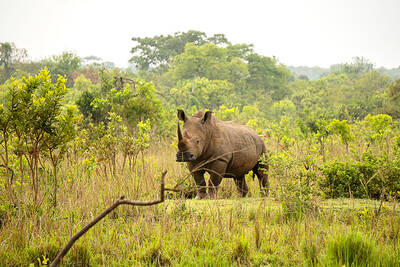
Ugandan wildlife authorities have reintroduced rhinos into a remote protected area where they were once poached into extinction, an event seen by conservationists as a milestone in efforts to support the recovery of a species threatened by poaching. On Tuesday, two southern white rhinos from a private ranch in the East African country were reintroduced into Kidepo Valley National Park in the country’s northeast. Two more rhinos in metallic crates arrived on Thursday. There have been no rhinos in the park since 1983, the result of poaching. However, a private ranch in central Uganda — the Ziwa Rhino Sanctuary — has been
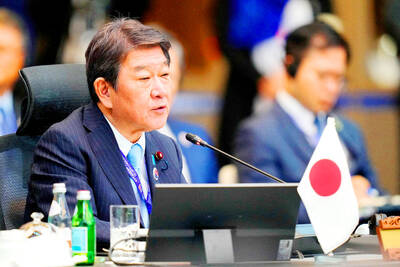
LAW CONSTRAINTS: The US has been pressing allies to send warships to open the Strait, but Tokyo’s military actions are limited under its postwar pacifist constitution Japan could consider deploying its military for minesweeping in the Strait of Hormuz if a ceasefire is reached in the war on Iran, Japanese Minister of Foreign Affairs Toshimitsu Motegi said yesterday. “If there were to be a complete ceasefire, hypothetically speaking, then things like minesweeping could come up,” Motegi said. “This is purely hypothetical, but if a ceasefire were established and naval mines were creating an obstacle, then I think that would be something to consider.” Japan’s military actions are limited under its postwar pacifist constitution, but 2015 security legislation allows Tokyo to use its Self-Defense Forces overseas if an attack,


 RSS
RSS