


Canadian Prime Minister Paul Martin called general elections for June 28, but he faces a much tougher test than expected six months ago, when he took office on his predecessor's retirement.
Martin, who replaced Jean Chretien in December, was supposed to romp to victory, but recent polls suggest support for his Liberal Party is teetering between majority and minority status.

PHOTO: REUTERS
Spending scandals and unpopular Liberal governments in Ontario, British Columbia and Quebec, which contain some 70 percent of the country's 31 million people, have rocked Martin's reputation earned as the finance minister who eliminated the federal deficit in the mid-1990s.
Martin doesn't have to call an election now, as there is still more than a year left in Chretien's term. But Martin has wanted to gain his own mandate from Canadians.
Taxes
He announced the polling date Sunday in a speech after emerging from a meeting with Governor-General Adrienne Clarkson at her residence. As the representative of Queen Elizabeth II of Britain, Clarkson is the one who dissolves Parliament to allow the election.
The Liberals have governed Canada since 1993, and some polls suggest rising support for Conservative Party leader Stephen Harper could stick Canada with a minority government. Under that scenario, the Liberals would get the most seats in Canada's Parliament, but would need support from other parties to pass legislation.
In his first speech on the campaign trail Sunday, Martin told Canadians in Ottawa that the election would turn on whether to retain Canada's social safety net.
He sniped at Harper, saying his plan to reduce taxes to below those in the US would have grave consequences.
``You cannot have a healthcare system like Canada's, you can't have social programs like Canada's, with taxation levels like those of the United States,'' Martin said.
Missile defense
Other major election themes include improving defense spending, helping city infrastructure and scrutinizing the financial credibility of the government in the wake of a US$72 million scandal over government advertising and a staggering US$700 million cost overrun on implementing a national gun registry.
The Canadian military is still crippled by budget reductions of about one-quarter during the 1990s, when then finance minister Martin cut costs as part of his plan to balance the budget.
Canada has now had balanced budgets for seven years in a row, longer than any other G-8 country, but it faces pressures from inside and abroad to restore funding for foreign troop deployments, such as in Afghanistan and Haiti, to hike border security and to join the US missile defense program.
Marijuana
There are also cross-border issues with the US that will contribute to the election debate: a ban on Canadian beef in the US due to outbreaks of mad cow disease, a longstanding dispute over softwood lumber sales -- and to a lesser extent, proposals to decriminalize marijuana possession and legalize gay marriage across the country.
Martin has striven to improve relations with the US after his predecessor, Chretien, refused to send troops to Iraq and one of his aides called US President George W. Bush a ``moron.'' Martin had positive meetings with Bush in Mexico in January and in Washington in April.
Martin also faces drooping support in the mostly French-speaking province of Quebec, where the separatist Bloc Quebecois Party has nearly twice the support of the Liberals, according to an Ipsos-Reid poll.
The prime minister said a vote for the Bloc would isolate the province and help ``lead Quebec out of Canada.''
Bloc leader Gilles Ducceppe campaigned on Sunday in Montreal, calling for the removal of ``obstacles and intrusion from Ottawa'' in Quebec affairs.
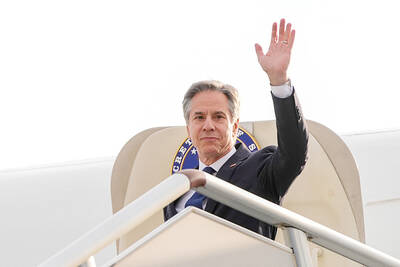
‘IN A DIFFERENT PLACE’: The envoy first visited Shanghai, where he attended a Chinese basketball playoff match, and is to meet top officials in Beijing tomorrow US Secretary of State Antony Blinken yesterday arrived in China on his second visit in a year as the US ramps up pressure on its rival over its support for Russia while also seeking to manage tensions with Beijing. The US diplomat tomorrow is to meet China’s top brass in Beijing, where he is also expected to plead for restraint as Taiwan inaugurates president-elect William Lai (賴清德), and to raise US concerns on Chinese trade practices. However, Blinken is also seeking to stabilize ties, with tensions between the world’s two largest economies easing since his previous visit in June last year. At the

UNSETTLING IMAGES: The scene took place in front of TV crews covering the Trump trial, with a CNN anchor calling it an ‘emotional and unbelievably disturbing moment’ A man who doused himself in an accelerant and set himself on fire outside the courthouse where former US president Donald Trump is on trial has died, police said yesterday. The New York City Police Department (NYPD) said the man was declared dead by staff at an area hospital. The man was in Collect Pond Park at about 1:30pm on Friday when he took out pamphlets espousing conspiracy theories, tossed them around, then doused himself in an accelerant and set himself on fire, officials and witnesses said. A large number of police officers were nearby when it happened. Some officers and bystanders rushed
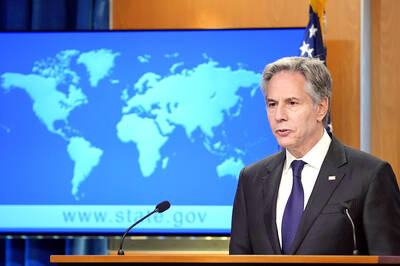
Beijing is continuing to commit genocide and crimes against humanity against Uyghurs and other Muslim minorities in its western Xinjiang province, U.S. Secretary of State Antony Blinken said in a report published on Monday, ahead of his planned visit to China this week. The State Department’s annual human rights report, which documents abuses recorded all over the world during the previous calendar year, repeated language from previous years on the treatment of Muslims in Xinjiang, but the publication raises the issue ahead of delicate talks, including on the war in Ukraine and global trade, between the top U.S. diplomat and Chinese
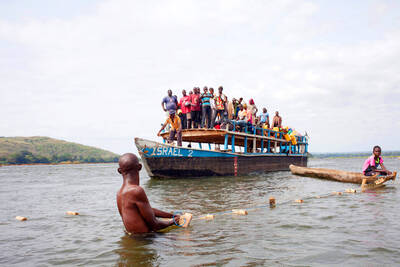
RIVER TRAGEDY: Local fishers and residents helped rescue people after the vessel capsized, while motorbike taxis evacuated some of the injured At least 58 people going to a funeral died after their overloaded river boat capsized in the Central African Republic’s (CAR) capital, Bangui, the head of civil protection said on Saturday. “We were able to extract 58 lifeless bodies,” Thomas Djimasse told Radio Guira. “We don’t know the total number of people who are underwater. According to witnesses and videos on social media, the wooden boat was carrying more than 300 people — some standing and others perched on wooden structures — when it sank on the Mpoko River on Friday. The vessel was heading to the funeral of a village chief in


 RSS
RSS