

US officials have for months asserted that foreign fighters and terrorists are playing a major role in the anti-American insurgency in Fallujah and the rest of Iraq.
By blaming foreigners, US authorities hope to quash the idea that Iraqis are rising up against military occupation and frame the conflict as part of the wider war on terror. However, foreign fighters play a tiny role in Iraq's insurgency, many military experts say.
In Fallujah, US military leaders say around 90 percent of the 1,000 or more fighters battling the Marines are Iraqis. To date, there have been no confirmed US captures of foreign fighters in the city -- although a handful of suspects have been arrested.
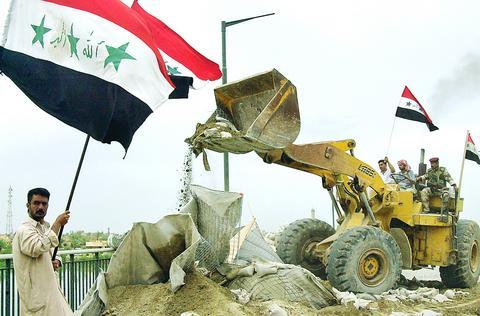
PHOTO: AP
Those who have spent time inside Fallujah have described a city consumed with the fight -- fathers and sons fighting for the local mujahidin and wives and daugh-ters cooking and caring for the wounded.
"The whole city supports this jihad," said Houssam Ali Ahmed, 53, a Fallujah resident who fled to Baghdad when his neighborhood was caught in the fighting. "The people of Fallujah are fighting to defend their homes. We are Muslim mujahidin fighting a holy war."
Elsewhere in Iraq, US military commanders say foreigners have an even smaller role in the insurgency.
In Baghdad, US Major General Martin Dempsey has said foreigners account for just 1 percent or so of guerrillas. Dempsey said his 1st Armored Division detained just 50 to 75 foreign fighter suspects in Baghdad over the past year, among a population of captured guerrillas that reached 2,000.
In March, Dempsey called the idea that foreign fighters were flooding Iraq ``a misconception.''
Foreigners are present, and have had a greater impact on the insurrection than their numbers would suggest, Dempsey and others have said. Foot soldiers of Jordanian terror suspect Abu Musab al-Zarqawi are thought to have operated in Fallujah and launched devastating bombings elsewhere.
At least one al-Qaeda-linked suspect has been detained in Iraq, and a Yemeni man attempting to set off a car bomb was detained last summer. A Kuwaiti newspaper reported Sunday that four of the country's citizens have been killed fighting the occupation.
US Marines have captured at least one foreigner in Fallujah, a Sudanese man, said Lieutenant Colonel Brennan Byrne, a Marine battalion commander. Five foreign passport holders have been detained in the city, a top military official said. Byrne said he was unsure whether any had fought in the uprising.
But foreign participation appears far lower than US occupation officials like chief spokesman Dan Senor have suggested. Senor has portrayed the battle of Fallujah as one in which foreign fighters and terrorists were holding the city's "silent majority" hostage.
"I would also say that there is a sense of frustration we are hearing among the silent majority of Fallujans about the foreign fighters and international terrorists that are hanging their hats in Fallujah right now," Senor said last month.
"I find it hard to imagine that the people of Fallujah would tolerate outsiders turning their town into a battlefield," said Jeremy Binnie, a Middle East military analyst with London consultancy Jane's. "The foreign fighters are not the primary problem. Iraqi nationalists and Islamists are the problem."
Guerrillas in Fallujah have the support of many, a US defense official in Washington said. Referring to the brutal March 30 killing of four US contractors and the mutilation of their corpses, he said, "It wasn't Fedayeen cheering those burning bodies. It was young children and adults."
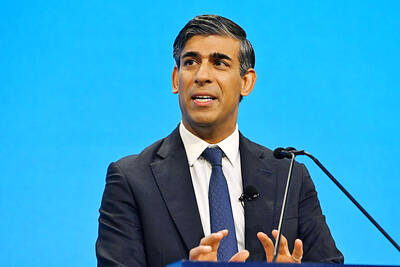
Former British prime minister Rishi Sunak on Wednesday urged so-called middle powers to become a “poisonous shrimp” to carve out strategic economic leverage in a more turbulent global environment. Sunak drew from a metaphor by former Singaporean prime minister Lee Kuan Yew (李光耀): A big fish will eat a smaller fish, and the smaller fish will eat the shrimp. Lee made the point a year after the Asian nation’s independence in 1966 that the city-state needed to build up its defense mechanisms — like a shrimp that stings — so it would be left alone by predators. “He was thinking about what Singapore’s
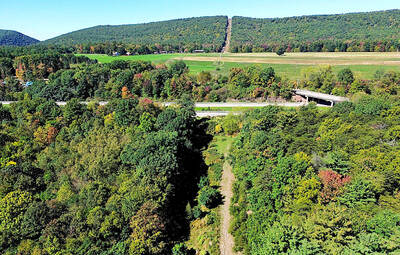
On his terrace overlooking the forest in eastern Pennsylvania, Ed Negra lays out four letters. All are from a developer promising a US$10,000 check to each household once its data center is running. “I call it a bribe,” the US retiree said. The scene is picture-perfect. Autumn leaves are turning russet, and there is a stunning mountain view in this corner of Pennsylvania, a key state in the US’ upcoming midterm elections. “We thought it was a beautiful place to retire,” said the septuagenarian, who used to manage a large building-supply store in neighboring New Jersey. He and his wife settled in a sprawling
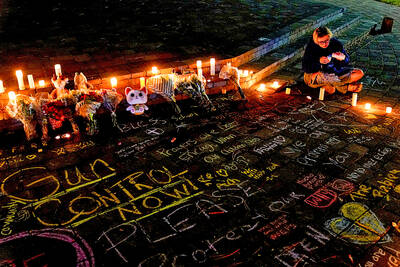
A 16-year-old on Thursday shot his way through locked doors to get into an elementary school in Bend, Oregon, killing three children and a teacher. He was then shot by a person at the scene who followed him inside, authorities said. The suspect was found dead inside the school minutes after the shooting was first reported, Bend Police Chief Mike Krantz said. The three children killed were aged 5, 8 and 11. Another child, 7, and a teacher, 54, were injured and taken to the hospital in critical condition, he said. The first 911 call came just before 1pm from a person in

DATA SHARING: The mission includes keeping New Zealand safe, and the wider Pacific region open, stable and resilient, the NZ Security Intelligence Service said Fiji is enlisting New Zealand’s intelligence agency to help overhaul its fragmented security sector, Suva said on Wednesday, as US warnings of suspected China-linked cyberintrusions highlight concerns about vulnerabilities in the nation. The Fijian Cabinet approved a six-month partnership with the New Zealand Security Intelligence Service (NZSIS), funded by Wellington, to assess Fiji’s intelligence structure and recommend reforms, Fiji’s government said in a statement. The review is designed to improve information-sharing and coordination across agencies, and reforms would create a more sustainable intelligence framework with clearer roles and improved support for security decisionmaking, the statement said. Fiji did not identify a specific threat


 RSS
RSS