


UN Secretary-General Kofi Annan urged more countries to join efforts to stabilize Iraq and said the United States was intensifying talks with France, Germany and Russia -- all of which opposed the war.
Annan said on Sunday that he believed the three key opponents of the US-led invasion weren't prepared "at this stage" to send troops to join occupation forces in Iraq. But he didn't rule out the possibility of their sending troops in the future.
"It would be extremely helpful to the process if we can really internationalize the efforts in Iraq and bring in everybody," he said in an interview on the US' NBC television network that focused largely on Iraq.
If more countries deploy troops, Annan said, the US might reduce its force, "but it will depend on how fast and how quickly we are able to get other governments to join and provide troops."
As Annan's envoy Lakhdar Brahimi prepares to return to Iraq this week, questions remain about the interim government he is trying to assemble to take over from the occupiers on June 30, including whether it will have limited or complete sovereignty and the future of coalition military forces.
Annan said the US and Britain, as the occupying powers in Iraq, should transfer complete sovereignty, acknowledging that any interim government would have limited powers because an elected government would take over after voting scheduled for January 2005.
Annan said he expects the UN Security Council to adopt a new resolution authorizing the foreign forces now in Iraq to remain after June 30 and encourage governments "to come together in a genuine international effort to help stabilize Iraq."
The council has already authorized the current multinational force of 138,000 US troops and 24,900 troops from other countries.
Asked if it would be helpful if US President George W. Bush sat down with the Germans, French, Russians and other countries that opposed the war to reach some kind of reconciliation, Annan replied: "I think we need to do whatever we can to pull in all countries."
He said US Secretary of State Colin Powell was in Germany recently and Bush had spoken to some key leaders. "I think the contacts and discussions are intensifying," Annan said.
He said he did not think France, Germany or Russia were ready to provide troops "at this stage," but added, "Down the line, one never knows."
Brahimi has come under fire for claiming his efforts in Iraq have been thwarted by Israel's "policy of domination and the suffering imposed on the Palestinians," which he called a "great poison."
Annan said this was Brahimi's perception of the public's views in the region, and expressed hope that these would not undermine his Iraq mission.
"One may disagree with the words he used, and I'm sure he himself would not use those words again. But I think to use his statement to prevent him from playing a constructive role would be a mistake," Annan said.

‘IN A DIFFERENT PLACE’: The envoy first visited Shanghai, where he attended a Chinese basketball playoff match, and is to meet top officials in Beijing tomorrow US Secretary of State Antony Blinken yesterday arrived in China on his second visit in a year as the US ramps up pressure on its rival over its support for Russia while also seeking to manage tensions with Beijing. The US diplomat tomorrow is to meet China’s top brass in Beijing, where he is also expected to plead for restraint as Taiwan inaugurates president-elect William Lai (賴清德), and to raise US concerns on Chinese trade practices. However, Blinken is also seeking to stabilize ties, with tensions between the world’s two largest economies easing since his previous visit in June last year. At the

UNSETTLING IMAGES: The scene took place in front of TV crews covering the Trump trial, with a CNN anchor calling it an ‘emotional and unbelievably disturbing moment’ A man who doused himself in an accelerant and set himself on fire outside the courthouse where former US president Donald Trump is on trial has died, police said yesterday. The New York City Police Department (NYPD) said the man was declared dead by staff at an area hospital. The man was in Collect Pond Park at about 1:30pm on Friday when he took out pamphlets espousing conspiracy theories, tossed them around, then doused himself in an accelerant and set himself on fire, officials and witnesses said. A large number of police officers were nearby when it happened. Some officers and bystanders rushed

Beijing is continuing to commit genocide and crimes against humanity against Uyghurs and other Muslim minorities in its western Xinjiang province, U.S. Secretary of State Antony Blinken said in a report published on Monday, ahead of his planned visit to China this week. The State Department’s annual human rights report, which documents abuses recorded all over the world during the previous calendar year, repeated language from previous years on the treatment of Muslims in Xinjiang, but the publication raises the issue ahead of delicate talks, including on the war in Ukraine and global trade, between the top U.S. diplomat and Chinese
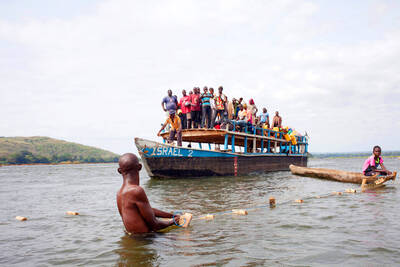
RIVER TRAGEDY: Local fishers and residents helped rescue people after the vessel capsized, while motorbike taxis evacuated some of the injured At least 58 people going to a funeral died after their overloaded river boat capsized in the Central African Republic’s (CAR) capital, Bangui, the head of civil protection said on Saturday. “We were able to extract 58 lifeless bodies,” Thomas Djimasse told Radio Guira. “We don’t know the total number of people who are underwater. According to witnesses and videos on social media, the wooden boat was carrying more than 300 people — some standing and others perched on wooden structures — when it sank on the Mpoko River on Friday. The vessel was heading to the funeral of a village chief in


 RSS
RSS