


Forty-five years after it was first proposed, a modern version of the ancient Silk Road that once linked Asia with Europe is taking shape -- a 140,000km web of highways and ferry routes that will again connect the two continents.
Twenty-three Asian nations, including China, Japan and South Korea, signed a treaty this week on the road system, the official Xinhua News Agency reported. Additional Asian countries were expected to endorse the pact later.
The Asian Highway Agreement signed late Monday is intended to ensure construction of a road system that would ease the isolation of many landlocked Asian nations and establish a modern version of the ancient trading route that once linked the continent to Europe by camel train.
First proposed in 1959 but delayed by decades of Cold War distrust, the project has been endorsed in principle by 32 countries.
Even as telecommunications links draw the world ever closer, the realities of geography -- enormous deserts, rugged mountain ranges and impassable jungles -- mean that many in Asia still live in relative isolation.
The Asian Highway would be not one road but an entire system of routes that -- by land and by sea -- would connect Tokyo to Turkey, Bhutan to Bulgaria.
A UN map of the highways as planned roughly resembles a spider web strung from Finland and St. Petersburg to Khabarovsk and Tokyo. Spurs extend through Turkey as it meshes across Central Asia, crosses India and loops through Southeast Asia down to the Indonesian island of Bali.
Big nations like Japan, China, South Korea, Russia and India would certainly benefit from the better trade links a unified highway system would bring. But the project is also designed to help smaller, landlocked countries gain coveted routes to sea ports.
As envisioned, seven landlocked countries would be included: Bhutan, Kazakhstan, Kyrgyzstan, Laos, Mongolia, Nepal and Uzbekistan. Island nations would be linked by ferry to the Asian continent.
"We see the importance of constructing transport linkage within the region in order to distribute development through all countries, not only to the developed ones," Raj Kumar, an economist for the Economic and Social Commission, said in a statement.
The highway plan is part of a broader project to build up all transport links in the region.
Most of the roads already exist but require upgrading to an agreed-upon international standard -- much like the US in the early 1900s, when smaller roads were cobbled together and improved to form the federal highways US 1 and Route 66. Signs would be unified and border facilities improved to handle an expected increase in traffic.
Since the 1990s, the project has gained support and its projected length has doubled to the currently planned 140,000km.
Though Beijing is a key proponent of the plan, so far the potential Asian Highway routes through China total only 13,530km. One would link Shanghai with the border crossing with Pakistan; another would connect the border with Mongolia to the north and Laos to the south.
So far, funding for most of the preliminary work on the Asian Highway has come from Japan. Further financing is expected to come from bigger nations participating, the World Bank and the Asian Development Bank.
"The amount will be tremendous," Kim Hak-su, executive secretary for the commission, said in a statement. "We propose public-private partnerships to fund this effort if governments cannot finance it."

Kouri Richins, a Utah mother who published a children’s book about grief after the death of her husband is to serve a life sentence for his murder without the possibility of parole, a judge ruled on Wednesday. Richins was convicted in March of aggravated murder for lacing a cocktail given to her husband, Eric Richins, with five times the lethal dose of fentanyl at their home near Park City in 2022. A jury also found her guilty of four other felonies, including insurance fraud, forgery and attempted murder for trying to poison her husband weeks earlier on Feb. 14, 2022, with a

‘PERSONAL MISTAKES’: Eileen Wang has agreed to plead guilty to the felony, which comes with a maximum sentence of 10 years in federal prison A southern California mayor has agreed to plead guilty to acting as an illegal agent for the Chinese government and has resigned from her city position, officials said on Monday. Eileen Wang (王愛琳), mayor of Arcadia, was charged last month with one count of acting in the US as an illegal agent of a foreign government. She was accused of doing the bidding of Chinese officials, such as sharing articles favorable to Beijing, without prior notification to the US government as required by law. The 58-year-old was elected in November 2022 to a five-person city council, from which the mayor is selected

DELA ROSA CASE: The whereabouts of the senator, who is wanted by the ICC, was unclear, while President Marcos faces a political test over the senate situation Philippine authorities yesterday were seeking confirmation of reports that a top politician wanted by the International Criminal Court (ICC) had fled, a day after gunfire rang out at the Philippine Senate where he had taken refuge fearing his arrest. Senator Ronald “Bato” dela Rosa, the former national police chief and top enforcer of former Philippine president Rodrigo Duterte’s “war on drugs,” has been under Senate protection and is wanted for crimes against humanity, the same charges Duterte is accused of. “Several sources confirmed that the senator, Senator Bato, is no longer in the Senate premises, but we are still getting confirmation,” Presidential
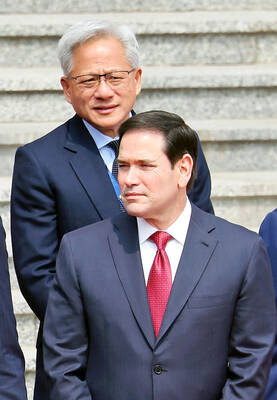
HELP DENIED? The US Department of State said that the Cuban leadership refuses to allow the US to provide aid to Cubans, ‘who are in desperate need of assistance’ US Secretary of State Marco Rubio on Wednesday said that Cuba’s leadership must change, as Washington renewed an offer of US$100 million in aid if the communist nation agrees to cooperate. Cuba has been suffering severe economic tumult led by an energy shortage that plunged 65 percent of the country into darkness on Tuesday. Cuba’s leaders have blamed US sanctions, but Rubio, a Cuban American and critic of the government established by Fidel Castro, said the system was to blame, including corruption by the military. “It’s a broken, nonfunctional economy, and it’s impossible to change it. I wish it were different,” he told


 RSS
RSS