


Spain's new prime minister, Jose Luis Rodriguez Zapatero, was to seek to deepen bilateral cooperation, particularly in the context of dealing with immigration issues and fighting terrorism, when he visited Morocco yesterday on his first foreign trip since taking office.
Socialist Zapatero, the surprise winner of a March 14 general election which followed in the wake of the Madrid train bombings believed the work of Moroccan extremists and which killed 191 people, would hold talks with King Mohamed VI and Moroccan Prime Minister Driss Jettou in Casablanca.
The city was itself the target of a bomb blast last May in which 45 people were killed, including four Spaniards and 12 suicide bombers.
Spanish authorities believe the Madrid bombers had links to the Moroccan Islamic Combat Group (GICM) deemed to be behind the earlier attack.
In an interview with Friday's edition of El Mundo daily, Zapatero called for "respect and dialogue" with Spain's southern neighbor, the two nations separated by the narrow Strait of Gibraltar but brought together by the pressing issues of terrorism and immigration to Europe via Morocco.
Ties between the two countries were strained under Zapatero's conservative predecessor Jose Maria Aznar and the summer of 2002 saw a spat over a small disputed island -- Perejil in Spanish and known to Moroccans as Leila.
US mediation helped resolve that standoff but Zapatero said he did not want outside involvement getting between Madrid and Rabat in future dealings between the two governments.
The longer-standing confrontation over the status of the former Spanish colony of Western Sahara, to which Morocco has a longstanding claim, is likely not to feature in Zapatero's five-and-a-half-hour visit yesterday, with Spain hoping Morocco will accept a UN-brokered settlement.
The Spanish north African enclaves of Ceuta and Melilla are also unlikely to be discussed.
"In principle, Ceuta and Melilla are not a problem and aside from occasional affirmations Morocco respects ... Spain on this issue," according to Zapatero.
In choosing Morocco as his first foreign destination as prime minister Zapatero is not only carrying on a recent Spanish tradition but showing Rabat that Spain wants to deepen ties and recognize that the links between them are of strategic importance for Afro-European relations as a whole.
First deputy prime minister Maria Teresa Fernandez de la Vega said the meeting would be a coming together of nations whose relations had often consisted of "reproach and unnecessary tension."
Zapatero and King Mohamed had a lengthy telephone conversation days after the former's election success in which the Moroccan monarch congratulated the Spanish leader on his win and passed on condolences for the March 11 attacks, the worst terrorist outrage Spain has known.
Earlier this week, the king also said he hoped to see "the inauguration of a new era" in bilateral relations during a conversation with Spain's King Juan Carlos.
In his interview with El Mundo, Zapatero said "given that the economic and democratic development of Morocco is in our interest," it was "fundamental" for Spain to give its north African neighbor economic and commercial help, investment and political cooperation.
While in Casablanca Zapatero will inaugurate a commemorative plaque to the victims of last May's blasts in the city.

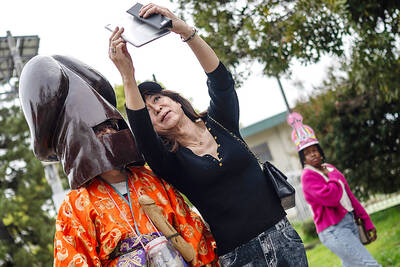
Showcasing phallus-shaped portable shrines and pink penis candies, Japan’s annual fertility festival yesterday teemed with tourists, couples and families elated by its open display of sex. The spring Kanamara Matsuri near Tokyo features colorfully dressed worshipers carrying a trio of giant phallic-shaped objects as they parade through the street with glee. The festival, as legend has it, honors a local blacksmith in the Edo Period (1603-1868) who forged an iron dildo to break the teeth of a sharp-toothed demon inhabiting a woman’s vagina that had been castrating young men on their wedding nights. A 1m black steel phallus sits in the courtyard of

HIGH HOPES: The power source is expected to have a future, as it is not dependent on the weather or light, and could be useful for places with large desalination facilities A Japanese water plant is harnessing the natural process of osmosis to generate renewable energy that could one day become a common power source. The possibility of generating power from osmosis — when water molecules pass from a less salty solution to a more salty one — has long been known. However, actually generating energy from that has proved more complicated, in part due the difficulty of designing the membrane through which the molecules pass. Engineers in Fukuoka, Japan, and their private partners think they might have cracked it, and have opened what is only the world’s second osmotic power plant. It generates

JAN. 1 CLAUSE: As military service is voluntary, applications for permission to stay abroad for over three months for men up to age 45 must, in principle, be granted A little-noticed clause in sweeping changes to Germany’s military service policy has triggered an uproar after it emerged that the law requires men aged up to 45 to get permission from the armed forces before any significant stay abroad, even in peacetime. The legislation, which went into effect on Jan. 1 aims to bolster the military and demands all 18-year-old men fill out a questionnaire to gauge their suitability to serve in the armed forces, but stops short of conscription. If the “modernized” model fails to pull in enough recruits, parliament will be compelled to discuss the reintroduction of compulsory service, German
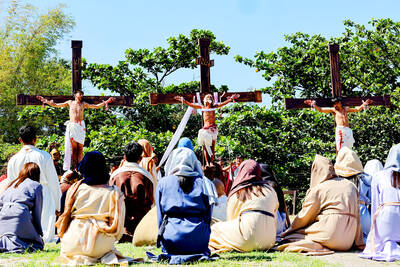
Hundreds of Filipinos and tourists flocked to a sun-bleached field north of Manila yesterday, on Good Friday, to witness one of the country’s most blood-soaked displays of religious fervor, undeterred by rising fuel prices. Scores of bare-chested flagellants with covered faces walked barefoot through the dusty streets of Pampanga Province’s San Fernando as they flogged their backs with bamboo whips in the scorching heat. Agence France-Presse (AFP) journalists said they saw devotees deliberately puncturing their skin with glass shards attached to a small wooden paddle to ensure their bleeding during the ritual, a way to atone for sins and seek miracles from


 RSS
RSS