


Saudi Arabia said on Monday that it would not use oil prices to try to sway the US presidential election, denying an allegation that the kingdom would cut petroleum prices before November to boost President George W. Bush's re-election bid.
Washington Post journalist Bob Woodward said in a television interview on Sunday that Saudi Arabia's ambassador to the US, Prince Bandar bin Sultan, promised Bush the Saudis would cut oil prices before November.
Woodward, author of Plan of Attack, a new book on Bush's preparations for the Iraq war, said Prince Bandar had pledged the Saudis would try to fine-tune oil prices to prime the US economy for the vote, something they understood would favor Bush.
Bandar said on CNN that he made no such pledge and suggested any conversations he had about oil prices with Bush were similar to discussions he had had with previous US presidents.
"Oil prices and Saudi Arabia and American politics are intertwined. I wish we can influence the oil price situation, but we can not," Bandar said.
A Saudi official issued a statement saying the world's largest oil exporter will remain a reliable supplier of oil.
"We do not use oil for political purposes," said Adel Al-Jubeir, a foreign affairs adviser to the crown prince of Saudi Arabia.
"It is too important a commodity, and its impact on the global economy [of which we are a part] is tremendous," he said.
"Saudi Arabia also does not interfere in elections," Al-Jubeir said.
White House spokesman Scott McClellan declined to comment directly on Woodward's remarks.
He said Bandar, in recent White House talks, "committed to making sure prices remained in a range of, I believe, US$22 to US$28 per barrel of oil, and that they don't want to do anything that would harm our consumers or harm our economy."
OPEC has an official price target band of US$22 to US$28 for its oil. It was last in that range on Dec. 1, having been above it repeatedly for weeks before that. On Monday, US crude oil futures rose above US$38 a barrel to a four-week high.
"Prices should be determined by market forces, and we are always in close contact with producers around the world on these issues," McClellan told reporters.
Woodward's assertion drew criticism on Monday from Democratic presidential challenger Senator John Kerry.
Kerry said it would be "outrageous and unacceptable" if the Bush administration and the Saudis reached a "secret" deal to tie the price of gasoline and fuel supplies to the election.
Democrats have attacked Bush, a former Texas oilman, for failing to stem rising domestic gasoline prices, which hit a high of US$1.81 a gallon on Monday, a new record for the fourth week in a row, according to the US Energy Department.
Kerry has criticized Bush for not taking a tougher stand against OPEC, and the Saudis in particular, after the cartel decided to cut its oil production quota earlier this month.
Prince Bandar has been the Saudi envoy to the US for 20 years and is part of the Saudi royal family, which has had a close relationship with the Bush family for years.
On April 1, after Saudi Arabia led OPEC's push to cut daily output by 1 million barrels, Bandar told the White House that the kingdom would not allow shortages to hurt world economic growth.
US Senator Charles Schumer, a Democrat, asked Bush on Monday to send Bandar home.
"I urge you to take immediate action to safeguard the integrity of the American electoral process by deporting Prince Bandar and canceling his diplomatic visa," Schumer said in a letter to Bush.

As the sun sets on another scorching Yangon day, the hot and bothered descend on the Myanmar city’s parks, the coolest place to spend an evening during yet another power blackout. A wave of exceptionally hot weather has blasted Southeast Asia this week, sending the mercury to 45°C and prompting thousands of schools to suspend in-person classes. Even before the chaos and conflict unleashed by the military’s 2021 coup, Myanmar’s creaky and outdated electricity grid struggled to keep fans whirling and air conditioners humming during the hot season. Now, infrastructure attacks and dwindling offshore gas reserves mean those who cannot afford expensive diesel

Does Argentine President Javier Milei communicate with a ghost dog whose death he refuses to accept? Forced to respond to questions about his mental health, the president’s office has lashed out at “disrespectful” speculation. Twice this week, presidential spokesman Manuel Adorni was asked about Milei’s English Mastiff, Conan, said to have died seven years ago. Milei, 53, had Conan cloned, and today is believed to own four copies he refers to as “four-legged children.” Or is it five? In an interview with CNN this month, Milei referred to his five dogs, whose faces and names he had engraved on the presidential baton. Conan,

French singer Kendji Girac, who was seriously injured by a gunshot this week, wanted to “fake” his suicide to scare his partner who was threatening to leave him, prosecutors said on Thursday. The 27-year-old former winner of France’s version of The Voice was found wounded after police were called to a traveler camp in Biscarrosse on France’s southwestern coast. Girac told first responders he had accidentally shot himself while tinkering with a Colt .45 automatic pistol he had bought at a junk shop, a source said. On Thursday, regional prosecutor Olivier Janson said, citing the singer, that he wanted to “fake” his suicide
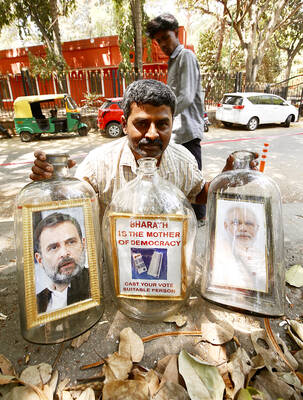
Indian Prime Minister Narendra Modi reaffirmed his pledge to replace India’s religion-based marriage and inheritance laws with a uniform civil code if he returns to office for a third term, a move that some minority groups have opposed. In an interview with the Times of India listing his agenda, Modi said his government would push for making the code a reality. “It is clear that separate laws for communities are detrimental to the health of society,” he said in the interview published yesterday. “We cannot be a nation where one community is progressing with the support of the Constitution while the other


 RSS
RSS