


More than half the US' population lives in or around areas that violate clean air standards, according to a list to be released tomorrow by the federal government.
The list is a result of new federal standards -- the first in more than two decades -- that will sweep beyond traditional smog-filled metropolises like Houston, Los Angeles and New York to encompass smaller cities such as Little Rock, Arkansas, and Birmingham, Alabama, where the air appears relatively clear. In San Antonio, which has already begun measures to combat air pollution, the local government broadcasts warnings telling children not to play outside even on days when the skies are azure blue.
Rural communities will be affected along with at least seven national parks, including the Great Smoky Mountains in North Carolina and Tennessee, Acadia in Maine and Yosemite in California.
Tomorrow, the Environmental Protection Agency will release a list of about 500 counties that violate or contribute to violations of ground-level ozone, more than double the number listed under older standards. Ground-level ozone, which is odorless and invisible, is a major component of smog on hot summer days. Prolonged exposure causes the equivalent of sunburn to the lungs.
The federal standards will have wide economic and environmental effects and the makeup of the list has been the subject of lobbying in Washington. Areas in violation face the loss of federal money for roads. Industrial development could be barred unless companies prove that they will not make pollution worse.
Since passage of the 1970 Clean Air Act, the country's air is significantly cleaner, but scientific research continues to ratchet down the amount of pollution that is considered healthy to breathe. One reason for the dirty-air designations is "to communicate to the residents of the areas that the air they are breathing is not as healthy as our national standards," said Michael Leavitt, the administrator of the Environmental Protection Agency, which makes the determinations.
The new designations are the result of a process that started in 1997 when the Bill Clinton administration tightened standards for ozone and fine particulate soot, which lodges in the lungs and contributes to lung disease, heart attacks and premature death.
In all, about 160 million people live in areas that will be affected by the new standards, up from 110 million affected by existing rules.

A humanoid robot that won a half-marathon race for robots in Beijing on Sunday ran faster than the human world record in a show of China’s technological leaps. The winner from Honor, a Chinese smartphone maker, completed the 21km race in 50 minutes and 26 seconds, said a WeChat post by the Beijing Economic-Technological Development Area, also known as Beijing E-Town, where the race began. That was faster than the human world record holder, Ugandan Jacob Kiplimo, who finished the same distance in about 57 minutes in March at the Lisbon road race. The performance by the robot marked a significant step forward
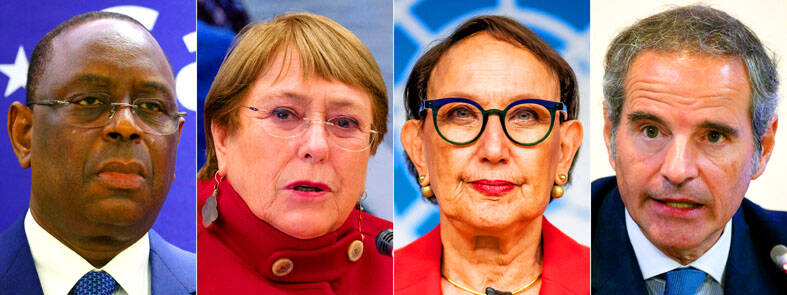
Four contenders are squaring up to succeed Antonio Guterres as secretary-general of the UN, which faces unprecedented global instability, wars and its own crushing budget crisis. Chile’s Michelle Bachelet, Argentina’s Rafael Grossi, Costa Rica’s Rebeca Grynspan and Senegal’s Macky Sall are each to face grillings by 193 member states and non-governmental organizations for three hours today and tomorrow. It is only the second time the UN has held a public question-and-answer, a format created in 2016 to boost transparency. Ultimately the five permanent members of the UN’s top body, the Security Council, hold the power, wielding vetoes over who leads the

South Korea’s air force yesterday apologized for a 2021 midair collision involving two fighter jets, a day after auditors said the pilots were taking selfies and filming during the flight and held them responsible for the accident. “We sincerely apologize to the public for the concern caused by the accident that occurred in 2021,” an air force spokesman told a news conference, adding that one of the pilots involved had been suspended from flying duties, received severe disciplinary action and has since left the military. The apology followed a report released on Wednesday by the South Korean Board of Audit and Inspection,

An earthquake registering a preliminary magnitude of 7.7 off northern Japan on Monday prompted a short-lived tsunami alert and the advisory of a higher risk of a possible mega-quake for coastal areas there. The Cabinet Office and the Japan Meteorological Agency said there was a 1% chance for a mega-quake, compared to a 0.1% chance during normal times, in the next week or so following the powerful quake near the Chishima and Japan trenches. Officials said the advisory was not a quake prediction but urged residents in 182 towns along the northeastern coasts to raise their preparedness while continuing their daily lives. Prime


 RSS
RSS