


Fresh links between last month's Madrid bomb attacks and the UK emerged on Sunday after it was reported that terror suspects telephoned the UK shortly before blowing themselves up 11 days ago.
At least one call to the UK was made while seven people were surrounded by police in an apartment building in the Madrid dormitory town of Leganes, according to police sources quoted by El Pais newspaper on Sunday.
No details were given of the conversation, which would have taken place during the two hours between the start of the siege and its dramatic end.
The identity of the person who received the call is also not known, with police sources speculating it might have been a "spiritual leader."
"This reinforces suspicions that the terrorists who have been active in Spain receive support from Britain," El Pais said.
The newspaper said investigators believed the recipient of the phone call was a radical preacher who had fallen out with moderate Muslim leaders. They said information on him was, at best, sketchy.
Previous reports in Spanish newspapers have suggested that several members of the group phoned relatives to say goodbye before they blew themselves up when police started to attack the apartment.
The call to the UK, therefore, could also have been to say farewell to family.
The commissioner of the London-based Metropolitan police, Sir John Stevens, has suggested there might be links between al-Qaeda supporters in the UK and the Madrid attacks, and Scotland Yard has sent detectives to Madrid to liaise with the investigating officers.
Last month detectives raided four homes in the East End of London and one in the north-west of the capital based on information received from the Spanish authorities. There were no arrests.
Spanish forensic scientists have, so far, identified four of the corpses found among the wreckage of the Leganes apartment -- some of which carried suicide bomb belts.
Three of those men appear in a video, made a week before their deaths, that survived the bomb blast, according to El Pais.
On the tape they threatened further attacks in Spain if troops were not pulled out of Iraq and Afghanistan.
The Spanish interior minister, Angel Acebes, has said that British police are helping with the investigation.
Abu Qatada, a Jordanian cleric being held without charge in the UK, has been linked to violence in Spain -- but could not have been the recipient of the call from Leganes.
An investigating magistrate, Baltasar Garzon, named Qatada as "a member of Osama bin Laden's infrastructure" in a case he has brought against more than a dozen people accused of, among other things, involvement in the Sept. 11 attacks in the US.
His indictment also charged two UK-based Islamists, who use the names Shakur and Abu Abdulrahman, with involvement in Sept. 11.
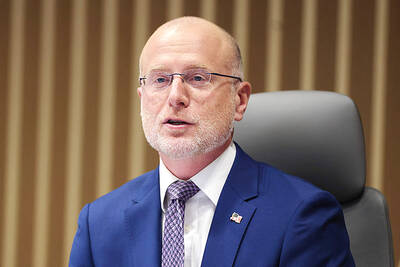
FAKE NEWS? ‘When the government demands the press become a state mouthpiece under the threat of punishment, something has gone very wrong,’ a civic group said The top US broadcast regulator on Saturday threatened media outlets over negative coverage of the Middle East war, after US President Donald Trump slammed critical headlines from the “Fake News Media.” The US president since his first term has derided mainstream media as “fake news” and has sued major outlets over what he sees as unfair coverage. Brendan Carr, head of the US Federal Communications Commission — which oversees the nation’s radio, television and Internet media — said broadcasters risked losing their licenses over news coverage. “The law is clear. Broadcasters must operate in the public interest, and they will
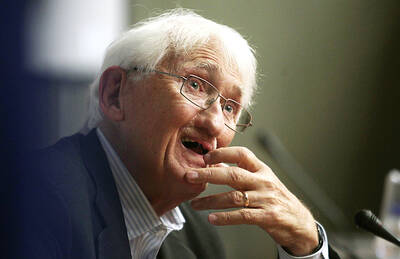
INFLUTENTIAL THEORIST: Habermas was particularly critical of the ‘limited interest’ shown by German politicians in ‘shaping a politically effective Europe Jurgen Habermas, whose work on communication, rationality and sociology made him one of the world’s most influential philosophers and a key intellectual figure in his native Germany, has died. He was 96. Habermas’ publisher, Suhrkamp, said he died on Saturday in Starnberg, near Munich. Habermas frequently weighed in on political matters over several decades. His extensive writing crossed the boundaries of academic and philosophical disciplines, providing a vision of modern society and social interaction. His best-known works included the two-volume Theory of Communicative Action. Habermas, who was 15 at the time of Nazi Germany’s defeat, later recalled the dawn of
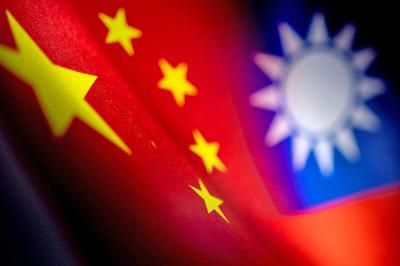
The Chinese public maintains relatively warm sentiments toward Taiwan and strongly prefers non-military paths to improving cross-strait relations, a recent survey conducted by the Atlanta, Georgia-based Carter Center and Emory University showed. The “China Pulse” research project, which polled 2,506 adults between Oct. 27 last year and Jan. 1 this year, found that 86 percent of respondents support strengthening cultural ties, while 81 percent favor deepening economic interaction. The report, co-authored by political scientists at Emory University and advisors at the Carter Center, indicates that the Chinese public views Taiwan’s importance through a lens of shared history and culture rather than geopolitical

Cannabis-based medicines have shown little evidence of effectiveness for treating most mental health and substance-use disorders, according to a large review of past studies published in a major medical journal on Monday. Medical use of cannabinoids has been expanding, including in the US, Canada and Australia, where many patients report using cannabis products to manage conditions such as anxiety, post-traumatic stress disorder and sleep problems. Researchers reviewed data from 54 randomized clinical trials conducted between 1980 and May last year involving 2,477 participants for their analysis published in The Lancet. The studies assessed cannabinoids as a primary treatment for mental disorders or substance-use


 RSS
RSS