


Thailand and Malaysia will speed up plans to economically develop the violence-prone region along their shared border to stop it from becoming a breeding ground for insurrection and terrorism, their leaders said yesterday.
Thai Prime Minister Thaksin Shinawatra flew to Malaysia yesterday for urgent talks with his counterpart, Abdullah Ahmad Badawi, about a recent upsurge in violence in his country's Muslim-dominated south which Thai officials blame on Muslim separatists.
The leaders read statements to reporters after their talks, which lasted less than an hour, but they refused to take questions.
There was no mention of the recent claim by Thaksin that terrorists responsible for the attacks have taken shelter in Malaysia. Kuala Lumpur strongly denied the accusation, which raised tensions between the two neighbors ahead of the talks.
Abdullah said Malaysia and Thailand had reaffirmed their agreement to share intelligence about cross-border security issues.
"Terrorism is something that we totally oppose, we stand together against combating terrorists, criminals, drug peddlers and other groups that are causing instability and trouble to both countries," Abdullah said.
He said senior officials from the two countries would meet soon to discuss how to fight poverty in the border region under a plan announced earlier this year.
"This is one of the most positive things that we can do, so that people along the border will have no cause to ... resort to certain acts that will be against the law," he said.
No timetable or goals have been set for the plan.
"Things cannot be done overnight, but efforts must be made to show some concrete results," Abdullah said.
Thaksin said yesterday's talks were candid and conducted "in all cordiality," and that Abdullah "fully understood the recent difficulties in southern Thailand."
"We were of the same mind in our analysis of the complex nature of the causes and remedies needed to address it," Thaksin said. "We are confident that with the spirit and the closeness of cooperation at all levels, we can confront and overcome common challenges that remain."
Thailand's southern provinces of Narathiwat, Pattani and Yala are the overwhelmingly Buddhist country's only Muslim-majority areas. Mus-lims complain of discrimination in jobs and education.
At least 64 people have been killed this year in shootings by unidentified gunmen who have largely targeted policemen, government officials, teachers and monks. The attacks have been blamed on Islamic separatists, although some officials say the violence may be related to personal conflict.

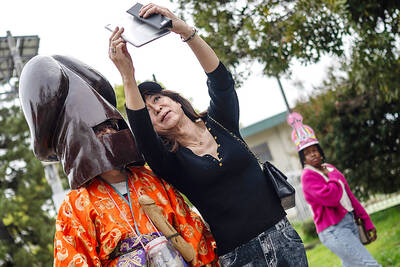
Showcasing phallus-shaped portable shrines and pink penis candies, Japan’s annual fertility festival yesterday teemed with tourists, couples and families elated by its open display of sex. The spring Kanamara Matsuri near Tokyo features colorfully dressed worshipers carrying a trio of giant phallic-shaped objects as they parade through the street with glee. The festival, as legend has it, honors a local blacksmith in the Edo Period (1603-1868) who forged an iron dildo to break the teeth of a sharp-toothed demon inhabiting a woman’s vagina that had been castrating young men on their wedding nights. A 1m black steel phallus sits in the courtyard of

HIGH HOPES: The power source is expected to have a future, as it is not dependent on the weather or light, and could be useful for places with large desalination facilities A Japanese water plant is harnessing the natural process of osmosis to generate renewable energy that could one day become a common power source. The possibility of generating power from osmosis — when water molecules pass from a less salty solution to a more salty one — has long been known. However, actually generating energy from that has proved more complicated, in part due the difficulty of designing the membrane through which the molecules pass. Engineers in Fukuoka, Japan, and their private partners think they might have cracked it, and have opened what is only the world’s second osmotic power plant. It generates

JAN. 1 CLAUSE: As military service is voluntary, applications for permission to stay abroad for over three months for men up to age 45 must, in principle, be granted A little-noticed clause in sweeping changes to Germany’s military service policy has triggered an uproar after it emerged that the law requires men aged up to 45 to get permission from the armed forces before any significant stay abroad, even in peacetime. The legislation, which went into effect on Jan. 1 aims to bolster the military and demands all 18-year-old men fill out a questionnaire to gauge their suitability to serve in the armed forces, but stops short of conscription. If the “modernized” model fails to pull in enough recruits, parliament will be compelled to discuss the reintroduction of compulsory service, German

Hundreds of Filipinos and tourists flocked to a sun-bleached field north of Manila yesterday, on Good Friday, to witness one of the country’s most blood-soaked displays of religious fervor, undeterred by rising fuel prices. Scores of bare-chested flagellants with covered faces walked barefoot through the dusty streets of Pampanga Province’s San Fernando as they flogged their backs with bamboo whips in the scorching heat. Agence France-Presse (AFP) journalists said they saw devotees deliberately puncturing their skin with glass shards attached to a small wooden paddle to ensure their bleeding during the ritual, a way to atone for sins and seek miracles from


 RSS
RSS