


Some brandishing sticks to represent rifles, others on horseback, hundreds of members of Namibia's Herero tribe on Friday re-enacted a bloody battle to commemorate an uprising against colonial German forces a century ago.
But the underlying theme of celebrations near the small Namibian town of Ovitoto, about 100km northeast of Windhoek, was one of reconciliation between the Namibian tribe and its former colonial ruler.
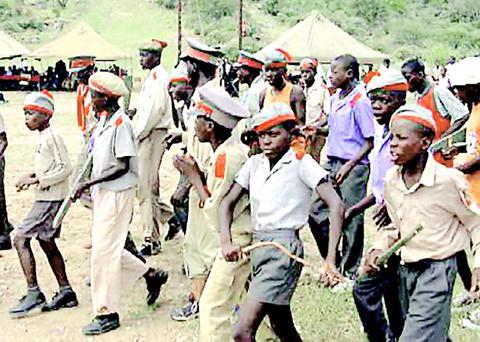
PHOTO: AFP
Dressed in black Victorian garments and wearing their distinct and colorful head-dresses, Herero women ululated, giving a chilling performance of the battle cries that spurned on their men during the re-enactment of the Battle of Okandjira which happened on April 9, 1904.
About 25 "German" soldiers dressed in blue uniforms represented some 800 colonial "Schutztruppe" (protection troops) who squared up against 10,000 Herero warriors during an uprising in the former German colony.
Opposing the riders were some 50 Herero horsemen who advanced while the troops lay in ambush in nearby scrubland.
Some 80 Herero fighters and 25 Germans under the command of major Theodor Leutwein, then governor of former German South West Africa, died in the clash.
With the thundering "Hu, hu!" the traditional Herero battle cry, the riders chased past as a nearby sound system rendered battle sounds and rifles bursts.
The "wounded" Germans were then taken from the battle scene to a clearing at the foot of the Okandjira Mountain.
The Battle of Okandjira lasted from dusk to dawn, ending in retreat for Herero fighters, women and children.
The Herero uprising eventually led to an "extermination order," issued by German colonial officers later in 1904 which resulted in the killing of thousands of the tribe's members.
A year later, in 1905, when the operation ground to a halt, about 16,000 of an estimated 60,000 to 80,000 Herero were left -- 14,000 of them in concentration camps.
Today, Hereros represent about seven percent of Namibia's 1.8 million-strong population, having never fully recovered from the executions at the turn of the century.
But speeches centered not around war on Friday, but around the reconciliation of two peoples.
"We would like the Germans to build us a monument at this spot to honor our ancestors," said Mostert Tjihuiko, the chairman of the Ovaherero 1904 Genocide Committee. "We can forgive, but we will never forget."
German ambassador to Namibia Wolfgang Massing spoke of a "new chapter in our common history" between Germany and the Herero people after the "difficult past for both sides."
He said: "Germany is prepared to help you to remember your history and [help you] if you want to erect a monument."
Afterwards Massing and Herero Chief Riruako laid wreaths at the graves of Herero warriors and colonial German officers.
"This we do together in the spirit of reconciliation exactly one hundred years after the fierce battle," said Chief Riruako while clasping the hand of the German ambassador.
A member of the Herero tribe in neighboring Botswana Stephen Kazeire Raurau told reporters he believed Herero members should be taught about their history.
"Today I stand here on the soil where my ancestors lost their blood and their lives a century ago. Our Herero people in South Africa must be taught about their culture."

‘IN A DIFFERENT PLACE’: The envoy first visited Shanghai, where he attended a Chinese basketball playoff match, and is to meet top officials in Beijing tomorrow US Secretary of State Antony Blinken yesterday arrived in China on his second visit in a year as the US ramps up pressure on its rival over its support for Russia while also seeking to manage tensions with Beijing. The US diplomat tomorrow is to meet China’s top brass in Beijing, where he is also expected to plead for restraint as Taiwan inaugurates president-elect William Lai (賴清德), and to raise US concerns on Chinese trade practices. However, Blinken is also seeking to stabilize ties, with tensions between the world’s two largest economies easing since his previous visit in June last year. At the

UNSETTLING IMAGES: The scene took place in front of TV crews covering the Trump trial, with a CNN anchor calling it an ‘emotional and unbelievably disturbing moment’ A man who doused himself in an accelerant and set himself on fire outside the courthouse where former US president Donald Trump is on trial has died, police said yesterday. The New York City Police Department (NYPD) said the man was declared dead by staff at an area hospital. The man was in Collect Pond Park at about 1:30pm on Friday when he took out pamphlets espousing conspiracy theories, tossed them around, then doused himself in an accelerant and set himself on fire, officials and witnesses said. A large number of police officers were nearby when it happened. Some officers and bystanders rushed

Beijing is continuing to commit genocide and crimes against humanity against Uyghurs and other Muslim minorities in its western Xinjiang province, U.S. Secretary of State Antony Blinken said in a report published on Monday, ahead of his planned visit to China this week. The State Department’s annual human rights report, which documents abuses recorded all over the world during the previous calendar year, repeated language from previous years on the treatment of Muslims in Xinjiang, but the publication raises the issue ahead of delicate talks, including on the war in Ukraine and global trade, between the top U.S. diplomat and Chinese

RIVER TRAGEDY: Local fishers and residents helped rescue people after the vessel capsized, while motorbike taxis evacuated some of the injured At least 58 people going to a funeral died after their overloaded river boat capsized in the Central African Republic’s (CAR) capital, Bangui, the head of civil protection said on Saturday. “We were able to extract 58 lifeless bodies,” Thomas Djimasse told Radio Guira. “We don’t know the total number of people who are underwater. According to witnesses and videos on social media, the wooden boat was carrying more than 300 people — some standing and others perched on wooden structures — when it sank on the Mpoko River on Friday. The vessel was heading to the funeral of a village chief in


 RSS
RSS