


Sudan's government says it is trying to disarm Arab militias who have rampaged through west Sudan, but residents here said on Friday they still feared attacks even when gathering wood.
"Young girls can't leave the camp. We are scared to send them out. They rape them. We can't send the young men out because they will kill the men," said Fatma, an African villager clutching her infant, in a camp on the edge of Kutum.
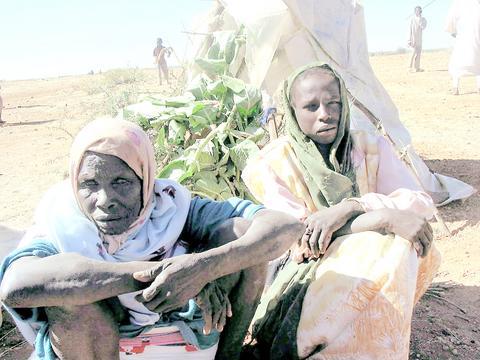
PHOTO:EPA
Just a few kilometers outside the town, armed members of the Janjaweed militias, who have looted and burned African villages over the last year, watched from their camels unperturbed as a government convoy passed by.
The US on Friday welcomed Thursday's 45-day ceasefire signed by the government and two rebel groups in the west who took up arms a year ago saying Khartoum had neglected the impoverished region.
"This agreement is a crucial, first step toward ending atrocities and reversing the humanitarian crisis in Darfur," said a US State Department spokesman, urging the two sides to facilitate the provision of humanitarian aid.
US President George W. Bush called on Sudan on Wednesday to stop "atrocities" by Arab militias against black Africans in west Sudan, where the UN says the conflict has affected a million people.
Aid workers said one of Khartoum's biggest challenges was to end the scorched-earth campaign of the lawless, mounted militias. They added that a food crisis was in the making unless the displaced felt safe enough to return to tend their land.
"The question is: will the government be able to control the militias, and will they be willing to voluntarily hand their weapons over when you are dealing with such a vast area and the government has such limited resources?" said a Western aid worker in Kutum who asked not to be identified.
Residents accuse the government of arming the militias to pillage African villages, a charge Khartoum dismisses. Analysts say the militias have taken on a life of their own -- looting, raping and killing at random.
"The problem is the word `Janjaweed' has become a coverall for so many things. There are militias that are outside the rule of law, and this is one of the things we are going to crack down on," Foreign Minister Mustafa Osman Ismail told reporters as he passed the camel-riding militiamen on his way to Kutum.
The UN has said a Rwanda-style genocide could be in the making in the Darfur area and international military force may be needed -- a suggestion Khartoum rejects.
The ceasefire deal included offering access for relief groups.
"We have free access along a number of corridors. Certain areas, in which we have concerns, we still have not been granted permission to travel to," said Glyn Taylor from the UN office for the co-ordination of humanitarian affairs for Sudan.
He told a meeting of aid repre-sentatives and government officials in Al-Fashir, capital of North Darfur state, that displaced people would only return when they felt safe.
"Should this not happen and should they not be able to engage in agricultural activity before the rains, then we will be looking at a severe food security situation over the next 12 months," he said.
Back in Kutum, camp residents gathered round the foreign minister telling him they needed water and medicine. But they also told visitors that the lack of security kept them trapped in their camp.
"There is a police station inside the camp, so we are not attacked inside the camp. But if we leave the camp for any reason we are attacked," said one African woman, saying one woman gathering wood was seized by the Janjaweed on Thursday.

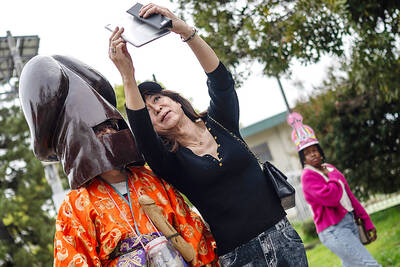
Showcasing phallus-shaped portable shrines and pink penis candies, Japan’s annual fertility festival yesterday teemed with tourists, couples and families elated by its open display of sex. The spring Kanamara Matsuri near Tokyo features colorfully dressed worshipers carrying a trio of giant phallic-shaped objects as they parade through the street with glee. The festival, as legend has it, honors a local blacksmith in the Edo Period (1603-1868) who forged an iron dildo to break the teeth of a sharp-toothed demon inhabiting a woman’s vagina that had been castrating young men on their wedding nights. A 1m black steel phallus sits in the courtyard of

HIGH HOPES: The power source is expected to have a future, as it is not dependent on the weather or light, and could be useful for places with large desalination facilities A Japanese water plant is harnessing the natural process of osmosis to generate renewable energy that could one day become a common power source. The possibility of generating power from osmosis — when water molecules pass from a less salty solution to a more salty one — has long been known. However, actually generating energy from that has proved more complicated, in part due the difficulty of designing the membrane through which the molecules pass. Engineers in Fukuoka, Japan, and their private partners think they might have cracked it, and have opened what is only the world’s second osmotic power plant. It generates

JAN. 1 CLAUSE: As military service is voluntary, applications for permission to stay abroad for over three months for men up to age 45 must, in principle, be granted A little-noticed clause in sweeping changes to Germany’s military service policy has triggered an uproar after it emerged that the law requires men aged up to 45 to get permission from the armed forces before any significant stay abroad, even in peacetime. The legislation, which went into effect on Jan. 1 aims to bolster the military and demands all 18-year-old men fill out a questionnaire to gauge their suitability to serve in the armed forces, but stops short of conscription. If the “modernized” model fails to pull in enough recruits, parliament will be compelled to discuss the reintroduction of compulsory service, German

Hundreds of Filipinos and tourists flocked to a sun-bleached field north of Manila yesterday, on Good Friday, to witness one of the country’s most blood-soaked displays of religious fervor, undeterred by rising fuel prices. Scores of bare-chested flagellants with covered faces walked barefoot through the dusty streets of Pampanga Province’s San Fernando as they flogged their backs with bamboo whips in the scorching heat. Agence France-Presse (AFP) journalists said they saw devotees deliberately puncturing their skin with glass shards attached to a small wooden paddle to ensure their bleeding during the ritual, a way to atone for sins and seek miracles from


 RSS
RSS