


Arab militias are conducting an organized campaign of ethnic cleansing to drive out black Africans from Sudan's Darfur region and the government is doing little to stop it, the UN emergency relief coordinator said on Friday.
"I have no reason to believe that the government is actively planning it, but I have reason to say that little is done to stop it, and therefore it seems as if it is being condoned," Jan Egeland, the world body's humanitarian affairs chief, said after briefing the Security Council.
"Scorched-earth tactics are being employed throughout Darfur, including the deliberate destruction of schools, wells, seed and food supplies, making whole towns and villages uninhabitable," he said, describing an "organized campaign" that has driven hundreds of thousands from their homes and triggered "one of the world's worst humanitarian crises."
Following his briefing, the 15-nation council issued a statement calling on the Sudan government and rebel groups to protect civilians in the northeast African nation, help aid workers gain access to needy regions, agree on a humanitarian ceasefire and "reach a political settlement to the dispute."
Two rebel groups, the Justice and Equality Movement and the Sudan Liberation Movement, launched a revolt in the Darfur region in February of last year, accusing Khartoum of neglecting the poor area bordering Chad and arming Arab militias to loot and burn villages.
But other parts of the arid nation, Africa's largest in size, have been mired in two decades of civil war, fueled by religion, ethnicity, oil and political ideology.
Darfur peace talks opened this week in N'Djamena, the capital of neighboring Chad, where the UN says tens of thousands of Darfur refugees have fled.
But the talks have gotten off to a slow start, with the first few days devoted to "talking about talks," Egeland said.
US envoy Stuart Holliday said Washington wanted all parties to the conflict to adopt an immediate ceasefire, quickly provide aid workers free access to the area, and let in monitors to ensure civilians are protected.
US officials privately grumbled that council members Pakistan and Algeria had insisted on watering down the council statement's language, a charge those two countries denied.
Sudan's UN ambassador, Elfatih Mohamed Ahmed Erwa, predicted the peace talks could take anywhere from two weeks to two or three months to reach a deal but accused UN officials of inflating the gravity of the crisis.
"It is inflated in its real magnitude, I think in both the number of people displaced, the number who have died and also the number of refugees," he told reporters.
Erwa also denied government involvement in the conflict although he did not deny that militias in Darfur blamed for the ethnic cleansing campaign may be backed by his government.
A UN spokesman in Geneva said on Friday the UN planned to send a fact-finding mission to Darfur in coming days to probe allegations of rights abuses.
While some have compared the Darfur conflict to the 1994 Rwandan genocide, Egeland said UN eyewitnesses reported a systematic campaign by Arab militias -- including a militia known as janjaweed to drive black Africans out of the region, rather than mass killings.
"I would say it is ethnic cleansing, but it is not genocide, and we should avoid it escalating," he said.

‘IN A DIFFERENT PLACE’: The envoy first visited Shanghai, where he attended a Chinese basketball playoff match, and is to meet top officials in Beijing tomorrow US Secretary of State Antony Blinken yesterday arrived in China on his second visit in a year as the US ramps up pressure on its rival over its support for Russia while also seeking to manage tensions with Beijing. The US diplomat tomorrow is to meet China’s top brass in Beijing, where he is also expected to plead for restraint as Taiwan inaugurates president-elect William Lai (賴清德), and to raise US concerns on Chinese trade practices. However, Blinken is also seeking to stabilize ties, with tensions between the world’s two largest economies easing since his previous visit in June last year. At the
Nearly half of China’s major cities are suffering “moderate to severe” levels of subsidence, putting millions of people at risk of flooding, especially as sea levels rise, according to a study of nationwide satellite data released yesterday. The authors of the paper, published by the journal Science, found that 45 percent of China’s urban land was sinking faster than 3mm per year, with 16 percent at more than 10mm per year, driven not only by declining water tables, but also the sheer weight of the built environment. With China’s urban population already in excess of 900 million people, “even a small portion

UNSETTLING IMAGES: The scene took place in front of TV crews covering the Trump trial, with a CNN anchor calling it an ‘emotional and unbelievably disturbing moment’ A man who doused himself in an accelerant and set himself on fire outside the courthouse where former US president Donald Trump is on trial has died, police said yesterday. The New York City Police Department (NYPD) said the man was declared dead by staff at an area hospital. The man was in Collect Pond Park at about 1:30pm on Friday when he took out pamphlets espousing conspiracy theories, tossed them around, then doused himself in an accelerant and set himself on fire, officials and witnesses said. A large number of police officers were nearby when it happened. Some officers and bystanders rushed
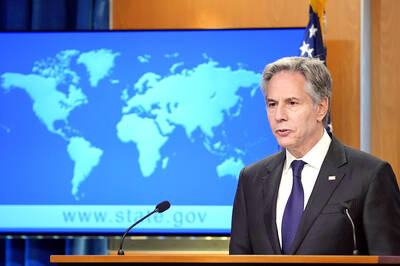
Beijing is continuing to commit genocide and crimes against humanity against Uyghurs and other Muslim minorities in its western Xinjiang province, U.S. Secretary of State Antony Blinken said in a report published on Monday, ahead of his planned visit to China this week. The State Department’s annual human rights report, which documents abuses recorded all over the world during the previous calendar year, repeated language from previous years on the treatment of Muslims in Xinjiang, but the publication raises the issue ahead of delicate talks, including on the war in Ukraine and global trade, between the top U.S. diplomat and Chinese


 RSS
RSS