


Israeli Prime Minister Ariel Sharon said he was determined to carry out his plan to "disengage" from the Palestinians despite a corruption probe and threats by his coalition partners to quit the government.
On Monday, Sharon said he would put his proposal to withdraw from all or most of the Gaza Strip and part of the West Bank to a Cabinet vote next month, after he returns from talks in Washington.
And if his current center-right government doesn't approve the disengagement plan, Sharon said, he will set up a new, moderate government instead.
The tough talk came a day after Israel's state attorney recommended indicting Sharon for accepting bribes, a move that could force his resignation.
Sharon told a closed meeting of parliament's Defense and Foreign Affairs Committee on Monday that he plans to seek Cabinet and parliamentary approval for the plan after returning from a US trip next month, spokesman Assaf Shariv said. Sharon is scheduled to meet US President George W. Bush on April 14.
During the meeting, Sharon also warned hardline critics that he could form a new coalition -- apparently with the dovish Labor Party -- if his plan is rejected, participants said. Two of Sharon's three coalition partners are hardline pro-settlement parties opposed to giving up control of any territory.
"If the parties leave the coalition, on the same day I will form a new government," Shariv quoted Sharon as saying.
The Maariv daily yesterday reported that Sharon and Labor had already drawn up an agreement to form a new government after Sharon's return from Washington, but that the agreement had been put on hold on the state attorney's recommendation.
However, Labor lawmaker Yitzhak Herzog told Israel Radio that the reported agreement -- which even included a division of Cabinet posts -- was a "smoke screen," apparently designed to ease pressure on Sharon.
Later yesterday, Sharon was to address a convention of his Likud Party. Although party activists have voiced harsh opposition to territorial concessions, it appeared Sharon's legal troubles would rally the party around him in a show of unity.
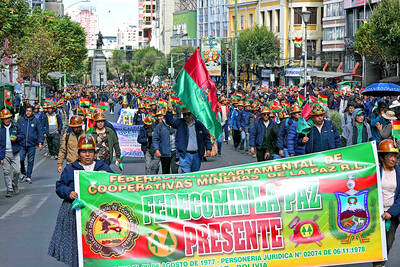
The Bolivian government on Friday struck a deal with protesting miners, but was still grappling with blockades and demonstrations by other workers across La Paz. Other groups are still blocking access roads into the city, which is also the seat of the government. Police on Thursday prevented the miners from entering the main square by using tear gas, while the demonstrators hurled stones and explosives with slingshots. Protests against the policies of Bolivian President Rodrigo Paz have convulsed the Andean nation since early this month, and roadblocks were choking routes into La Paz throughout Friday, the national road authority said. Miners demanded that Paz
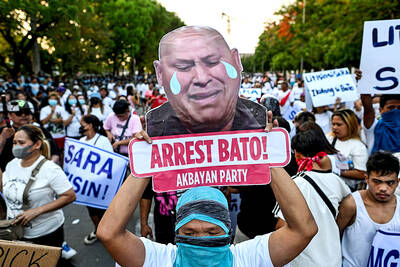
The Philippines said it has asked the country’s Supreme Court to allow it to arrest former Philippine president Rodrigo Duterte’s chief drug war enforcer to stand trial in an international tribunal. The International Criminal Court (ICC) last week unsealed an arrest warrant against Philippine Senator Ronald dela Rosa, accusing him along with Duterte and other “coperpetrators” of the “crime against humanity of murder.” Dela Rosa briefly sought refuge in the Philippine Senate last week while asking the Philippine Supreme Court to stop an ongoing attempt by government agents to arrest him. “By his own conduct, he has placed himself outside the protection of

A ship anchored off the United Arab Emirates (UAE) was seized and taken toward Iran and another — a cargo ship near Oman — sank after being attacked, authorities said on Thursday, as tensions escalated near the Strait of Hormuz. It was not immediately clear who was behind these incidents, but they happened as a senior Iranian official reiterated his country’s claim of control over the waterway and another said it had a right to seize oil tankers connected to the US. The turmoil in the strait has been a sticking point for weeks in talks between the US and Iran to

Crowds in Bangladesh are flocking to snap photographs with an unlikely social media star — an albino buffalo with flowing blond hair nicknamed “Donald Trump” that is due to be sacrificed within days. Owner Zia Uddin Mridha, 38, said his brother named the 700kg bull over its flowing helmet of hair resembling the signature look of the US president. “My younger brother picked this name because of the buffalo’s extraordinary hair,” he said at his farm in Narayanganj, just outside the capital, Dhaka. Mridha said that a constant stream of curious visitors — social media fans, onlookers and children — have come throughout


 RSS
RSS