


Israeli tanks thrust into a Gaza refugee camp yesterday, while Washington warned Americans in the Middle East and North Africa of a heightened attack threat after Israel's assassination of Hamas leader Ahmed Yassin.
"In the aftermath of the killing ... a Hamas spokesman has threatened revenge against ... US interests," the US State Department said, telling Americans in the Gaza Strip to leave and advising against travel to Israel, the West Bank or Gaza.
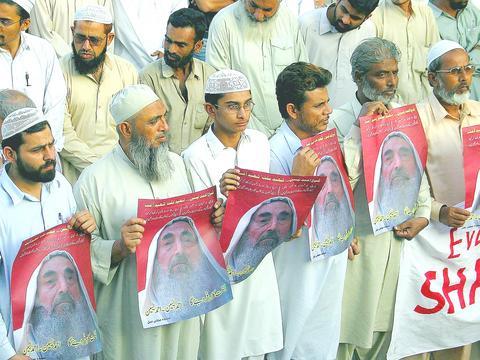
PHOTO: EPA
US President George W. Bush told reporters in Washington: "Whether it be an Hamas threat, or an al-Qaeda threat, we take them very seriously in this administration."
Israel vowed on Tuesday to kill more top Palestinian militants, while Hamas replaced Yassin with a Gaza-based leader seen as a hardliner even within a group that uses suicide bombing as its main weapon.
Keeping up pressure in Gaza, about 10 Israeli tanks backed by helicopter gunships rolled about 100m into Khan Younis refugee camp early on Wednesday and bulldozers razed several homes overlooking a Jewish settlement, witnesses said.
About 60 families fled their huts as the tanks laid down covering fire, witnesses said. There were no immediate reports of clashes with Palestinian gunmen, or casualties.
"The army is clearing the area where terrorists could fire mortar bombs and anti-tank rockets towards army positions and settlements in the area," an Israeli military source said. Before the raid, Defence Minister Shaul Mofaz said Israel would keep targeting Hamas, a group dedicated to the destruction of the Jewish state.
"If we will continue, in a determined way, with our strikes against Hamas and other terror groups ... including action against those leaders, we will bring more security to Israeli citizens," Mofaz said.
Sources in Hamas said it had appointed a supreme leader and a new chief for the Gaza Strip to replace Yassin, Hamas's founder and spiritual leader who was killed in an Israeli helicopter missile strike outside a mosque on Monday.
Both Khaled Meshaal, believed by Israel to be in Syria, and Gaza-based Abdel-Aziz al-Rantissi are opposed to any accommodation with the Jewish state.
While security forces were on high alert in Israeli cities for the painful payback Hamas has promised, violence mounted on the Israel-Lebanon border, where Israeli aircraft killed two members of a Palestinian rocket-launching squad on Tuesday.
Bush, in his first personal remarks on the killing of Yassin, backed what he called Israel's right to defend itself against terror but injected a note of caution.
"And as she does so, I hope she keeps consequences in mind as to how to make sure we stay on the path to peace," he said.
The 15-member UN Security Council held a debate on the strike against Yassin after Arab ambassadors and the US failed to agree on a statement criticizing Israel.
"Not one resolution, not one presidential statement has been adopted by this Council to specifically denounce the deliberate massacre of our innocent civilians," Israeli UN ambassador Dan Gillerman said in a speech to the meeting.
Gillerman said Yassin had helped direct or inspire 425 attacks that killed 377 Israelis and wounded 2,076 in the past three-and-a-half years.
Some Palestinians considered Yassin a relative moderate inside Hamas.
His successors, Meshaal and Rantissi, have survived Israeli attempts on their lives and Israel has accused them of directing attacks on its citizens.
"We will fight them everywhere. We will hit them everywhere. We will chase them everywhere. We will teach them lessons in confrontation," Rantissi told supporters in his first public remarks after his appointment.
Rantissi's firebrand approach has won him many admirers among a Palestinian younger generation increasingly radicalized by Israel's crackdown in the West Bank and Gaza Strip since an uprising began in 2000.

South Korea’s air force yesterday apologized for a 2021 midair collision involving two fighter jets, a day after auditors said the pilots were taking selfies and filming during the flight and held them responsible for the accident. “We sincerely apologize to the public for the concern caused by the accident that occurred in 2021,” an air force spokesman told a news conference, adding that one of the pilots involved had been suspended from flying duties, received severe disciplinary action and has since left the military. The apology followed a report released on Wednesday by the South Korean Board of Audit and Inspection,

Indonesian police have arrested 13 people after shocking images of alleged abuse against small children at a daycare center went viral, sparking outrage across the nation, officials said on Monday. Police on Friday last week raided Little Aresha, a daycare center in Yogyakarta on Java island, following a report from a former employee. CCTV footage circulating on social media showed children, most younger than two, lying on the floor wearing only diapers, their hands and feet bound with rags. The police have confirmed that the footage is authentic. Police said they also found 20 children crammed into a room just 3m by 3m. “So

About 240 Indians claiming descent from a Biblical tribe landed at Tel Aviv airport on Thursday as part of a government operation to relocate them to Israel. The newcomers passed under a balloon arch in blue and white, the colors of the Israeli flag, as dozens of well-wishers welcomed them with a traditional Jewish song. They were the first “bnei Menashe” (“sons of Manasseh”) to arrive in Israel since the government in November last year announced funding for the immigration of about 6,000 members of the community from the states of Manipur and Mizoram in northeast India. The community claims to descend from

‘TROUBLING’: The firing of Phelan, who was an adviser to a nonprofit that supported the defense of Taiwan, was another example of ‘dysfunction’ under Trump, a US senator said US Secretary of the Navy John Phelan has been fired, a US official and a person familiar with the matter said on Wednesday, in another wartime shakeup at the Pentagon coming just weeks after US Secretary of Defense Pete Hegseth ousted the Army’s top general. The Pentagon announced his departure in a brief statement, saying he was leaving the administration “effective immediately,” but it did not provide a reason or say whether it was his decision to go. The sources, who spoke on condition of anonymity, said Phelan was dismissed in part because he was moving too slowly to implement reforms to


 RSS
RSS