


A judge filed charges early yesterday against four more suspects in the Madrid train bombings and ordered them held pending further investigation.
The judge charged three Moroccans and a Spaniard with terrorism and mass killings for their alleged participation in the bombings, which killed 202 people, wounded 1,800 and helped drive the ruling right-of-center government from power.
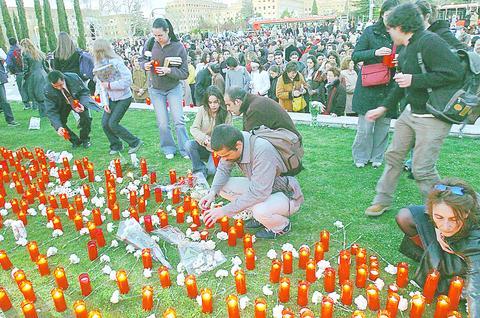
PHOTO: EPA
A fifth suspect, a Moroccan arrested with the others yesterday, was released without charges.
The charges came after six hours of questioning at the National Court, and bring to nine the number of people charged in the March 11 bombings. Six are Moroccan.
Suspicion over the 10 bombs targeting Madrid commuter trains has focused on an alleged Morocco-based terrorist cell believed to have links to Osama bin Laden's al-Qaeda network and on al-Qaeda itself.
All three Moroccans questioned into the early hours yesterday denied involvement in the Madrid attacks. One left the courtroom in tears. Another said that when he learned of the attacks the morning of March 11, he was at home watching cartoons with his children, court officials said.
The charges stop short of a formal indictment, but suggest the court has strong evidence against the suspects. They can remain in jail two years while investigators gather more evidence.
A total of 13 people are now in custody over the bombing. The latest four arrests came Monday in Madrid. Those four, believed to be of North African origin, have yet to appear before a judge.
Spaniard Jose Emilio Suarez, accused of providing explosives for the attacks, was charged with 190 counts of murder, 1,430 counts of attempted murder, robbery and collaborating or belonging to a terrorist organization. Court officials said the latter charge will be specified further as the probe continues. The figure of 190 cited by the judge is the number of bodies officially identified so far.
Moroccan Abderrahim Zbakh, who cried as he left the courtroom, was charged with all those same offenses except robbery, officials said.
Mohamed El Hadi Chedadi and Abdelouahid Berrak, also Moroccans, were charged with collaborating with or belonging to a terrorist organization.
Berrak said he knows lead suspect Jamal Zougam because they own a barber shop together. Berrak also said he was an acquaintance of Imad Yarkas, the accused leader of an alleged Spanish al-Qaeda cell who was arrested in Madrid in November 2001.
The freed suspect was named as Farid Oulad Ali. Judge Juan del Olmo said there was insufficient evidence against him.
Zougam, a Moroccan immigrant who is the prime suspect in the Madrid bombings, and two other Moroccans have been jailed on multiple counts of murder, and two Indians have been jailed on charges of collaborating with a terrorist group.
The scale of the attacks was reflected in the government's decision to hold a state funeral today for those slain.
It is the first time since democracy was restored after General Francisco Franco's death in 1975 that a state funeral has been held for anyone other than a member of the royal family, government officials said.
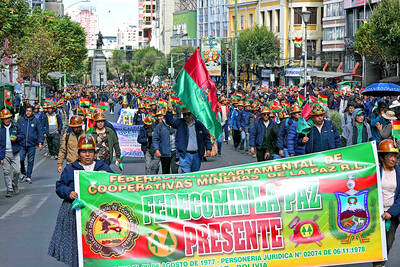
The Bolivian government on Friday struck a deal with protesting miners, but was still grappling with blockades and demonstrations by other workers across La Paz. Other groups are still blocking access roads into the city, which is also the seat of the government. Police on Thursday prevented the miners from entering the main square by using tear gas, while the demonstrators hurled stones and explosives with slingshots. Protests against the policies of Bolivian President Rodrigo Paz have convulsed the Andean nation since early this month, and roadblocks were choking routes into La Paz throughout Friday, the national road authority said. Miners demanded that Paz
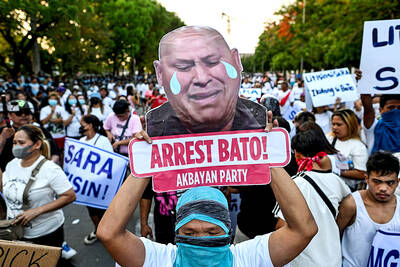
The Philippines said it has asked the country’s Supreme Court to allow it to arrest former Philippine president Rodrigo Duterte’s chief drug war enforcer to stand trial in an international tribunal. The International Criminal Court (ICC) last week unsealed an arrest warrant against Philippine Senator Ronald dela Rosa, accusing him along with Duterte and other “coperpetrators” of the “crime against humanity of murder.” Dela Rosa briefly sought refuge in the Philippine Senate last week while asking the Philippine Supreme Court to stop an ongoing attempt by government agents to arrest him. “By his own conduct, he has placed himself outside the protection of
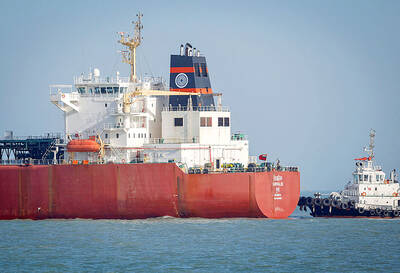
A ship anchored off the United Arab Emirates (UAE) was seized and taken toward Iran and another — a cargo ship near Oman — sank after being attacked, authorities said on Thursday, as tensions escalated near the Strait of Hormuz. It was not immediately clear who was behind these incidents, but they happened as a senior Iranian official reiterated his country’s claim of control over the waterway and another said it had a right to seize oil tankers connected to the US. The turmoil in the strait has been a sticking point for weeks in talks between the US and Iran to

Crowds in Bangladesh are flocking to snap photographs with an unlikely social media star — an albino buffalo with flowing blond hair nicknamed “Donald Trump” that is due to be sacrificed within days. Owner Zia Uddin Mridha, 38, said his brother named the 700kg bull over its flowing helmet of hair resembling the signature look of the US president. “My younger brother picked this name because of the buffalo’s extraordinary hair,” he said at his farm in Narayanganj, just outside the capital, Dhaka. Mridha said that a constant stream of curious visitors — social media fans, onlookers and children — have come throughout


 RSS
RSS