


An explosion blamed on a natural gas leak destroyed a section of a nine-story apartment building in the northern Russian city of Arkhan-gelsk early yesterday as residents slept, killing at least 15 people and leaving dozens trapped, rescuers said.
Authorities refused to rule out terrorism amid heightened tension in Russia after a series of terrorist attacks blamed on Chechen rebels. In 1999, explosions blamed on rebels ripped through apartment buildings in Moscow and two other cities, killing some 300 people.
Yesterday's blast hit at 3:25am when most of the 80 residents registered in the building in Arkhangelsk, about 960km north of Moscow, would have been at home and in bed, said Emergency Situations Ministry spokeswoman Marina Ryklina.
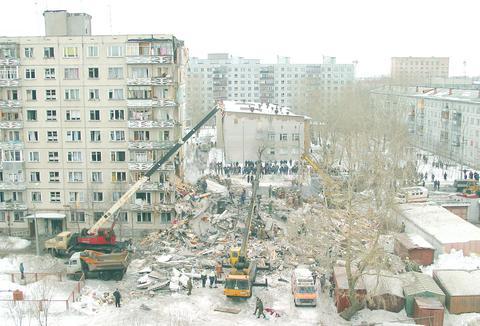
PHOTO: REUTERS
Eighteen people have been retrieved from under the rubble, said Emergency Situations Ministry spokesman Sergei Vlasov. He said that emergency officials believed around 50 people remained trapped under the debris.
Valery Ishchenko, chief of the local rescue headquarters, said that five bodies were recovered, and 20 people received medical treatment.
The explosion sheared a whole section of the building off, leaving huge chunks of debris. Windows in neighboring buildings were blown out by the force of the blast.
Russian state television showed footage of rescue crews clambering over the debris, using power saws to cut through piles of building materials as cranes lifted off the biggest beams.
Authorities said a gas leak was the most likely cause of the blast, though other causes, including terrorism, were not ruled out.
"The base version is a natural gas explosion," Vladimir Lobanov, a regional official, told Russian state television. He said gas officials were checking all buildings in the area.
City fire service official Alexei Semyonov said that there was a strong smell of gas at the blast site and that gas leaks had been reported in other Arkhangelsk buildings overnight, according to remarks shown on Russian television. Citing an unidentified gas worker, the ITAR-Tass news agency reported that overnight repair teams had to fix gas leaks in two neighboring buildings after discovering "plugs unscrewed from the gas pipes" -- hinting at possible sabotage.
A fire broke out after the building section collapsed, complicating rescue efforts, the Interfax news agency reported. An Il-76 cargo plane arrived in Arkhangelsk from Moscow, carrying more rescue workers and heavy equipment. Two Mi-8 helicopters also departed from Karelia, bringing rescue crews and search dogs, Vlasov said.
Arkhangelsk prosecutors opened a criminal investigation into the case on charges of death by negligence and causing damage through negligence, a standard procedure, Interfax reported. The General Prosecutor's Office said it wasn't excluding any possibility, but the main likelihood remained a gas explosion.
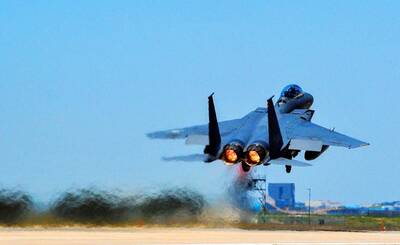
South Korea’s air force yesterday apologized for a 2021 midair collision involving two fighter jets, a day after auditors said the pilots were taking selfies and filming during the flight and held them responsible for the accident. “We sincerely apologize to the public for the concern caused by the accident that occurred in 2021,” an air force spokesman told a news conference, adding that one of the pilots involved had been suspended from flying duties, received severe disciplinary action and has since left the military. The apology followed a report released on Wednesday by the South Korean Board of Audit and Inspection,

Indonesian police have arrested 13 people after shocking images of alleged abuse against small children at a daycare center went viral, sparking outrage across the nation, officials said on Monday. Police on Friday last week raided Little Aresha, a daycare center in Yogyakarta on Java island, following a report from a former employee. CCTV footage circulating on social media showed children, most younger than two, lying on the floor wearing only diapers, their hands and feet bound with rags. The police have confirmed that the footage is authentic. Police said they also found 20 children crammed into a room just 3m by 3m. “So

About 240 Indians claiming descent from a Biblical tribe landed at Tel Aviv airport on Thursday as part of a government operation to relocate them to Israel. The newcomers passed under a balloon arch in blue and white, the colors of the Israeli flag, as dozens of well-wishers welcomed them with a traditional Jewish song. They were the first “bnei Menashe” (“sons of Manasseh”) to arrive in Israel since the government in November last year announced funding for the immigration of about 6,000 members of the community from the states of Manipur and Mizoram in northeast India. The community claims to descend from

‘TROUBLING’: The firing of Phelan, who was an adviser to a nonprofit that supported the defense of Taiwan, was another example of ‘dysfunction’ under Trump, a US senator said US Secretary of the Navy John Phelan has been fired, a US official and a person familiar with the matter said on Wednesday, in another wartime shakeup at the Pentagon coming just weeks after US Secretary of Defense Pete Hegseth ousted the Army’s top general. The Pentagon announced his departure in a brief statement, saying he was leaving the administration “effective immediately,” but it did not provide a reason or say whether it was his decision to go. The sources, who spoke on condition of anonymity, said Phelan was dismissed in part because he was moving too slowly to implement reforms to


 RSS
RSS