


One of five Britons released from the US military base at Guantanamo Bay, Cuba, said he suffered beatings, humiliation and interrogation for up to 12 hours at a time during two years' detention.
In an interview with the Daily Mirror headlined "My Hell in Camp X-Ray," Jamal al-Harith said punishment beatings were handed out by guards known as the Extreme Reaction Force who "waded into inmates in full riot gear, raining blows on them."
Al-Harith, a 37-year-old convert to Islam, arrived in Britain on Tuesday night on a military flight with four other men who were immediately arrested and taken to a London police station. They were freed on Wednesday without charge.
Al-Harith was not arrested, however; he was held at the Northolt air base for a few hours and then freed.
"He has been detained as an innocent person for a period of two years. He has been treated in a cruel, inhumane and degrading manner," his lawyer, Robert Lizar, told reporters.
The US military repeatedly has denied that Guantanamo prisoners have been mistreated. The US government says the roughly 640 prisoners are at Guantanamo because of suspicions they have links to Afghanistan's fallen Taliban regime or the al-Qaeda terror network.
The water and food was foul at Guantanamo, and sometimes as punishment, water taps in the cells would be turned off, al-Harith said in the interview published yesterday.
"They would shut off the water before prayers so we couldn't wash ourselves according to our religion," al-Harith told the paper. "We were only allowed a shower once a week at the beginning and none at all in solitary confinement. This was tough because you are supposed to be clean when you pray."
The article said "vice girls" were used to torment the most religiously devout detainees, who had not seen "unveiled" women.
"The whole point of Guantanamo was to get to you psychologically. The beatings were not nearly as bad as the psychological torture," al-Harith was quoted as saying.
He was regularly interrogated by FBI and CIA agents, and later Britain's MI5, the newspaper said.
"On 40 occasions, he was [put] in chains, which were bolted to the floor, for up to 12 hours at a time," the account said.
Al-Harith describes a stay in an isolation unit known as an ISO, where those accused of misbehaving were kept in solitary confinement with just a mat and towel.
The paper says al-Harith went to Pakistan weeks after the Sept. 11, 2001, attacks on the US to learn about Muslim culture. Al-Harith was in Quetta near the Afghan border when the US bombings against the Taliban began. He paid a driver to take him to Turkey, but was stopped in Afghanistan by an armed gang who accused him of being a spy after they saw his British passport and jailed him, the newspaper said.

South Korea’s air force yesterday apologized for a 2021 midair collision involving two fighter jets, a day after auditors said the pilots were taking selfies and filming during the flight and held them responsible for the accident. “We sincerely apologize to the public for the concern caused by the accident that occurred in 2021,” an air force spokesman told a news conference, adding that one of the pilots involved had been suspended from flying duties, received severe disciplinary action and has since left the military. The apology followed a report released on Wednesday by the South Korean Board of Audit and Inspection,

Indonesian police have arrested 13 people after shocking images of alleged abuse against small children at a daycare center went viral, sparking outrage across the nation, officials said on Monday. Police on Friday last week raided Little Aresha, a daycare center in Yogyakarta on Java island, following a report from a former employee. CCTV footage circulating on social media showed children, most younger than two, lying on the floor wearing only diapers, their hands and feet bound with rags. The police have confirmed that the footage is authentic. Police said they also found 20 children crammed into a room just 3m by 3m. “So

About 240 Indians claiming descent from a Biblical tribe landed at Tel Aviv airport on Thursday as part of a government operation to relocate them to Israel. The newcomers passed under a balloon arch in blue and white, the colors of the Israeli flag, as dozens of well-wishers welcomed them with a traditional Jewish song. They were the first “bnei Menashe” (“sons of Manasseh”) to arrive in Israel since the government in November last year announced funding for the immigration of about 6,000 members of the community from the states of Manipur and Mizoram in northeast India. The community claims to descend from
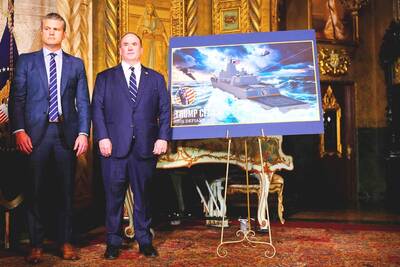
‘TROUBLING’: The firing of Phelan, who was an adviser to a nonprofit that supported the defense of Taiwan, was another example of ‘dysfunction’ under Trump, a US senator said US Secretary of the Navy John Phelan has been fired, a US official and a person familiar with the matter said on Wednesday, in another wartime shakeup at the Pentagon coming just weeks after US Secretary of Defense Pete Hegseth ousted the Army’s top general. The Pentagon announced his departure in a brief statement, saying he was leaving the administration “effective immediately,” but it did not provide a reason or say whether it was his decision to go. The sources, who spoke on condition of anonymity, said Phelan was dismissed in part because he was moving too slowly to implement reforms to


 RSS
RSS