


UN investigators are increasingly certain Pakistani leaders knew the country's top atomic scientist was supplying nuclear technology and designs to other nations, particularly North Korea, according to diplomats familiar with a probe of the world's nuclear black market.
While rogue nations were the main customers of the black market, sales of enriched uranium and warhead drawings have fed international fears that terrorists also could have bought weapons technology or material, the diplomats said in a series of interviews.
The investigation has widened beyond Iran, Libya and North Korea -- the identified customers of the network headed by Abdul Qadeer Khan -- the diplomats said, speaking on condition of anonymity.
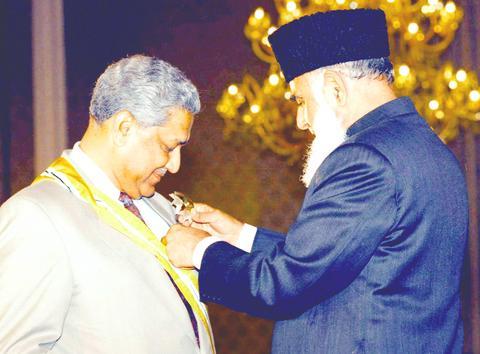
PHOTO: EPA
The diplomats' assessment comes about half way through the probe by the International Atomic Energy Agency and Western intelligence services into the Khan network, whose tentacles extended from Pakistan to Dubai, Malaysia, South Korea, Switzerland, Germany, Japan, Britain, the Netherlands and beyond with potential ties to Syria, Turkey and Spain.
Investigators said they expect to complete the probe by June, eight months after US officials confronted the Pakistani government with suspicions about Khan, setting into motion events that led the father of Islamabad's nuclear program to confess last month.
Despite denials by the Pakistani government, investigators now are certain that some, if not all, of the country's decision makers were aware of Khan's dealings, especially with North Korea, which apparently helped Islamabad build missiles in exchange for help with its nuclear arms program, said one of the diplomats.
"In Pakistan, it's hard to believe all this happened under their noses and nobody knew about it," he said.
The diplomats didn't say which parts of the Pakistani government might have know of Khan's black market activity -- military, political or both.
But Andrew Koch, of Jane's Defense Weekly, said he ran into evidence that senior military officers knew of Khan's sideline four years ago when he attended a military technology exhibition in Karachi. There, the booth of A.Q. Khan's Research Laboratories, complete with pamphlets offering uranium enrichment equipment, shared space with displays of electronics, anti-tank missiles and other items being sold by the government defense industry, he said.
"I picked up the [Khan] brochures and I inquired whether everything inside was for sale and was told, `yes, of course, it all had government approval and was available for sale and export,'" he said from Washington.
Pakistani President Pervez Musharraf has insisted his government was not involved.
"The Pakistani government has never and will never proliferate," he told a meeting of world leaders in January in Davos, Switzerland, pledging to prosecute all "anti-state" elements found culpable.
But his pardon of Khan led to speculation the scientist agreed to keep silent on any government involvement.
Much of the goods involved were expensive and high-tech uranium enrichment centrifuge components sold to Libya -- which has confessed to trying to build weapons of mass destruction -- and to Iran, which denies such ambitions and says its enrichment plans are not for warheads but nuclear power.
Such equipment would be useless to terrorists lacking the space and expertise needed to set up thousands of centrifuges in series and repeatedly recycle isotopes until they were weapons grade. The tens of millions of dollars needed to buy the equipment might also be a deterrent.
"It would be difficult for a non-state actor to engage in a uranium enrichment program because of the massive industrial infrastructure that is required," said Melissa Fleming, spokeswoman of the Vienna-based IAEA.
But the diplomats identified two recent discoveries -- traces of highly enriched uranium apparently of Russian origin found in Iran, and drawings of a nuclear warhead surrendered by Libya as representing a potential fast track for terrorists looking to build a weapon.
The uranium apparently was sold by individuals in the black market and not by the Russian government and carried a signature typical of enrichment in the former Soviet Union, the diplomats said. While short of the 90 percent weapons level, it was enriched enough to make it suitable for a warhead with much less equipment and effort than needed to enrich natural uranium.
"We're talking a couple of dozen centrifuges, as compared to about 1,000," said a diplomat.
The engineers' drawings of a nuclear weapon, now under IAEA seal in the US, were of Chinese origin. The texts accompanying them were in both Chinese and English, some handwritten. China is widely assumed to have supplied much of the clandestine nuclear technology that Khan used to establish Pakistan as a nuclear power in 1998.
With such high-tech drawings and about 22.5kg of highly enriched uranium, nuclear experts associated with terrorist groups could make a crude warhead, said one diplomat.
"The simplest way to go about it is to get ready-made nuclear material and weapons design, and -- from what's been found in Iran and Libya -- both seem to be available on the market," said another.
Investigators cannot say whether other countries -- or groups -- have the drawings.
Al-Qaeda has shown an interest in acquiring nuclear weapons.
The US federal indictment of Osama bin Laden charges that as far back as 1992 the al-Qaeda leader "and others known and unknown, made efforts to obtain the components of nuclear weapons."
Bin Laden, in a November 2001 interview with a Pakistani journalist, boasted of having hidden such components "as a deterrent." And in 1998, a Russian nuclear weapons design expert was investigated for allegedly working with the Taliban allies of bin Laden.
Another open question is whether states other than Iran, Libya and North Korea were supplied by the Khan network. Fleming of the IAEA said getting an answer was the agency's "No. 1 priority."
A possible suspect is Syria, which denies nuclear weapons ambitions. US officials are divided on whether Syria constitutes a nuclear threat, with Undersecretary of State John Bolton at odds with senior intelligence officials who insist there's no clear evidence implicating Syria.
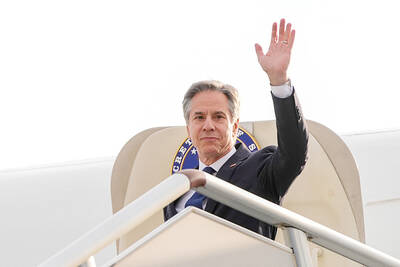
‘IN A DIFFERENT PLACE’: The envoy first visited Shanghai, where he attended a Chinese basketball playoff match, and is to meet top officials in Beijing tomorrow US Secretary of State Antony Blinken yesterday arrived in China on his second visit in a year as the US ramps up pressure on its rival over its support for Russia while also seeking to manage tensions with Beijing. The US diplomat tomorrow is to meet China’s top brass in Beijing, where he is also expected to plead for restraint as Taiwan inaugurates president-elect William Lai (賴清德), and to raise US concerns on Chinese trade practices. However, Blinken is also seeking to stabilize ties, with tensions between the world’s two largest economies easing since his previous visit in June last year. At the

UNSETTLING IMAGES: The scene took place in front of TV crews covering the Trump trial, with a CNN anchor calling it an ‘emotional and unbelievably disturbing moment’ A man who doused himself in an accelerant and set himself on fire outside the courthouse where former US president Donald Trump is on trial has died, police said yesterday. The New York City Police Department (NYPD) said the man was declared dead by staff at an area hospital. The man was in Collect Pond Park at about 1:30pm on Friday when he took out pamphlets espousing conspiracy theories, tossed them around, then doused himself in an accelerant and set himself on fire, officials and witnesses said. A large number of police officers were nearby when it happened. Some officers and bystanders rushed
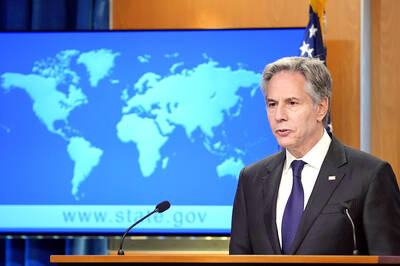
Beijing is continuing to commit genocide and crimes against humanity against Uyghurs and other Muslim minorities in its western Xinjiang province, U.S. Secretary of State Antony Blinken said in a report published on Monday, ahead of his planned visit to China this week. The State Department’s annual human rights report, which documents abuses recorded all over the world during the previous calendar year, repeated language from previous years on the treatment of Muslims in Xinjiang, but the publication raises the issue ahead of delicate talks, including on the war in Ukraine and global trade, between the top U.S. diplomat and Chinese
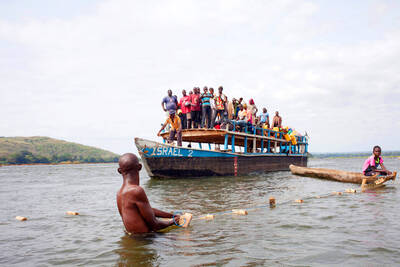
RIVER TRAGEDY: Local fishers and residents helped rescue people after the vessel capsized, while motorbike taxis evacuated some of the injured At least 58 people going to a funeral died after their overloaded river boat capsized in the Central African Republic’s (CAR) capital, Bangui, the head of civil protection said on Saturday. “We were able to extract 58 lifeless bodies,” Thomas Djimasse told Radio Guira. “We don’t know the total number of people who are underwater. According to witnesses and videos on social media, the wooden boat was carrying more than 300 people — some standing and others perched on wooden structures — when it sank on the Mpoko River on Friday. The vessel was heading to the funeral of a village chief in


 RSS
RSS