


Prime Minister Abdullah Ahmad Badawi said yesterday he could understand why people had sympathy for Anwar Ibrahim, the jailed figurehead of Malaysia's opposition, but urged voters to back his ruling coalition in upcoming elections.
Launching his campaign for March 21 polls at his home district in northern Penang state, Abdullah added he didn't expect Anwar to be a major issue in the contest.
Public outrage at Anwar's jailing shortly before the last elections in 1999 helped the opposition make its strongest gains in years. It's trying to once again make Anwar into a campaign issue, maintaining that it will free the former deputy premier if it wins power and make him prime minister.
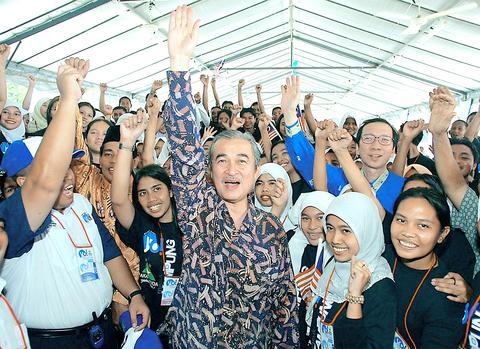
PHOTO: REUTERS
The opposition accuses Abdullah of ignoring the plight of Anwar because he is a political threat. Anwar was former Prime Minister Mahathir Mohamad's anointed successor, before he fell out of favor.
Mahathir retired in October after 22 years in power, handing it over to Abdullah.
"I don't think it will be a factor," Abdullah said when asked about possible voter sympathy for Anwar.
"There may be some who have sympathy for him, but despite [this] they will want to vote for the National Front" governing coalition, he told a news conference after addressing about 2,000 people in his hometown.
Voters understood that the government could do more for them than the opposition, he said.
"It's not about one personality, it's about forming a government," he said. "I am not telling people not to be sympathetic, but they must try to decide what kind of government they want."
Anwar was arrested, tried and convicted of sodomy and corruption after falling out with Mahathir during the Asian financial crisis. He says the charges were a political conspiracy to prevent him from challenging Mahathir, which the government denies.
Abdul Hadi Awang, the leader of a fundamentalist Islamic party that is Malaysia's largest opposition group, said Friday it would campaign for Anwar's release.
"To us, Anwar remains a symbol of oppression," Hadi said. "It is our responsibility to defend him. ... Even Saddam Hussein received better treatment as a war prisoner."
Later yesterday, Abdullah held a smaller rally in the rural district of Kepala Batas -- his birthplace and parliamentary constituency since 1978 -- where he boasted to about 500 supporters about the government's record of delivering services to the people.
Malaysia's northern states, with their large ethnic Malay Muslim populations, are the fiercest battlegrounds between Abdullah's United Malays National Organization and the fundamentalist Pan-Malaysian Islamic Party.
Signs of campaigning are increasingly clear. In Penang, Abdullah drove past roadside stalls and streetlights draped with flags -- some with UMNO's scales of justice logo and slogans such as "UMNO: Then, now and forever," and other's with the Islamic party's crescent moon logo.
Abdullah's government is almost certain to be returned to power when voters select 219 members of a new federal Parliament and 505 representatives of legislatures in 12 of Malaysia's 13 states.
Abdullah has made fighting corruption and achieving more efficient, open government his campaign themes.
The opposition is targeting him over Anwar, and his handling of an investigation into a company controlled by his son played in supplying parts to a nuclear black market.
On Friday, the opposition claimed Washington is going easy on the prime minister on the nuclear issue because it wants him returned to power.
Police cleared the company, Scomi Precision Engineering, of any wrongdoing, finding it was deceived into making the parts by Buhary Syed Abu Tahir, a middleman working for the trafficking network in Pakistani nuclear secrets.
But the opposition alleges the investigation didn't delve deep enough into Tahir's links to the prime minister's son, Kamaluddin Abdullah, and says US officials didn't press hard enough. At the time of the deal, the two were co-directors an investment company that controls Scomi.
"Bush is not serious in handling the issue of nuclear proliferation," Islamic party leader Hadi said. "He has to protect governments which sympathize with the US."
Abdullah has dismissed the attacks against him on the nuclear issue as "character assassination."

South Korea’s air force yesterday apologized for a 2021 midair collision involving two fighter jets, a day after auditors said the pilots were taking selfies and filming during the flight and held them responsible for the accident. “We sincerely apologize to the public for the concern caused by the accident that occurred in 2021,” an air force spokesman told a news conference, adding that one of the pilots involved had been suspended from flying duties, received severe disciplinary action and has since left the military. The apology followed a report released on Wednesday by the South Korean Board of Audit and Inspection,

Indonesian police have arrested 13 people after shocking images of alleged abuse against small children at a daycare center went viral, sparking outrage across the nation, officials said on Monday. Police on Friday last week raided Little Aresha, a daycare center in Yogyakarta on Java island, following a report from a former employee. CCTV footage circulating on social media showed children, most younger than two, lying on the floor wearing only diapers, their hands and feet bound with rags. The police have confirmed that the footage is authentic. Police said they also found 20 children crammed into a room just 3m by 3m. “So

About 240 Indians claiming descent from a Biblical tribe landed at Tel Aviv airport on Thursday as part of a government operation to relocate them to Israel. The newcomers passed under a balloon arch in blue and white, the colors of the Israeli flag, as dozens of well-wishers welcomed them with a traditional Jewish song. They were the first “bnei Menashe” (“sons of Manasseh”) to arrive in Israel since the government in November last year announced funding for the immigration of about 6,000 members of the community from the states of Manipur and Mizoram in northeast India. The community claims to descend from

‘TROUBLING’: The firing of Phelan, who was an adviser to a nonprofit that supported the defense of Taiwan, was another example of ‘dysfunction’ under Trump, a US senator said US Secretary of the Navy John Phelan has been fired, a US official and a person familiar with the matter said on Wednesday, in another wartime shakeup at the Pentagon coming just weeks after US Secretary of Defense Pete Hegseth ousted the Army’s top general. The Pentagon announced his departure in a brief statement, saying he was leaving the administration “effective immediately,” but it did not provide a reason or say whether it was his decision to go. The sources, who spoke on condition of anonymity, said Phelan was dismissed in part because he was moving too slowly to implement reforms to


 RSS
RSS