


International Monetary Fund (IMF) chief Horst Koehler is resigning to accept his nomination as a candidate for the German presidency.
Koehler, 61, said on Thursday in Washington that one of his deputies, Anne Krueger, would take over as acting managing director of the 183-nation international financial institution that he has headed since 2000 until a successor could be found.
"I have accepted the nomination because it is an honor," Koehler told a news conference, speaking in German.
"I believe that I am up to the challenge and that with my professional national and international experience will be able to bring something to the office that Germany needs now."
Koehler said his resignation would be effective immediately and he would work with Krueger to ensure a smooth transition.
Koehler was nominated early Thursday by Germany's conservative and centrist opposition parties, which hold a majority in the Federal Assembly that elects the nation's ninth president on May 23.
Within hours, Chancellor Gerhard Schroeder made the surprise announcement of his governing party's candidate, Gesine Schwan, who heads a German-Polish university in the border town of Frankfurt an der Oder.
Germany's presidency is considered a position of moral influence and the president traditionally has little direct say in politics. Yet Koehler expressed confidence his experience in international organizations would enhance his ability to galvanize change in Germany.
"Namely a discussion and a process of change, principally, but not uniquely, in the economic sector," Koehler said.
Schroeder's Social Democratic party -- to which outgoing President Johannes Rau also belongs -- has been in a popularity slump for months as the chancellor trims costly social programs and struggles to revive Europe's largest economy.
Koehler, a member of the main opposition Christian Democrats, has criticized Germany's resistance to economic reforms in the past.
Koehler's nomination followed weeks of wrangling among Germany's opposition parties, which have a 21-seat edge among the 1,206 lower-house lawmakers and state representatives choosing the next president.
The UK Chancellor of the Exchequer Gordon Brown was being lined up in Washington on Thursday as a possible new head of the IMF in a move which would end the longest chancellorship in Labour's history and force him to give up hope of becoming UK prime minister.
IMF sources confirmed that Brown was one of the top candidates to succeed Kohler, whose resignation has triggered a leadership crisis at the fund. Some sources have said Brown's reputation for seeking social justice on a global scale made him a potential frontrunner.
A British Treasury spokesman said any suggestions that the chancellor was about to quit British politics were pure speculation and it was premature to comment.

The Bolivian government on Friday struck a deal with protesting miners, but was still grappling with blockades and demonstrations by other workers across La Paz. Other groups are still blocking access roads into the city, which is also the seat of the government. Police on Thursday prevented the miners from entering the main square by using tear gas, while the demonstrators hurled stones and explosives with slingshots. Protests against the policies of Bolivian President Rodrigo Paz have convulsed the Andean nation since early this month, and roadblocks were choking routes into La Paz throughout Friday, the national road authority said. Miners demanded that Paz
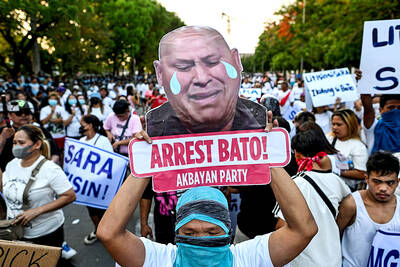
The Philippines said it has asked the country’s Supreme Court to allow it to arrest former Philippine president Rodrigo Duterte’s chief drug war enforcer to stand trial in an international tribunal. The International Criminal Court (ICC) last week unsealed an arrest warrant against Philippine Senator Ronald dela Rosa, accusing him along with Duterte and other “coperpetrators” of the “crime against humanity of murder.” Dela Rosa briefly sought refuge in the Philippine Senate last week while asking the Philippine Supreme Court to stop an ongoing attempt by government agents to arrest him. “By his own conduct, he has placed himself outside the protection of

A ship anchored off the United Arab Emirates (UAE) was seized and taken toward Iran and another — a cargo ship near Oman — sank after being attacked, authorities said on Thursday, as tensions escalated near the Strait of Hormuz. It was not immediately clear who was behind these incidents, but they happened as a senior Iranian official reiterated his country’s claim of control over the waterway and another said it had a right to seize oil tankers connected to the US. The turmoil in the strait has been a sticking point for weeks in talks between the US and Iran to

Crowds in Bangladesh are flocking to snap photographs with an unlikely social media star — an albino buffalo with flowing blond hair nicknamed “Donald Trump” that is due to be sacrificed within days. Owner Zia Uddin Mridha, 38, said his brother named the 700kg bull over its flowing helmet of hair resembling the signature look of the US president. “My younger brother picked this name because of the buffalo’s extraordinary hair,” he said at his farm in Narayanganj, just outside the capital, Dhaka. Mridha said that a constant stream of curious visitors — social media fans, onlookers and children — have come throughout


 RSS
RSS