


A pro-democracy activist who helped organize the 1989 Tiananmen Square protests was released by China and arrived Thursday in Rhode Island, where he joined another recently freed dissident.
It was the third time in a week Beijing has acted on a case after lobbying from Washington.
Wang Youcai, 37, a physicist, was given medical parole and left the Zhejiang No. 1 prison early in the day, said John Kamm, executive director of the Dui Hua Foundation, a rights group.
After a midmorning stop in San Francisco, Wang arrived at T.F. Green Airport in Warwick Thursday night. He said he was overwhelmed with his new freedom.
"I'm not sure what exactly is going on," he said through a woman acting as his interpreter. "I need time to clear my head."
Asked if he wanted to thank anyone for his release, he said.
"I can't explain things with words very well. But with my whole heart I have a lot of people to thank," he said.
Wang was greeted with hugs and flowers by recently freed dissident Xu Wenli, who is hosting him and also was in prison in China in the 1990s.
In 1998, Wang and Xu were both sentenced to prison terms of more than a decade for activities related to the founding of the China Democracy Party.
Xu was released from prison in December 2002 and came with his wife to Rhode Island to join their daughter. He currently is a visiting senior fellow at Brown University in Providence.
Wang was also one of more than a dozen student leaders of the 1989 pro-democracy demonstrations that led to the Tiananmen Square military crackdown. He served a year in prison in 1990 on charges related to those activities.
At the time of the crackdown, Xu was in prison for earlier democratic activities. Released in 1993, Xu first came into contact with Wang when he was detained in 1998. Wang's friends turned to Xu for help, and Xu publicized Wang's plight.
Despite an age gap of more than 20 years, the two ended up working together to found a democratic party in China.
"I think in 1998 the two generations [of the movement for democracy in China] have merged together and started an open democratic party as the opposition party in China," Xu said Thursday, through his daughter, Xu Jin, who acted as a translator.
Although Xu and Wang have talked by phone, they never met in person.
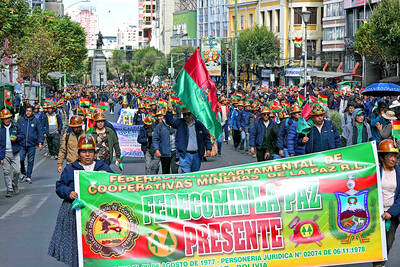
The Bolivian government on Friday struck a deal with protesting miners, but was still grappling with blockades and demonstrations by other workers across La Paz. Other groups are still blocking access roads into the city, which is also the seat of the government. Police on Thursday prevented the miners from entering the main square by using tear gas, while the demonstrators hurled stones and explosives with slingshots. Protests against the policies of Bolivian President Rodrigo Paz have convulsed the Andean nation since early this month, and roadblocks were choking routes into La Paz throughout Friday, the national road authority said. Miners demanded that Paz
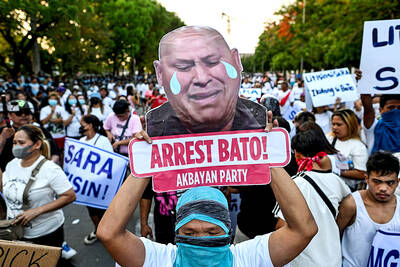
The Philippines said it has asked the country’s Supreme Court to allow it to arrest former Philippine president Rodrigo Duterte’s chief drug war enforcer to stand trial in an international tribunal. The International Criminal Court (ICC) last week unsealed an arrest warrant against Philippine Senator Ronald dela Rosa, accusing him along with Duterte and other “coperpetrators” of the “crime against humanity of murder.” Dela Rosa briefly sought refuge in the Philippine Senate last week while asking the Philippine Supreme Court to stop an ongoing attempt by government agents to arrest him. “By his own conduct, he has placed himself outside the protection of

A ship anchored off the United Arab Emirates (UAE) was seized and taken toward Iran and another — a cargo ship near Oman — sank after being attacked, authorities said on Thursday, as tensions escalated near the Strait of Hormuz. It was not immediately clear who was behind these incidents, but they happened as a senior Iranian official reiterated his country’s claim of control over the waterway and another said it had a right to seize oil tankers connected to the US. The turmoil in the strait has been a sticking point for weeks in talks between the US and Iran to

Crowds in Bangladesh are flocking to snap photographs with an unlikely social media star — an albino buffalo with flowing blond hair nicknamed “Donald Trump” that is due to be sacrificed within days. Owner Zia Uddin Mridha, 38, said his brother named the 700kg bull over its flowing helmet of hair resembling the signature look of the US president. “My younger brother picked this name because of the buffalo’s extraordinary hair,” he said at his farm in Narayanganj, just outside the capital, Dhaka. Mridha said that a constant stream of curious visitors — social media fans, onlookers and children — have come throughout


 RSS
RSS