


Venezuela's electoral council was set yesterday to rule on a drive to recall President Hugo Chavez amid violent protests by the president's supporters and a threat to use oil as a weapon if Washington tried to intervene.
"In the interests of preserving and maintaining peace in the country, we have decided to give the results of the decisions for the presidential recall referendum tomorrow," electoral council executive Jorge Rodriguez said Sunday.
Rodriguez said the council had postponed announcing preliminary results because it was checking petition signatures collected by Chavez opponents calling for a referendum.
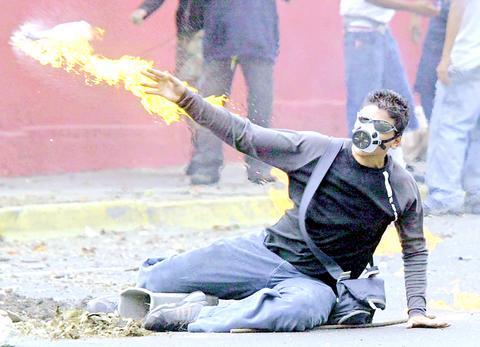
PHOTO: AFP
Pro-Chavez demonstrators meanwhile set up roadblocks in poor neighborhoods, where the left-populist president has much of his support. Two people were shot to death at the barricades, state-run VTV television reported.
A motorcyclist was also shot in the head in a neighborhood opposed to Chavez's rule near the Caracas freeway where National Guard troops were positioned to stop opposition demonstrators from blocking the road, television reports said. Later in the day, two journalists were shot at during an anti-Chavez demonstration.
A photographer received a superficial injury to the chest, saved by a bulletproof vest, after a youth targeted him with a 9 mm weapon.
A Univision cameraman was shot in the exclusive Chacao district as opposition demonstrators attempting to set up a roadblock clashed with highway police. Another opposition protester was shot, as was a highway police officer, the Caracas fire chief said.
Opposition leaders say they collected 3.4 million signatures seeking the recall referendum. The constitution requires a minimum of 2.4 million valid signatures.
The government says that fraud was widespread in collecting the petitions.
But former US president Jimmy Carter, an electoral observer, said the electoral council guaranteed monitors access to the signature verification.
Carter and the Organization of American States brokered a deal last year between Chavez and the opposition to end attempts to oust Chavez through mass demonstrations and instead to use the constitutional provision allowing the president to be recalled at any time after the halfway point of the term.
Venezuela's constitution calls for a vote on a new president within 30 days if Chavez is ousted in a referendum. Chavez, whose term ends in 2006, has agreed to abide by the results of the vote.
At a rally, the president told some 60,000 cheering supporters that he would block US access to Venezuela's vast oil resources if Washington decides to move against his government.
In a three-hour anti-American diatribe that singled out US President George W. Bush as an illegitimate leader, Chavez said "if Mr. Bush is possessed with the madness of trying to blockade Venezuela, or worse for them, to invade Venezuela in response to the desperate song of his lackeys ... sadly not a drop of petroleum will come to them from Venezuela."
Chavez has long accused Washington of backing the opposition, which has tried to oust Chavez twice -- once in a nationwide strike that ended last year and in an aborted 2002 coup.
The US is keenly interested in stability in Venezuela, its fourth-largest oil supplier and and the only Latin American member of the Organization of Oil Producing Countries.
US interest in Caribbean stability peaked this week as an armed rebellion led to the resignation Sunday of Haitian president Jean Bertrand Aristide.
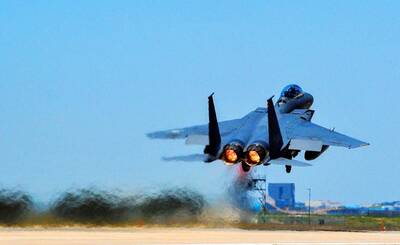
South Korea’s air force yesterday apologized for a 2021 midair collision involving two fighter jets, a day after auditors said the pilots were taking selfies and filming during the flight and held them responsible for the accident. “We sincerely apologize to the public for the concern caused by the accident that occurred in 2021,” an air force spokesman told a news conference, adding that one of the pilots involved had been suspended from flying duties, received severe disciplinary action and has since left the military. The apology followed a report released on Wednesday by the South Korean Board of Audit and Inspection,

Indonesian police have arrested 13 people after shocking images of alleged abuse against small children at a daycare center went viral, sparking outrage across the nation, officials said on Monday. Police on Friday last week raided Little Aresha, a daycare center in Yogyakarta on Java island, following a report from a former employee. CCTV footage circulating on social media showed children, most younger than two, lying on the floor wearing only diapers, their hands and feet bound with rags. The police have confirmed that the footage is authentic. Police said they also found 20 children crammed into a room just 3m by 3m. “So

About 240 Indians claiming descent from a Biblical tribe landed at Tel Aviv airport on Thursday as part of a government operation to relocate them to Israel. The newcomers passed under a balloon arch in blue and white, the colors of the Israeli flag, as dozens of well-wishers welcomed them with a traditional Jewish song. They were the first “bnei Menashe” (“sons of Manasseh”) to arrive in Israel since the government in November last year announced funding for the immigration of about 6,000 members of the community from the states of Manipur and Mizoram in northeast India. The community claims to descend from

‘TROUBLING’: The firing of Phelan, who was an adviser to a nonprofit that supported the defense of Taiwan, was another example of ‘dysfunction’ under Trump, a US senator said US Secretary of the Navy John Phelan has been fired, a US official and a person familiar with the matter said on Wednesday, in another wartime shakeup at the Pentagon coming just weeks after US Secretary of Defense Pete Hegseth ousted the Army’s top general. The Pentagon announced his departure in a brief statement, saying he was leaving the administration “effective immediately,” but it did not provide a reason or say whether it was his decision to go. The sources, who spoke on condition of anonymity, said Phelan was dismissed in part because he was moving too slowly to implement reforms to


 RSS
RSS