


Parents of unruly children in the UK will be sent on residential courses to teach them how to raise a family.
Under a dramatic extension of the state's power to intervene in family life to be unveiled this week, education chiefs will be able to force parents whose children have been expelled from school to take parenting lessons.
The new powers will be controversial, with accusations of a "boot camp" approach and fears of damaging trust between parents and teachers if schools are seen to be judging families on how they bring up their children.
However, government ministers will argue that it is unfair to children not to tackle inadequate parenting and that "tough love" measures can divert them before they slide too deep into trouble.
"We will try to help first and, if that help is refused, we look to a legal sanction," said a spokesman for the UK Department for Education and Skills.
The move, which is to be introduced on Friday, springs from alarm among MPs about anti-social behavior. Last week a 13-year-old girl in the north of England became subject to an order banning her from going into Leeds city center or traveling on a bus unless accompanied by a responsible adult; wearing hooded tops that disguise her face; and mixing with other named children.
Under the new breed of parenting orders, adults whose children are considered at risk of getting into trouble could be sent on weekend courses on how to control their offspring.
Education authorities will also be able to obtain court orders against the parents of expelled pupils to tackle the root causes of misbehavior, backed by the threat of a ?1,000 (US$1,862) fine for failure to comply. They could also draw up "parenting contracts," setting out what each side will do to help a child to improve: contracts will be voluntary.
Until now, youth offending teams could only seek parenting orders against children convicted of a crime. But from Friday they can intervene with those merely considered at risk of getting into trouble.
Some children's charities believe residential courses would go too far, arguing there is little evidence to justify separating parents from their children, even for short periods.
"We wouldn't knock help for parents, but if it's given in a way that is likely to increase tensions within the families, we have concerns," said Sharon Moore, policy manager of the Children's Society.
However the UK National Family and Parenting Institute said some parents would never accept they were doing anything wrong.
"The experience I have had over 30 years in social work is that there are families who do need a lot of encouragement, or to be required to get help," said director Mary McLeod.

‘IN A DIFFERENT PLACE’: The envoy first visited Shanghai, where he attended a Chinese basketball playoff match, and is to meet top officials in Beijing tomorrow US Secretary of State Antony Blinken yesterday arrived in China on his second visit in a year as the US ramps up pressure on its rival over its support for Russia while also seeking to manage tensions with Beijing. The US diplomat tomorrow is to meet China’s top brass in Beijing, where he is also expected to plead for restraint as Taiwan inaugurates president-elect William Lai (賴清德), and to raise US concerns on Chinese trade practices. However, Blinken is also seeking to stabilize ties, with tensions between the world’s two largest economies easing since his previous visit in June last year. At the

UNSETTLING IMAGES: The scene took place in front of TV crews covering the Trump trial, with a CNN anchor calling it an ‘emotional and unbelievably disturbing moment’ A man who doused himself in an accelerant and set himself on fire outside the courthouse where former US president Donald Trump is on trial has died, police said yesterday. The New York City Police Department (NYPD) said the man was declared dead by staff at an area hospital. The man was in Collect Pond Park at about 1:30pm on Friday when he took out pamphlets espousing conspiracy theories, tossed them around, then doused himself in an accelerant and set himself on fire, officials and witnesses said. A large number of police officers were nearby when it happened. Some officers and bystanders rushed
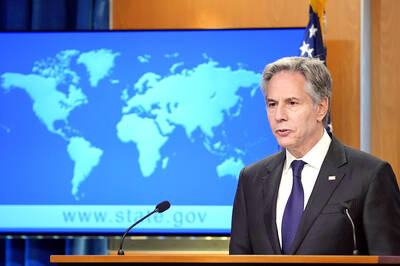
Beijing is continuing to commit genocide and crimes against humanity against Uyghurs and other Muslim minorities in its western Xinjiang province, U.S. Secretary of State Antony Blinken said in a report published on Monday, ahead of his planned visit to China this week. The State Department’s annual human rights report, which documents abuses recorded all over the world during the previous calendar year, repeated language from previous years on the treatment of Muslims in Xinjiang, but the publication raises the issue ahead of delicate talks, including on the war in Ukraine and global trade, between the top U.S. diplomat and Chinese
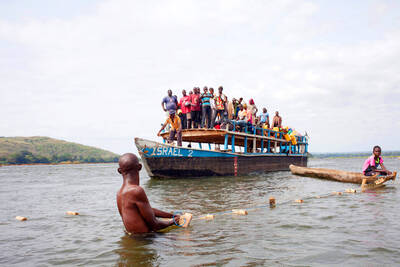
RIVER TRAGEDY: Local fishers and residents helped rescue people after the vessel capsized, while motorbike taxis evacuated some of the injured At least 58 people going to a funeral died after their overloaded river boat capsized in the Central African Republic’s (CAR) capital, Bangui, the head of civil protection said on Saturday. “We were able to extract 58 lifeless bodies,” Thomas Djimasse told Radio Guira. “We don’t know the total number of people who are underwater. According to witnesses and videos on social media, the wooden boat was carrying more than 300 people — some standing and others perched on wooden structures — when it sank on the Mpoko River on Friday. The vessel was heading to the funeral of a village chief in


 RSS
RSS