


They've been accused of everything from brutalizing government opponents to drug trafficking, but today it's the Haitian police force that's on the run.
Rebels trying to oust President Jean-Bertrand Aristide launched a bloody uprising two weeks ago, marking the police as prime targets. Some 40 officers have been killed. Eight have fled to Jamaica. Others have gone into hiding in the Dominican Republic.
"We do not know who we are protecting," said Corporal Louis Larieux, 40, a rookie policeman in the capital, Port-au-Prince. "Things are bad. We don't have the reinforcements."
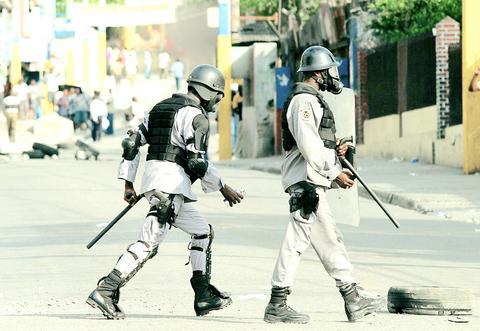
PHOTO: REUTERS
Although they look menacing in their black knee pads, helmets and bullet proof vests, the fear is visible on their faces even when they're only dealing with rioters.
Confronted by rebels including ex-soldiers from Haiti's disbanded army, their inclination has been to run.
Paid about 1,000 Haitian dollars per month (US$125), they number fewer than 4,000, the exact number being unknown since droves have abandoned police stations in more than a dozen towns.
Last week, a group of a dozen or so rebels drove 50 officers out of Hinche in the central Artibonite district, where about 1 million of Haiti's 8 million people live. This week they began deserting outlying posts without a guerrilla in sight.
In eastern Belladere, the handful of officers on Monday thoughtfully distributed their mattresses to residents, carefully padlocked their station and sped away.
Last week, Aristide conceded that the police may not be able to halt the rebellion.
He told officers at a ceremony to honor their fallen comrades that he was ready to die to defend Haiti.
"I order the police to accompany the people courageously," Aristide demanded.
Stony-faced officers did not respond.
The answer came instead from those who fled their posts. In Cap-Haitien, the last major government bastion in the north, police officers stripped off their uniforms in the street when word spread this week that a boat approaching the harbor was filled with rebels.
The day after that false alarm, some two dozen officers barricaded themselves into their station, leaving the streets to armed Aristide thugs who terrorized the populace.
One officer admitted they did not have the men or arms to repel a rebel attack and admitted they were frightened: "Of course we are," he said. "It's a natural reaction after what happened."
Aristide asked US and Caribbean officials this week for help to "professionalize" the police force.
But US officials say it was he who politicized the force they helped train: Civilians loyal to Aristide were appointed over professional commanders. Commissioners known to be trafficking in drugs were never punished. Officers have been encouraged to attack anti-government protesters or stand by while Aristide militants attack them.
In August, the National Coalition for Haitian Rights said the government had created special brigades of auxiliaries who rob, rape and murder, creating a climate of fear reminiscent of dark days under military dictatorship.
The government denied the report's findings, calling it a "partisan" account.
It also has defended itself against Amnesty International's charges that police commit summary executions, make arbitrary arrests and brutalize arrested people.
A police corporal in Port-au-Prince said he was not risking his life: "The government wants us to protect Aristide, but they don't tell us why we should. We put our lives in danger, and for what? This killing is senseless."

‘IN A DIFFERENT PLACE’: The envoy first visited Shanghai, where he attended a Chinese basketball playoff match, and is to meet top officials in Beijing tomorrow US Secretary of State Antony Blinken yesterday arrived in China on his second visit in a year as the US ramps up pressure on its rival over its support for Russia while also seeking to manage tensions with Beijing. The US diplomat tomorrow is to meet China’s top brass in Beijing, where he is also expected to plead for restraint as Taiwan inaugurates president-elect William Lai (賴清德), and to raise US concerns on Chinese trade practices. However, Blinken is also seeking to stabilize ties, with tensions between the world’s two largest economies easing since his previous visit in June last year. At the
Nearly half of China’s major cities are suffering “moderate to severe” levels of subsidence, putting millions of people at risk of flooding, especially as sea levels rise, according to a study of nationwide satellite data released yesterday. The authors of the paper, published by the journal Science, found that 45 percent of China’s urban land was sinking faster than 3mm per year, with 16 percent at more than 10mm per year, driven not only by declining water tables, but also the sheer weight of the built environment. With China’s urban population already in excess of 900 million people, “even a small portion

UNSETTLING IMAGES: The scene took place in front of TV crews covering the Trump trial, with a CNN anchor calling it an ‘emotional and unbelievably disturbing moment’ A man who doused himself in an accelerant and set himself on fire outside the courthouse where former US president Donald Trump is on trial has died, police said yesterday. The New York City Police Department (NYPD) said the man was declared dead by staff at an area hospital. The man was in Collect Pond Park at about 1:30pm on Friday when he took out pamphlets espousing conspiracy theories, tossed them around, then doused himself in an accelerant and set himself on fire, officials and witnesses said. A large number of police officers were nearby when it happened. Some officers and bystanders rushed

Beijing is continuing to commit genocide and crimes against humanity against Uyghurs and other Muslim minorities in its western Xinjiang province, U.S. Secretary of State Antony Blinken said in a report published on Monday, ahead of his planned visit to China this week. The State Department’s annual human rights report, which documents abuses recorded all over the world during the previous calendar year, repeated language from previous years on the treatment of Muslims in Xinjiang, but the publication raises the issue ahead of delicate talks, including on the war in Ukraine and global trade, between the top U.S. diplomat and Chinese


 RSS
RSS